Comparison

Black-legged Tick vs Taiga Tick

Black-legged Tick (Ixodes scapularis) and Taiga Tick (Ixodes persulcatus) both belong to the genus Ixodes and part ways below it.

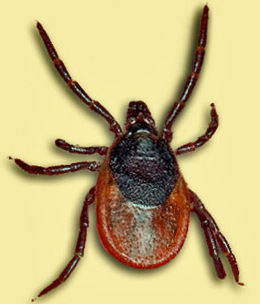
Black-legged Tick

Black-legged Tick

Ixodes scapularis

Photo by Scott Bauer. (USDA ARS), Public domain, via Wikimedia Commons
Taiga Tick

Taiga Tick

Ixodes persulcatus

Lamiot, CC BY-SA 3.0, via Wikimedia Commons

Side by side

Black-legged TickTaiga Tick
Scientific nameIxodes scapularis Say, 1821Ixodes persulcatus Schulze, 1930
English nameBlack-legged TickTaiga Tick
GroupSpiders and other arachnidsSpiders and other arachnids
ClassArachnida ArachnidArachnida Arachnid
OrderIxodida TickIxodida Tick
FamilyIxodidae Hard TicksIxodidae Hard Ticks
GenusIxodesIxodes
Named in18211930
Countries on record3 countries13 countries
GBIF occurrence records20,377 records2,898 records

Rows where the two agree are shown in grey.

Where each is found

Only Black-legged Tick (3)

Only Taiga Tick (13)

From Catalogue of Life checklists and GBIF occurrence records. A country missing from a list means no record is held, which is not proof of absence.

Checked facts

Black-legged TickTaiga Tick
Appearance
SizeNo checked fact yet
Habitat
  • The species occurs in forested areas containing leaf litter, brush and grasses. entomology.umn.edu
  • Its habitat distribution is associated with humidity, lower elevation and the presence of white-tailed deer. entomology.umn.edu
  • In northern Sweden, the species was found mainly in vegetation communities containing Alnus incana, Sorbus aucuparia, Picea abies, and Pinus sylvestris on islands in the Bothnian Bay. hpruezi.nihr.ac.uk
Diet
  • Adult ticks feed on large and medium-sized wild mammals, including ungulates, carnivores, and hares, as well as domestic cattle, dogs, and cats. pmc.ncbi.nlm.nih.gov
  • Larvae and nymphs parasitize medium-sized and small mammals, reptiles, and birds. pmc.ncbi.nlm.nih.gov
  • Recorded hosts include humans, dogs, rabbits, wild and domestic ungulates, dormice, Amur hedgehogs, and occasionally birds. English Wikipedia
Behaviour
  • The species completes its life cycle in approximately two years. English Wikipedia
  • The species passes through larval, nymphal and adult stages. English Wikipedia
  • Individuals require a blood meal at each life stage before progressing to the next stage. English Wikipedia
  • Adult females remain attached to a host and feed for four to five days. English Wikipedia
  • Adult females drop off their hosts after becoming engorged. English Wikipedia
  • The species can remain active after hard frost when daytime temperatures become sufficiently warm. English Wikipedia
  • The species can become active among invertebrates early in spring. English Wikipedia
  • Individuals use questing behaviour by waiting on vegetation and extending their front legs toward passing hosts. entomology.umn.edu
  • The species moves by crawling rather than flying or jumping. entomology.umn.edu
  • Individuals seek hosts from ground level or nearby. entomology.umn.edu
  • The species is most active from March through October. entomology.umn.edu
  • Adult ticks may search for hosts during winter whenever temperatures are above freezing. cdc.gov
  • The species is a temporary ectoparasite with an extended feeding period and a pasture-questing attack strategy. pmc.ncbi.nlm.nih.gov
  • Unfed individuals crawl from the forest litter onto its surface and surrounding vegetation. pmc.ncbi.nlm.nih.gov
  • Females can generally climb shrubs or grass blades to heights of approximately one metre. pmc.ncbi.nlm.nih.gov
  • Nymphs and larvae crawl to substantially lower heights than adult females. pmc.ncbi.nlm.nih.gov
  • Adult ticks exhibit pronounced spring–summer activity with a single seasonal abundance peak. pmc.ncbi.nlm.nih.gov
  • In Karelia, adult activity reaches its maximum in late May and early June before declining sharply in July. pmc.ncbi.nlm.nih.gov
  • Adult activity decreases to a minimum by midsummer. pmc.ncbi.nlm.nih.gov
  • Monitoring comparisons between the 1980s and the 2010s showed that seasonal activity had begun earlier in the later period. pmc.ncbi.nlm.nih.gov
  • Moose, hares, domestic dogs, and ground-feeding birds are considered likely carriers dispersing the species in northern Sweden. hpruezi.nihr.ac.uk
Reproduction
  • After overwintering, females lay several hundred to a few thousand eggs in clusters during the following spring. English Wikipedia
  • Vertical transmission of Borrelia from mother ticks to their eggs is uncommon. English Wikipedia
Distribution
  • Climate-change-associated warming is extending its distribution toward higher latitudes in Canada and the northern United States. English Wikipedia
  • Warming trends are also extending populations into central regions of the United States. English Wikipedia
  • The species occurs across Europe, central and northern Asia, China, and Japan. English Wikipedia
  • The species has a boreal distribution extending from Sweden to the Pacific Ocean. pmc.ncbi.nlm.nih.gov
Other
  • The species is a vector of Lyme disease in North America. English Wikipedia
  • The species can transmit babesiosis, anaplasmosis and Powassan virus disease. English Wikipedia
  • Adult males cannot engorge because their rigid scutum covers the entire body. English Wikipedia
  • The species is a principal vector of tick-borne encephalitis virus. pmc.ncbi.nlm.nih.gov
  • The species transmits Lyme disease, relapsing fever caused by Borrelia miyamotoi, babesiosis, and Siberian and Far Eastern tick-borne encephalitis. English Wikipedia

In brief

Black-legged Tick

Ixodes scapularis occurs in forested areas containing leaf litter, brush and grasses. It lacks eyes and has a dark, unornamented scutum and no festoons. Full profile

Taiga Tick

The Taiga tick is a hard-bodied tick in the family Ixodidae, order Ixodida, and class Arachnida. It has a boreal distribution extending from Sweden to the Pacific Ocean. It is a principal vector of tick-borne encephalitis virus and transmits several other diseases. Full profile

Compare something else

Page built on 28 November 2026 from the data on the two species pages, where every source is listed.

Cite this page

ScientificNames.org. (2026). Black-legged Tick vs Taiga Tick. Retrieved November 28, 2026, from https://scientificnames.org/compare/black-legged-tick-vs-taiga-tick