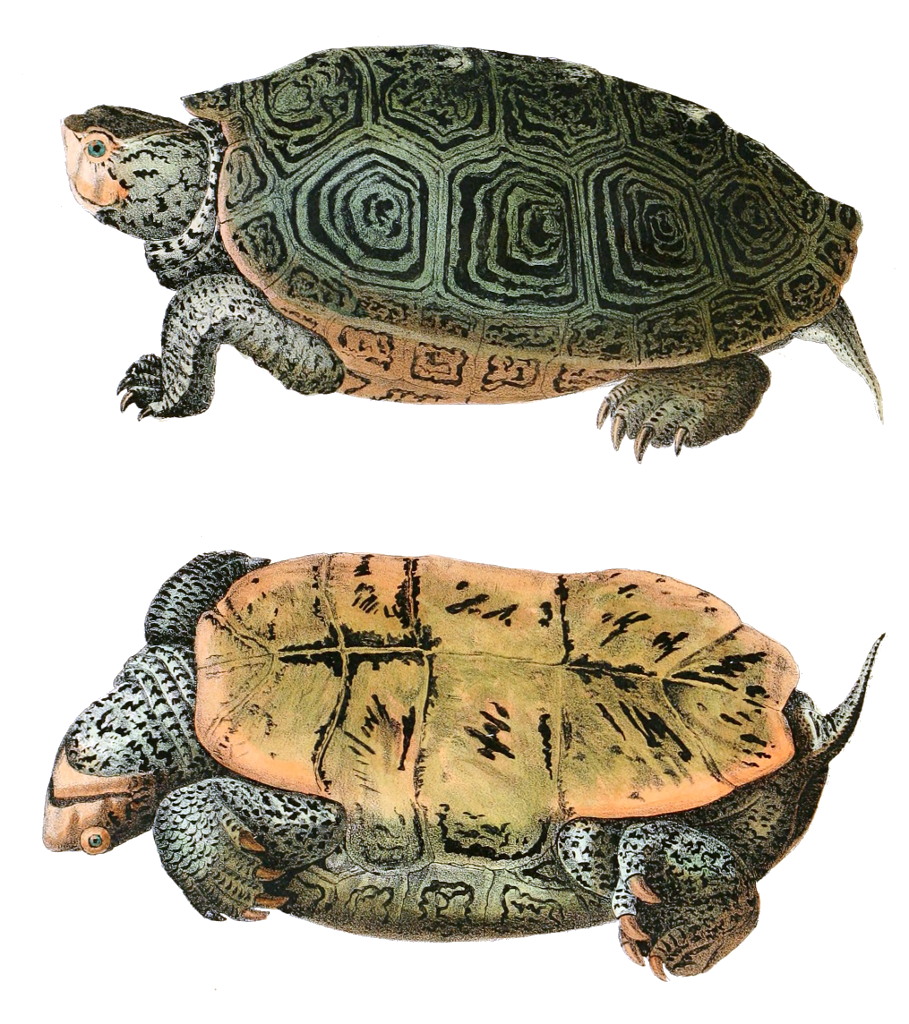
| Appearance | - The turtle has a bright yellow chin and throat. English Wikipedia
- Its upper shell is domed, slightly flattened along the midline, and oblong when viewed from above. English Wikipedia
- Its upper shell has numerous yellow or light-colored flecks or streaks against a dark background. English Wikipedia
- Its lower shell is yellow with symmetrically arranged dark blotches. English Wikipedia
- Its head and legs are dark and usually speckled or mottled with yellow. English Wikipedia
- Its lower shell is hinged, but its lobes do not close as tightly as those of box turtles. English Wikipedia
| - The species has a diamond-shaped pattern on the upper surface of its shell, although its overall coloration and pattern vary considerably. English Wikipedia
- Its carapace is generally wider at the rear than at the front and has a longitudinal central ridge. English Wikipedia
- Its carapace ranges from brown to grey, while its plastron is lighter in coloration. English Wikipedia
- Its body coloration can be grey, brown, yellow, or white. English Wikipedia
- Almost all individuals have distinctive irregular black markings or spots on their heads and bodies. English Wikipedia
- The species has large webbed feet. English Wikipedia
|
|---|
| Size | | |
|---|
| Habitat | | - The species inhabits brackish coastal tidal marshes. English Wikipedia
- In most of its range, the species inhabits Spartina marshes that flood during high tides. English Wikipedia
- In Florida, the species also inhabits mangrove swamps. English Wikipedia
- South Florida diamondback terrapins use subtropical mangrove creek and island habitats in Everglades National Park. pubs.usgs.gov
- The species can tolerate freshwater and full-strength ocean water, although adults prefer intermediate salinities. English Wikipedia
- The species is exclusively estuarine. pubs.usgs.gov
|
|---|
| Diet | | - The species feeds on fish, crustaceans, marine worms, snails, clams, barnacles, mussels, other mollusks, insects, and carrion. English Wikipedia
- The species sometimes consumes small quantities of plant material, including algae. English Wikipedia
- Gastropods, crabs, and bivalves are the dominant food categories of diamondback terrapins in South Florida mangrove habitats. pubs.usgs.gov
- Food sources in South Florida terrapins differ more according to habitat than to body size class. pubs.usgs.gov
- Decapod crustacean remains occurred in all 13 fecal samples examined from the Florida East Coast subspecies. digitalcommons.fau.edu
- Decapod crustaceans accounted for 96.3% of the fecal mass in the examined Florida East Coast terrapins. digitalcommons.fau.edu
- The examined Florida East Coast terrapins also consumed small quantities of vegetation, bivalves, gastropods, and insects. digitalcommons.fau.edu
|
|---|
| Behaviour | - It overwinters under or near water, in mud, or beneath vegetation or debris. English Wikipedia
- During nesting season, females may travel more than one kilometre from their hibernation sites. English Wikipedia
- When disturbed, it may retreat into its shell or remain underwater for hours. English Wikipedia
- It is a highly agile and effective swimmer. English Wikipedia
- Young individuals may travel considerable distances to find mating sites, new habitat, or food sources. English Wikipedia
| - The species is a strong swimmer. English Wikipedia
- The species can remain in full-strength salt water for extended periods. English Wikipedia
- Terrapins can obtain freshwater by drinking the surface layer that accumulates over salt water after rainfall. English Wikipedia
- Terrapins can raise their heads and open their mouths to catch falling raindrops. English Wikipedia
- Individuals tend to remain in the same areas for most or all of their lives rather than undertaking long-distance migrations. English Wikipedia
- The species generally hibernates during colder months in the mud of creeks and marshes. English Wikipedia
|
|---|
| Reproduction | - It reaches sexual maturity at approximately 14–20 years of age. English Wikipedia
- Mating begins between March and April. English Wikipedia
- Females dig nests from late May through early July. English Wikipedia
- In New York, clutch sizes range from five to twelve eggs, averaging eight. English Wikipedia
- The incubation temperature of the eggs determines the sex of hatchlings, with colder temperatures producing males and warmer temperatures producing females. English Wikipedia
| - Adults mate in early spring. English Wikipedia
- Females lay clutches containing 4–22 eggs in sand dunes during early summer. English Wikipedia
- Eggs generally hatch 60–85 days after being laid, depending on incubation temperature and nest depth. English Wikipedia
- Females can produce up to three egg clutches annually in the wild. English Wikipedia
- Females can produce up to five egg clutches annually in captivity. English Wikipedia
- Female terrapins can mate with multiple males and retain sperm for years. English Wikipedia
- The sex of hatchlings depends on incubation temperature. English Wikipedia
- Male terrapins generally reach sexual maturity at 2–3 years of age. English Wikipedia
- Female terrapins generally reach sexual maturity at 6–7 years, while northern populations may take 8–10 years. English Wikipedia
|
|---|
| Distribution | - Its geographic range is centred on the Great Lakes. English Wikipedia
- Its range extends from central Nebraska and Minnesota eastward through southern Ontario and the south shore of Lake Erie to northern New York. English Wikipedia
- Isolated populations occur in southeastern New York, New England, and Nova Scotia. English Wikipedia
| - The species occurs along the Atlantic and Gulf coasts of the United States, from Cape Cod to Texas. English Wikipedia
- The species also has a naturally established population in Bermuda. English Wikipedia
|
|---|
| Conservation | - Habitat fragmentation and destruction are identified as primary threats to the species. English Wikipedia
- Nest predation by unnaturally large predator populations is another primary threat. English Wikipedia
- The Great Lakes–St. Lawrence River population in Ontario and Quebec is federally threatened in Canada. English Wikipedia
- The Nova Scotia population is classified as endangered. English Wikipedia
- The species is classified as a Special Concern species in Wisconsin. apps.dnr.wi.gov
- In Michigan, the species is fully protected as a special concern species. English Wikipedia
- Prescribed burns can adversely affect the species. English Wikipedia
- A long-term recovery program for the species has operated in Lake County, Illinois, since 2009. English Wikipedia
- Conservation and recovery efforts in Nova Scotia have been in place for two decades. English Wikipedia
| - The IUCN classifies the species as Vulnerable because its population numbers are decreasing across most of its range. English Wikipedia
- The species is listed as endangered in Rhode Island. English Wikipedia
- The species is listed as threatened in Massachusetts. English Wikipedia
- Crab traps cause substantial mortality among diamondback terrapins along the New Jersey coast. English Wikipedia
- Coastal development has destroyed or altered more than 75% of the salt marshes historically inhabited by the species. English Wikipedia
- Rising ocean levels threaten the remaining salt marsh habitat. English Wikipedia
|
|---|
| Uses | No checked fact yet | - Diamondback terrapins were historically consumed as a delicacy in the early twentieth century. English Wikipedia
|
|---|