Comparison

Turkish Pond Turtle vs Diamondback Terrapin

Turkish Pond Turtle (Emys orbicularis eiselti) and Diamondback Terrapin (Malaclemys terrapin) both belong to the family Emydidae (terrapins) and part ways below it.

Turkish Pond Turtle

Emys orbicularis eiselti
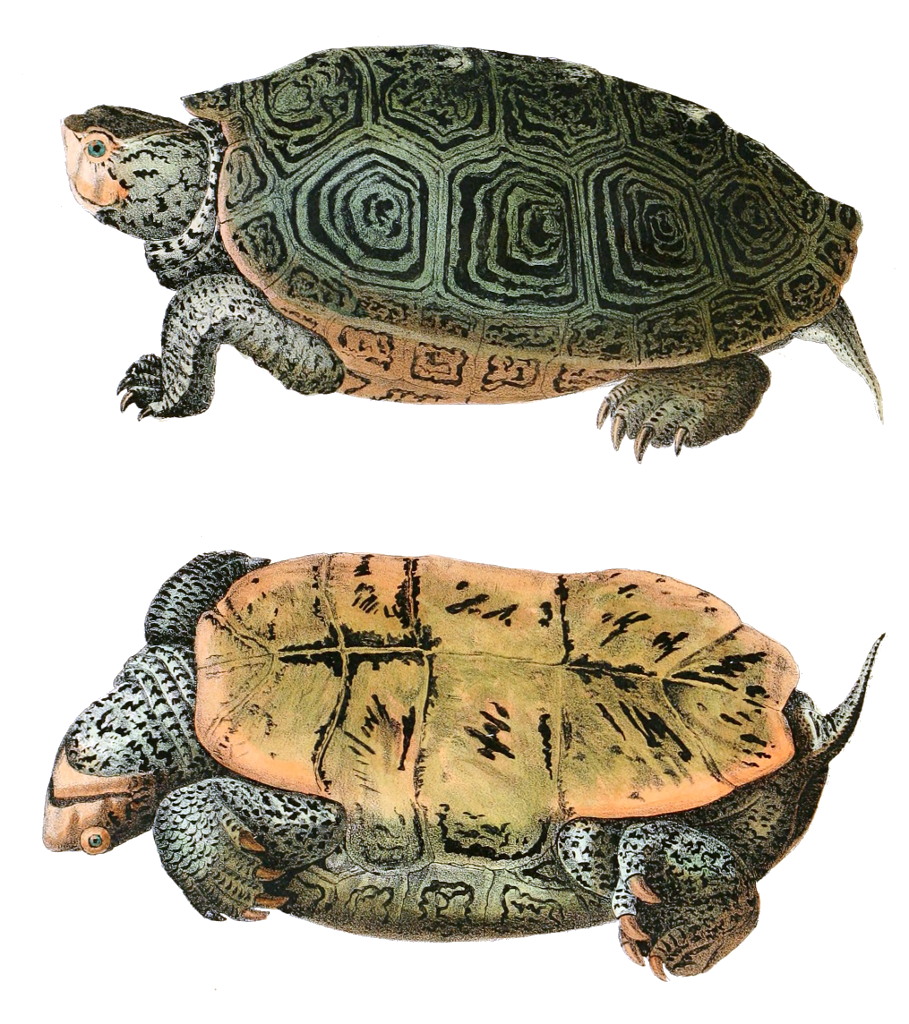
Diamondback Terrapin

Diamondback Terrapin

Malaclemys terrapin

Holbrook, John Edwards, 1794-1871 (English Wikipedia), Public domain, via Wikimedia Commons

Side by side

Turkish Pond TurtleDiamondback Terrapin
Scientific nameEmys orbicularis eiselti Fritz, Baran, Budak & Amthauer, 1998Malaclemys terrapin (Schoepff, 1793)
English nameTurkish Pond TurtleDiamondback Terrapin
Ranksubspeciesspecies
GroupReptilesReptiles
ClassReptilia ReptileReptilia Reptile
OrderTestudines TurtleTestudines Turtle
FamilyEmydidae TerrapinsEmydidae Terrapins
GenusEmys European Pond TurtlesMalaclemys Diamondback Terrapins
Named in19981793
Red List categoryNot recordedVulnerable
Countries on recordNot recorded2 countries
GBIF occurrence recordsNot recorded12,957 records

Rows where the two agree are shown in grey.

Where each is found

Only Diamondback Terrapin (2)

From Catalogue of Life checklists and GBIF occurrence records. A country missing from a list means no record is held, which is not proof of absence.

Checked facts

Turkish Pond TurtleDiamondback Terrapin
AppearanceNo checked fact yet
  • The species has a diamond-shaped pattern on the upper surface of its shell, although its overall coloration and pattern vary considerably. English Wikipedia
  • Its carapace is generally wider at the rear than at the front and has a longitudinal central ridge. English Wikipedia
  • Its carapace ranges from brown to grey, while its plastron is lighter in coloration. English Wikipedia
  • Its body coloration can be grey, brown, yellow, or white. English Wikipedia
  • Almost all individuals have distinctive irregular black markings or spots on their heads and bodies. English Wikipedia
  • The species has large webbed feet. English Wikipedia
SizeNo checked fact yet
HabitatNo checked fact yet
  • The species inhabits brackish coastal tidal marshes. English Wikipedia
  • In most of its range, the species inhabits Spartina marshes that flood during high tides. English Wikipedia
  • In Florida, the species also inhabits mangrove swamps. English Wikipedia
  • South Florida diamondback terrapins use subtropical mangrove creek and island habitats in Everglades National Park. pubs.usgs.gov
  • The species can tolerate freshwater and full-strength ocean water, although adults prefer intermediate salinities. English Wikipedia
  • The species is exclusively estuarine. pubs.usgs.gov
DietNo checked fact yet
  • The species feeds on fish, crustaceans, marine worms, snails, clams, barnacles, mussels, other mollusks, insects, and carrion. English Wikipedia
  • The species sometimes consumes small quantities of plant material, including algae. English Wikipedia
  • Gastropods, crabs, and bivalves are the dominant food categories of diamondback terrapins in South Florida mangrove habitats. pubs.usgs.gov
  • Food sources in South Florida terrapins differ more according to habitat than to body size class. pubs.usgs.gov
  • Decapod crustacean remains occurred in all 13 fecal samples examined from the Florida East Coast subspecies. digitalcommons.fau.edu
  • Decapod crustaceans accounted for 96.3% of the fecal mass in the examined Florida East Coast terrapins. digitalcommons.fau.edu
  • The examined Florida East Coast terrapins also consumed small quantities of vegetation, bivalves, gastropods, and insects. digitalcommons.fau.edu
BehaviourNo checked fact yet
  • The species is a strong swimmer. English Wikipedia
  • The species can remain in full-strength salt water for extended periods. English Wikipedia
  • Terrapins can obtain freshwater by drinking the surface layer that accumulates over salt water after rainfall. English Wikipedia
  • Terrapins can raise their heads and open their mouths to catch falling raindrops. English Wikipedia
  • Individuals tend to remain in the same areas for most or all of their lives rather than undertaking long-distance migrations. English Wikipedia
  • The species generally hibernates during colder months in the mud of creeks and marshes. English Wikipedia
ReproductionNo checked fact yet
  • Adults mate in early spring. English Wikipedia
  • Females lay clutches containing 4–22 eggs in sand dunes during early summer. English Wikipedia
  • Eggs generally hatch 60–85 days after being laid, depending on incubation temperature and nest depth. English Wikipedia
  • Females can produce up to three egg clutches annually in the wild. English Wikipedia
  • Females can produce up to five egg clutches annually in captivity. English Wikipedia
  • Female terrapins can mate with multiple males and retain sperm for years. English Wikipedia
  • The sex of hatchlings depends on incubation temperature. English Wikipedia
  • Male terrapins generally reach sexual maturity at 2–3 years of age. English Wikipedia
  • Female terrapins generally reach sexual maturity at 6–7 years, while northern populations may take 8–10 years. English Wikipedia
DistributionNo checked fact yet
  • The species occurs along the Atlantic and Gulf coasts of the United States, from Cape Cod to Texas. English Wikipedia
  • The species also has a naturally established population in Bermuda. English Wikipedia
ConservationNo checked fact yet
  • The IUCN classifies the species as Vulnerable because its population numbers are decreasing across most of its range. English Wikipedia
  • The species is listed as endangered in Rhode Island. English Wikipedia
  • The species is listed as threatened in Massachusetts. English Wikipedia
  • Crab traps cause substantial mortality among diamondback terrapins along the New Jersey coast. English Wikipedia
  • Coastal development has destroyed or altered more than 75% of the salt marshes historically inhabited by the species. English Wikipedia
  • Rising ocean levels threaten the remaining salt marsh habitat. English Wikipedia
UsesNo checked fact yet
  • Diamondback terrapins were historically consumed as a delicacy in the early twentieth century. English Wikipedia

In brief

Diamondback Terrapin

Malaclemys terrapin inhabits brackish coastal tidal marshes along the Atlantic and Gulf coasts of the United States, from Cape Cod to Texas, and has a naturally established population in Bermuda. It is distinguished by a diamond-shaped pattern on the upper surface of its shell and distinctive irregular black markings or spots on almost all individuals. Full profile

Compare something else

Page built on 26 November 2026 from the data on the two species pages, where every source is listed.

Cite this page

ScientificNames.org. (2026). Turkish Pond Turtle vs Diamondback Terrapin. Retrieved November 26, 2026, from https://scientificnames.org/compare/turkish-pond-turtle-vs-diamondback-terrapin