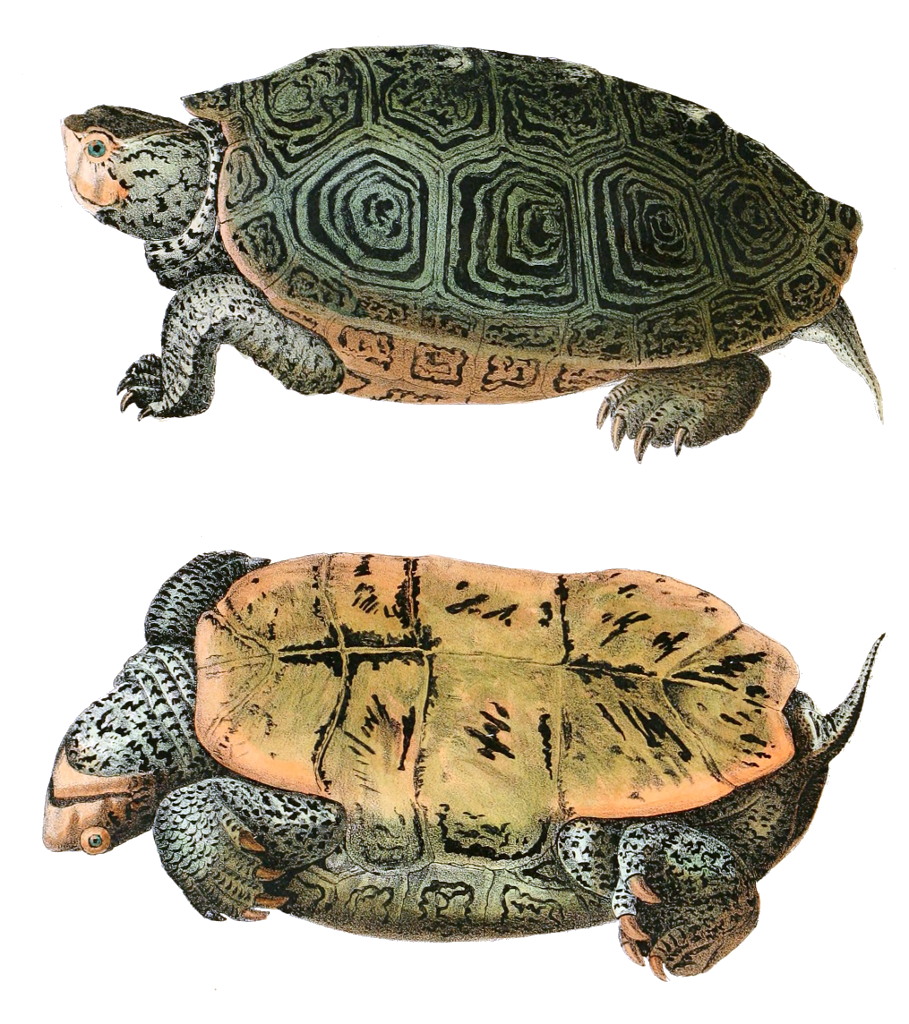
| Appearance | | - The species has a diamond-shaped pattern on the upper surface of its shell, although its overall coloration and pattern vary considerably. English Wikipedia
- Its carapace is generally wider at the rear than at the front and has a longitudinal central ridge. English Wikipedia
- Its carapace ranges from brown to grey, while its plastron is lighter in coloration. English Wikipedia
- Its body coloration can be grey, brown, yellow, or white. English Wikipedia
- Almost all individuals have distinctive irregular black markings or spots on their heads and bodies. English Wikipedia
- The species has large webbed feet. English Wikipedia
|
|---|
| Size | | |
|---|
| Habitat | - The species prefers freshwater habitats including ponds, lakes, rivers, and swamps. English Wikipedia
- The species inhabits wetlands and slow-moving bodies of water, including lagoons, deltas, inland waters, and mountain lakes. pmc.ncbi.nlm.nih.gov
- Its aquatic habitats have soft bottoms and abundant aquatic vegetation, particularly along the banks. pmc.ncbi.nlm.nih.gov
- The species occurs at elevations ranging from sea level to 1,036 metres. pmc.ncbi.nlm.nih.gov
- Wetland vegetation is an important factor associated with the species' habitat suitability. pmc.ncbi.nlm.nih.gov
| - The species inhabits brackish coastal tidal marshes. English Wikipedia
- In most of its range, the species inhabits Spartina marshes that flood during high tides. English Wikipedia
- In Florida, the species also inhabits mangrove swamps. English Wikipedia
- South Florida diamondback terrapins use subtropical mangrove creek and island habitats in Everglades National Park. pubs.usgs.gov
- The species can tolerate freshwater and full-strength ocean water, although adults prefer intermediate salinities. English Wikipedia
- The species is exclusively estuarine. pubs.usgs.gov
|
|---|
| Diet | No checked fact yet | - The species feeds on fish, crustaceans, marine worms, snails, clams, barnacles, mussels, other mollusks, insects, and carrion. English Wikipedia
- The species sometimes consumes small quantities of plant material, including algae. English Wikipedia
- Gastropods, crabs, and bivalves are the dominant food categories of diamondback terrapins in South Florida mangrove habitats. pubs.usgs.gov
- Food sources in South Florida terrapins differ more according to habitat than to body size class. pubs.usgs.gov
- Decapod crustacean remains occurred in all 13 fecal samples examined from the Florida East Coast subspecies. digitalcommons.fau.edu
- Decapod crustaceans accounted for 96.3% of the fecal mass in the examined Florida East Coast terrapins. digitalcommons.fau.edu
- The examined Florida East Coast terrapins also consumed small quantities of vegetation, bivalves, gastropods, and insects. digitalcommons.fau.edu
|
|---|
| Behaviour | No checked fact yet | - The species is a strong swimmer. English Wikipedia
- The species can remain in full-strength salt water for extended periods. English Wikipedia
- Terrapins can obtain freshwater by drinking the surface layer that accumulates over salt water after rainfall. English Wikipedia
- Terrapins can raise their heads and open their mouths to catch falling raindrops. English Wikipedia
- Individuals tend to remain in the same areas for most or all of their lives rather than undertaking long-distance migrations. English Wikipedia
- The species generally hibernates during colder months in the mud of creeks and marshes. English Wikipedia
|
|---|
| Reproduction | No checked fact yet | - Adults mate in early spring. English Wikipedia
- Females lay clutches containing 4–22 eggs in sand dunes during early summer. English Wikipedia
- Eggs generally hatch 60–85 days after being laid, depending on incubation temperature and nest depth. English Wikipedia
- Females can produce up to three egg clutches annually in the wild. English Wikipedia
- Females can produce up to five egg clutches annually in captivity. English Wikipedia
- Female terrapins can mate with multiple males and retain sperm for years. English Wikipedia
- The sex of hatchlings depends on incubation temperature. English Wikipedia
- Male terrapins generally reach sexual maturity at 2–3 years of age. English Wikipedia
- Female terrapins generally reach sexual maturity at 6–7 years, while northern populations may take 8–10 years. English Wikipedia
|
|---|
| Distribution | | - The species occurs along the Atlantic and Gulf coasts of the United States, from Cape Cod to Texas. English Wikipedia
- The species also has a naturally established population in Bermuda. English Wikipedia
|
|---|
| Conservation | - The IUCN Global Red List classifies Emys trinacris as Data Deficient. pmc.ncbi.nlm.nih.gov
- The Italian Red List classifies the species as Endangered (EN, A2c). pmc.ncbi.nlm.nih.gov
- The species is threatened by habitat destruction and fragmentation, pollution, the release of non-native species, and illegal capture for the pet trade. pmc.ncbi.nlm.nih.gov
- Emys trinacris is listed in Annexes II and IV of the European Union Habitats Directive. pmc.ncbi.nlm.nih.gov
- The species is included in Appendix II of the Bern Convention. pmc.ncbi.nlm.nih.gov
- The species' suitable habitats are concentrated in central and southern Sicily, with moderate to high suitability in western coastal areas. pmc.ncbi.nlm.nih.gov
- Agricultural reservoirs are not covered by the existing protected-area network assessed in the study. pmc.ncbi.nlm.nih.gov
- The study identifies expanding protected areas and improving habitat connectivity as important conservation strategies for the species. pmc.ncbi.nlm.nih.gov
- Winter temperature and summer precipitation are key predictors of the species' habitat suitability. pmc.ncbi.nlm.nih.gov
| - The IUCN classifies the species as Vulnerable because its population numbers are decreasing across most of its range. English Wikipedia
- The species is listed as endangered in Rhode Island. English Wikipedia
- The species is listed as threatened in Massachusetts. English Wikipedia
- Crab traps cause substantial mortality among diamondback terrapins along the New Jersey coast. English Wikipedia
- Coastal development has destroyed or altered more than 75% of the salt marshes historically inhabited by the species. English Wikipedia
- Rising ocean levels threaten the remaining salt marsh habitat. English Wikipedia
|
|---|
| Uses | No checked fact yet | - Diamondback terrapins were historically consumed as a delicacy in the early twentieth century. English Wikipedia
|
|---|
| Similar species | - Emys trinacris differs from Emys orbicularis in its mitochondrial DNA. English Wikipedia
| No checked fact yet |
|---|
| Other | - Human activities such as industrialization disrupt gene flow between populations of this species. English Wikipedia
- Roads and buildings make migration between groups of Sicilian pond turtles more difficult. English Wikipedia
| No checked fact yet |
|---|