| Appearance | - Eucalyptus leucoxylon has smooth white, yellow or bluish-grey bark, with rough fibrous to flaky bark usually covering the lower 0.5–2 m of the trunk. English Wikipedia
- Young plants and coppice regrowth have opposite, egg-shaped to broadly lance-shaped leaves measuring 45–105 mm long and 20–73 mm wide. English Wikipedia
- Adult leaves are alternately arranged, slightly glossy green on both sides, and lance-shaped to curved, measuring 60–185 mm long and 10–30 mm wide. English Wikipedia
- The flower buds occur in groups of three in the leaf axils on unbranched peduncles measuring 4–11 mm long. English Wikipedia
- Individual flower buds are borne on pedicels measuring 2–14 mm long. English Wikipedia
- Mature flower buds are oval, diamond-shaped or approximately spherical, measuring 6–17 mm long and 5–7 mm wide. English Wikipedia
- The flowers may be white, red or pink. English Wikipedia
- The fruit is a woody capsule that may be cylindrical, barrel-shaped or shortened spherical, measuring 6–13 mm long and 6–14 mm wide. English Wikipedia
- The fruit capsule valves are enclosed below the rim level. English Wikipedia
- Eucalyptus leucoxylon subsp. megalocarpa has red flowers and large fruit. English Wikipedia
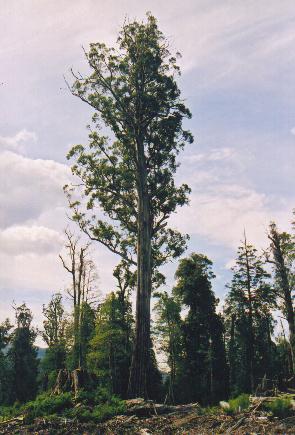
| - Eucalyptus regnans is an evergreen tree with a straight trunk and an open, relatively small crown. English Wikipedia
- The trunk has smooth cream-coloured, greyish or brown bark and rough, fibrous or flaky bark around its base. English Wikipedia
- Adult leaves are glossy green and range from lance-shaped to sickle-shaped. English Wikipedia
- The adult leaves measure 90–230 mm long and 15–50 mm wide. English Wikipedia
- Flower buds occur in groups of nine to fifteen. English Wikipedia
- The flowers are white and bloom between March and May. English Wikipedia
- The fruit is a woody, cup-shaped or conical capsule measuring 5–8 mm long. English Wikipedia
- The seeds are pyramid-shaped and measure 1.5–3 mm long. English Wikipedia
|
|---|
| Size | | - The tree typically reaches heights of 70–114 metres. English Wikipedia
- The trunk typically reaches 2.5 metres in diameter at breast height. English Wikipedia
- The tallest measured living specimen, named Centurion, is 100 metres tall in Tasmania. English Wikipedia
|
|---|
| Habitat | - Eucalyptus leucoxylon subsp. connata grows on skeletal soils, mainly in the Brisbane Ranges. English Wikipedia
- Eucalyptus leucoxylon subsp. megalocarpa occurs only in coastal areas. English Wikipedia
| - The species grows in tall wet forests, sometimes with rainforest understorey. English Wikipedia
- The species favours deep loam soils in temperate areas with high rainfall. English Wikipedia
- The species grows mainly in cool mountainous areas receiving more than 1,000 millimetres of annual rainfall. English Wikipedia
- The species is particularly suited to deep, friable clay loam soils, often of volcanic origin. English Wikipedia
- On poorer soils, the species may be restricted to watercourses and valleys. English Wikipedia
|
|---|
| Behaviour | No checked fact yet | - Young trees can grow in height by an average of one to two metres annually. English Wikipedia
- Some individuals grow more than two metres annually during their first 20 years. English Wikipedia
- The species lacks a lignotuber and cannot resprout following intense fires. English Wikipedia
|
|---|
| Reproduction | | - The species regenerates exclusively from seeds after intense fires. English Wikipedia
- Seeds remain enclosed in woody capsules until the branchlets die and the capsules dry out. English Wikipedia
- Seedlings require substantial light to germinate and develop into saplings. English Wikipedia
- Some trees develop mature fruit capsules as early as seven years of age. English Wikipedia
- Most trees probably begin producing seeds after approximately eleven years. English Wikipedia
- The mean age at which trees become reproductively viable is approximately 21 years. English Wikipedia
- Seedling densities following major fires have been recorded at up to 2.5 million per hectare. English Wikipedia
|
|---|
| Distribution | - Eucalyptus leucoxylon is endemic to south-eastern continental Australia. English Wikipedia
- The species occurs in Victoria, south-eastern South Australia and far south-western New South Wales. English Wikipedia
| - The species is native to the Australian states of Victoria and Tasmania. English Wikipedia
- Its distribution covers an area approximately 700 kilometres by 500 kilometres in southern Australia. English Wikipedia
|
|---|
| Conservation | No checked fact yet | - Large numbers of trees have been logged, including some of the tallest known specimens. English Wikipedia
- Much of the species' forest distribution across Gippsland was cleared for farmland between 1860 and 1880. English Wikipedia
- Frequent fires occurring before trees reach reproductive maturity can cause local extinction through inadequate regeneration. English Wikipedia
- Modified contemporary fire regimes pose a risk to the species' forests in many regions. English Wikipedia
|
|---|
| Uses | - The leaves of Eucalyptus leucoxylon are distilled to produce cineole-based eucalyptus oil. English Wikipedia
- Eucalyptus leucoxylon subsp. megalocarpa is widely planted as an ornamental plant. English Wikipedia
- The cultivar 'Euky Dwarf' is grown as a street and garden tree. English Wikipedia
- Eucalyptus leucoxylon subsp. leucoxylon has been recommended for larger gardens and parklands. English Wikipedia
| - The species is cultivated in plantations in Australia and other countries. English Wikipedia
- Its timber is marketed as Tasmanian oak together with timber from Eucalyptus obliqua and Eucalyptus delegatensis. English Wikipedia
|
|---|
| Similar species | - Eucalyptus leucoxylon resembles Eucalyptus melliodora and Eucalyptus sideroxylon subsp. sideroxylon, but can be distinguished by having three flower buds in each group. English Wikipedia
| - Eucalyptus fastigata is a close relative that shares the unusual characteristic of paired inflorescences arising from axillary buds. English Wikipedia
|
|---|
| Other | - Eucalyptus leucoxylon is widely cultivated. English Wikipedia
- Yellow gum, blue gum and white ironbark are common names recorded for Eucalyptus leucoxylon. inaturalist.org
| No checked fact yet |
|---|