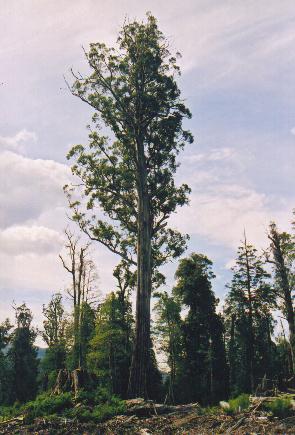
| Appearance | - Its greyish bark is mostly smooth and sheds in long ribbons. English Wikipedia
- Rough, flaky or fibrous bark often remains at the base of the trunk. English Wikipedia
- Young plants have glossy green leaves that are elliptical, egg-shaped or lance-shaped. English Wikipedia
- Juvenile leaves are arranged in opposite pairs. English Wikipedia
- Adult leaves are lance-shaped and have the same dull-green colour on both surfaces. English Wikipedia
- Mature trees characteristically retain numerous juvenile and intermediate leaves in their crowns. English Wikipedia
- Its fruit is a woody, cup-shaped capsule. English Wikipedia
- The trunk may be single or divided. anbg.gov.au
- The trunk sheds its bark in thin strips, exposing a smooth dark-grey surface. anbg.gov.au
- Mature trees retain opposite juvenile leaves approximately 25 mm long. anbg.gov.au
| - Eucalyptus regnans is an evergreen tree with a straight trunk and an open, relatively small crown. English Wikipedia
- The trunk has smooth cream-coloured, greyish or brown bark and rough, fibrous or flaky bark around its base. English Wikipedia
- Adult leaves are glossy green and range from lance-shaped to sickle-shaped. English Wikipedia
- The adult leaves measure 90–230 mm long and 15–50 mm wide. English Wikipedia
- Flower buds occur in groups of nine to fifteen. English Wikipedia
- The flowers are white and bloom between March and May. English Wikipedia
- The fruit is a woody, cup-shaped or conical capsule measuring 5–8 mm long. English Wikipedia
- The seeds are pyramid-shaped and measure 1.5–3 mm long. English Wikipedia
|
|---|
| Size | | - The tree typically reaches heights of 70–114 metres. English Wikipedia
- The trunk typically reaches 2.5 metres in diameter at breast height. English Wikipedia
- The tallest measured living specimen, named Centurion, is 100 metres tall in Tasmania. English Wikipedia
|
|---|
| Habitat | - The species grows in grassy woodland in cold, damp locations. English Wikipedia
- The species grows in valleys with poorly drained soils. anbg.gov.au
- Its natural habitat experiences frost, snow and heavy mist. anbg.gov.au
| - The species grows in tall wet forests, sometimes with rainforest understorey. English Wikipedia
- The species favours deep loam soils in temperate areas with high rainfall. English Wikipedia
- The species grows mainly in cool mountainous areas receiving more than 1,000 millimetres of annual rainfall. English Wikipedia
- The species is particularly suited to deep, friable clay loam soils, often of volcanic origin. English Wikipedia
- On poorer soils, the species may be restricted to watercourses and valleys. English Wikipedia
|
|---|
| Behaviour | - The species tolerates waterlogged growing conditions. anbg.gov.au
| - Young trees can grow in height by an average of one to two metres annually. English Wikipedia
- Some individuals grow more than two metres annually during their first 20 years. English Wikipedia
- The species lacks a lignotuber and cannot resprout following intense fires. English Wikipedia
|
|---|
| Reproduction | | - The species regenerates exclusively from seeds after intense fires. English Wikipedia
- Seeds remain enclosed in woody capsules until the branchlets die and the capsules dry out. English Wikipedia
- Seedlings require substantial light to germinate and develop into saplings. English Wikipedia
- Some trees develop mature fruit capsules as early as seven years of age. English Wikipedia
- Most trees probably begin producing seeds after approximately eleven years. English Wikipedia
- The mean age at which trees become reproductively viable is approximately 21 years. English Wikipedia
- Seedling densities following major fires have been recorded at up to 2.5 million per hectare. English Wikipedia
|
|---|
| Distribution | - The species is endemic to south-eastern New South Wales. inaturalist.org
- Its documented range extends across the Southern Tablelands east of Cooma, from near Badja south to Dragon Swamp near Cathcart. English Wikipedia
- A documented natural stand occurs at the headwaters of the Tuross River, north-east of Kybean towards Nimmitabel. anbg.gov.au
| - The species is native to the Australian states of Victoria and Tasmania. English Wikipedia
- Its distribution covers an area approximately 700 kilometres by 500 kilometres in southern Australia. English Wikipedia
|
|---|
| Conservation | | - Large numbers of trees have been logged, including some of the tallest known specimens. English Wikipedia
- Much of the species' forest distribution across Gippsland was cleared for farmland between 1860 and 1880. English Wikipedia
- Frequent fires occurring before trees reach reproductive maturity can cause local extinction through inadequate regeneration. English Wikipedia
- Modified contemporary fire regimes pose a risk to the species' forests in many regions. English Wikipedia
|
|---|
| Uses | - The species can be planted in groups to provide wind protection. anbg.gov.au
- The species can be planted in hedge-like rows to provide privacy. anbg.gov.au
| - The species is cultivated in plantations in Australia and other countries. English Wikipedia
- Its timber is marketed as Tasmanian oak together with timber from Eucalyptus obliqua and Eucalyptus delegatensis. English Wikipedia
|
|---|
| Similar species | No checked fact yet | - Eucalyptus fastigata is a close relative that shares the unusual characteristic of paired inflorescences arising from axillary buds. English Wikipedia
|
|---|