Comparison

Caatinga Parakeet vs Spix's Macaw

Caatinga Parakeet (Eupsittula cactorum) and Spix's Macaw (Cyanopsitta spixii) both belong to the family Psittacidae (macaws) and part ways below it. Both are recorded in 1 country.
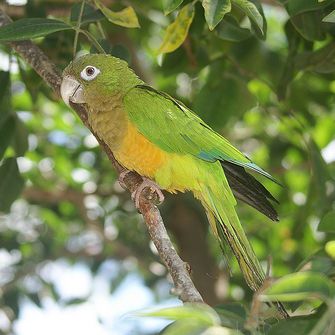
Caatinga Parakeet

Caatinga Parakeet

Eupsittula cactorum

Aratinga_cactorum_-Brazil-8.jpg: Phillipe derivative work: Snowmanradio (talk), CC BY-SA 3.0, via Wikimedia Commons

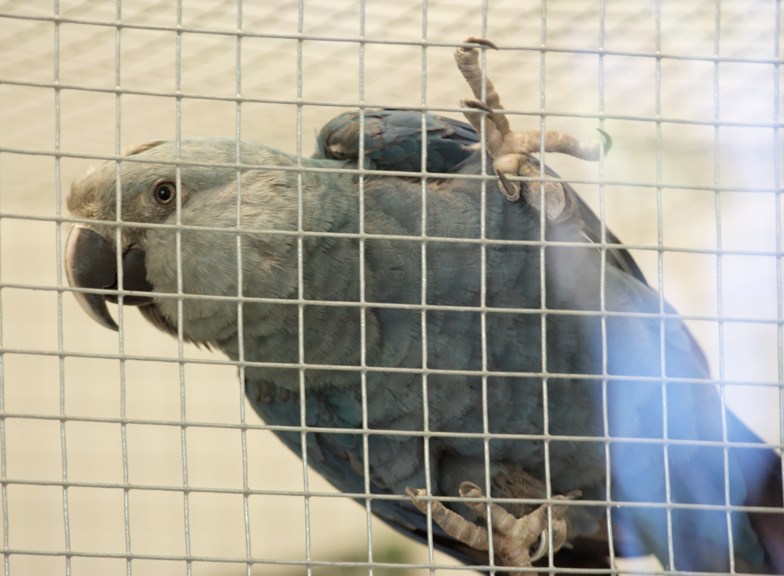
Spix's Macaw

Spix's Macaw

Cyanopsitta spixii

The original uploader was Robert01 at German Wikipedia. (Original text: Robert01), CC BY-SA 2.0 de, via Wikimedia Commons

Side by side

Caatinga ParakeetSpix's Macaw
Scientific nameEupsittula cactorum (Kuhl, 1820)Cyanopsitta spixii (Wagler, 1832)
English nameCaatinga ParakeetSpix's Macaw
GroupBirdsBirds
ClassAves BirdAves Bird
OrderPsittaciformes ParrotPsittaciformes Parrot
FamilyPsittacidae MacawsPsittacidae Macaws
GenusEupsittula Eupsittula ParakeetsCyanopsitta Spix's Macaw
Named in18201832
Red List categoryLeast ConcernExtinct in the Wild
Countries on record1 country1 country
GBIF occurrence records15,242 records12 records

Rows where the two agree are shown in grey.

Where each is found

Both recorded in 1 country

From Catalogue of Life checklists and GBIF occurrence records. A country missing from a list means no record is held, which is not proof of absence.

Checked facts

Caatinga ParakeetSpix's Macaw
Appearance
  • Adult individuals of the nominate subspecies have pale brown forecrowns, cheeks, throats, sides of the neck, and breasts. English Wikipedia
  • Adults have bare whitish skin surrounding their eyes. English Wikipedia
  • The belly and vent area of adults are yellow-orange. English Wikipedia
  • The nape, ear coverts, upperparts, and tail are green. English Wikipedia
  • The wings are mostly green and have bluish flight feathers. English Wikipedia
  • Immature birds have completely green crowns and duller underparts compared with adults. English Wikipedia
  • The subspecies E. c. caixana has the same plumage pattern as the nominate subspecies but is paler overall. English Wikipedia
  • Adults have grey-blue heads, pale blue underparts, and vivid blue upperparts, wings, and tails. English Wikipedia
  • Adult Spix's macaws have grey bare facial skin, dark grey bills, and yellow irises. English Wikipedia
  • Juveniles have pale grey facial skin, brown irises, and a white stripe along the upper center of the bill. English Wikipedia
  • Males and females have almost identical external appearances. English Wikipedia
  • The species has brownish-black legs and feet. English Wikipedia
Size
  • Adults measure approximately 56 cm in total length, including a tail measuring 26–38 cm. English Wikipedia
  • The wing length ranges from 24.7 to 30.0 cm. English Wikipedia
  • Captive males average approximately 318 g, while captive females average approximately 288 g. English Wikipedia
  • The species averages 55 cm in length and 360 g in weight according to Animal Diversity Web. animaldiversity.org
  • The reported wingspan averages 1.2 m. animaldiversity.org
Habitat
  • The species inhabits both pristine and second-growth Caatinga vegetation. English Wikipedia
  • Its Caatinga habitat is characterized by thorny vegetation, shrubs, and succulents. English Wikipedia
  • The species also occurs in cerrado and moister woodlands. English Wikipedia
  • The species inhabited riparian Caraibeira woodland galleries in the Rio São Francisco drainage basin. English Wikipedia
  • Its natural habitat was within the Caatinga dry forest climate of interior northeastern Brazil. English Wikipedia
  • The species depended on Caraibeira trees for nesting, feeding, and roosting. English Wikipedia
  • Caraibeira woodland galleries extended up to 18 m on either side of seasonal waterways. English Wikipedia
  • The Caraibeira trees grew at regular intervals of approximately 10 meters along watercourse banks. animaldiversity.org
  • The woodland habitat included thorny shrubs, cacti, and tall craibeira trees along watercourses. animaldiversity.org
  • Dead crowns of craibeira trees were used as perches. animaldiversity.org
Diet
  • The species feeds primarily on Caraiba seeds and nuts and those of Euphorbiaceae shrubs. English Wikipedia
  • Wild Spix's macaws commonly consumed seeds and nuts from Pinhão and Favela plants. English Wikipedia
Behaviour
  • The species has no established movement pattern, although local movements in response to food availability are considered probable. English Wikipedia
Reproduction
  • The breeding season is not precisely established but is thought to occur between August and March. English Wikipedia
  • The species typically excavates its nests in arboreal termite mounds. English Wikipedia
  • Wild nests have been recorded containing as many as six eggs. English Wikipedia
  • The typical clutch size in captivity is six eggs. English Wikipedia
  • The incubation period in captivity lasts at least 16 days. English Wikipedia
  • Captive young typically fledge approximately six weeks after hatching. English Wikipedia
  • Wild breeding takes place between November and March. English Wikipedia
  • The species nests in hollows of large mature Caraibeira trees and reuses nests annually. English Wikipedia
  • Wild females were believed to lay three eggs per clutch. English Wikipedia
  • Incubation lasts approximately 25–28 days and is performed exclusively by the female. English Wikipedia
  • Chicks fledge at approximately 70 days and become independent between 100 and 130 days. English Wikipedia
  • Captive incubation lasts approximately 26 days. animaldiversity.org
  • Captive-bred chicks fledge at approximately two months and become independent at five months. animaldiversity.org
DistributionNo checked fact yet
Conservation
  • The IUCN classifies the Caatinga parakeet as Least Concern. English Wikipedia
  • The species has a large geographical range. English Wikipedia
  • Although its population size is unknown, the species is believed to have a stable population. English Wikipedia
  • No immediate threats to the species have been identified. English Wikipedia
  • The species is the most common parrot in some parts of its geographical range. English Wikipedia
  • Only 0.1% of the original Caatinga area is protected within reserves, while the habitat is steadily degraded. English Wikipedia
  • The IUCN declared the species extinct in the wild in 2019. English Wikipedia
  • A total of 52 individual birds were reintroduced into their natural environment in June 2022. English Wikipedia
  • The species is listed on CITES Appendix I. English Wikipedia
  • International trade in the species is prohibited except for legitimate conservation, scientific, or educational purposes. English Wikipedia
  • A captive breeding program is maintained by several conservation organizations under the Brazilian government's aegis. English Wikipedia
  • Deforestation within its restricted range and specialized habitat contributed to the species' rarity in the wild. English Wikipedia
Similar species
  • The Caatinga parakeet and the brown-throated parakeet (Eupsittula pertinax) form a species pair. English Wikipedia
  • The red-bellied macaw and blue-headed macaw are identified as the species' nearest relatives. English Wikipedia
OtherNo checked fact yet

In brief

Caatinga Parakeet

The species is endemic to eastern Brazil and the Caatinga region. Adults of the nominate subspecies have pale brown forecrowns and underparts, green upperparts, and yellow-orange bellies and vent areas. Full profile

Spix's Macaw

The natural habitat was riparian Caraibeira woodland galleries in the Rio São Francisco drainage basin, within the Caatinga dry forest climate of interior northeastern Brazil. Adults have grey-blue heads, pale blue underparts, and vivid blue upperparts, wings, and tails. Full profile

Compare something else

Page built on 28 November 2026 from the data on the two species pages, where every source is listed.

Cite this page

ScientificNames.org. (2026). Caatinga Parakeet vs Spix's Macaw. Retrieved November 28, 2026, from https://scientificnames.org/compare/caatinga-parakeet-vs-spixs-macaw