Comparison

European Mudminnow vs Eastern Mudminnow

European Mudminnow (Umbra krameri) and Eastern Mudminnow (Umbra pygmaea) both belong to the genus Umbra (mudminnows) and part ways below it. Both are recorded in 2 countries.
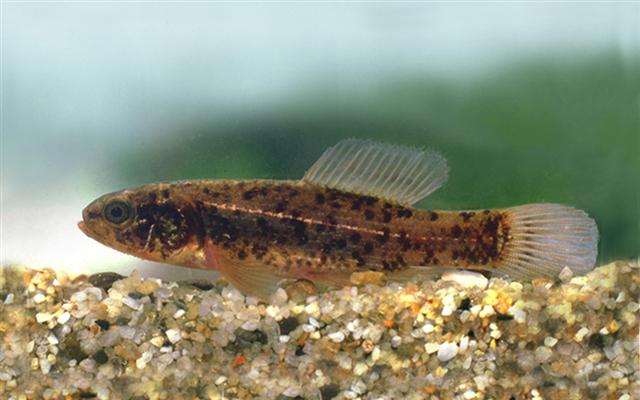
European Mudminnow

European Mudminnow

Umbra krameri

Akos Harka, CC BY 3.0, via Wikimedia Commons

Eastern Mudminnow

Eastern Mudminnow

Umbra pygmaea

geosesarma, CC BY 4.0, via Wikimedia Commons

Side by side

European MudminnowEastern Mudminnow
Scientific nameUmbra krameri Walbaum, 1792Umbra pygmaea (DeKay, 1842)
English nameEuropean MudminnowEastern Mudminnow
GroupFishesFishes
ClassTeleostei TeleostTeleostei Teleost
OrderEsociformesEsociformes
FamilyUmbridae MudminnowsUmbridae Mudminnows
GenusUmbra MudminnowsUmbra Mudminnows
Named in17921842
Red List categoryVulnerableLeast Concern
Environmentfreshwaterfreshwater
Countries on record11 countries7 countries
GBIF occurrence records234 records9,197 records

Rows where the two agree are shown in grey.

Where each is found

Both recorded in 2 countries

Only European Mudminnow (9)

Only Eastern Mudminnow (5)

From Catalogue of Life checklists and GBIF occurrence records. A country missing from a list means no record is held, which is not proof of absence.

Checked facts

European MudminnowEastern Mudminnow
Appearance
  • The European mudminnow has a long, cylindrical body. English Wikipedia
  • Its coloration ranges from green to brown, with lighter undersides and grey to dark brown mottled spots. English Wikipedia
  • The species has distinct dark lateral stripes that are particularly noticeable in juveniles. English Wikipedia
  • The European mudminnow has a flat head and a small mouth. English Wikipedia
Size
Habitat
  • The eastern mudminnow inhabits still or slow-moving waters. English Wikipedia
  • The species frequently occurs in densely vegetated environments. English Wikipedia
  • Its habitats include heavily vegetated streams, swamps, and ponds. English Wikipedia
  • The species can inhabit natural waters with pH values ranging from 3.5 to 8.1. English Wikipedia
  • The eastern mudminnow can tolerate habitats with low pH, temperature, and oxygen availability. English Wikipedia
DietNo checked fact yet
  • The eastern mudminnow primarily consumes insect larvae and other small aquatic invertebrates. English Wikipedia
  • The species feeds on insect larvae, worms, molluscs, and crustaceans. English Wikipedia
  • The eastern mudminnow is a bottom-feeding fish. English Wikipedia
  • Midge larvae and small crustaceans are recorded as foods of the eastern mudminnow. fairfaxcounty.gov
Behaviour
  • The species exhibits limited dispersal, as described in the study's discussion of aquatic species with restricted movement. pmc.ncbi.nlm.nih.gov
ReproductionNo checked fact yet
  • Nests occur in algae cavities, beneath loose rocks, and in depressions in sand. English Wikipedia
  • In the studied New Jersey population, peak spawning occurred in mid-April at water temperatures of 9–12 °C. usgs.gov
  • All females in the studied population had completed spawning by late April. usgs.gov
  • Estimated fecundity ranged from 250 eggs per female at age one to 2,168 eggs per female at age five. usgs.gov
  • The diameter of mature ova averaged 1.41 mm in early February before spawning. usgs.gov
  • The female-to-male ratio in the studied population increased from 0.6 at age one to 4.6 at age five. usgs.gov
Distribution
  • The European mudminnow occurs in Austria, Bosnia and Herzegovina, Bulgaria, Croatia, Hungary, Moldova, Romania, Serbia, Slovakia, Slovenia, and Ukraine. English Wikipedia
  • An introduced population of the European mudminnow occurs in northern Germany. English Wikipedia
No checked fact yet
Conservation
  • The IUCN classifies the European mudminnow as vulnerable to extinction within its indigenous range. English Wikipedia
  • Only a few scattered populations of the European mudminnow have survived habitat loss and fragmentation. pmc.ncbi.nlm.nih.gov
  • The invasive Amur sleeper (Perccottus glenii) has further worsened the conservation situation of the European mudminnow, particularly in the Tisza region. pmc.ncbi.nlm.nih.gov
  • The European mudminnow has been extirpated from numerous locations. pmc.ncbi.nlm.nih.gov
  • The species has been extirpated particularly from backwaters connected to the upper and middle sections of the Hungarian Tisza River. pmc.ncbi.nlm.nih.gov
  • The area of wetlands and river-connected backwaters in the Carpathian Basin was reduced to 700 km2. pmc.ncbi.nlm.nih.gov
  • The study detected strictly limited gene flow between the investigated regions of the species. pmc.ncbi.nlm.nih.gov
  • The study proposed two evolutionary significant units for the European mudminnow in the Carpathian Basin, corresponding to the Danube and Tisza catchments. pmc.ncbi.nlm.nih.gov
  • The study recommended conservation-unit boundaries spanning approximately 80–90 km. pmc.ncbi.nlm.nih.gov
  • The study recommended establishing 16 management units for the 33 investigated populations. pmc.ncbi.nlm.nih.gov
  • The genetic study examined 404 European mudminnow specimens from eight regions. pmc.ncbi.nlm.nih.gov
  • The genetic analysis of the European mudminnow used eight microsatellite loci. pmc.ncbi.nlm.nih.gov
  • River regulation in the Carpathian Basin included the construction of more than 4,200 km of levees. pmc.ncbi.nlm.nih.gov
  • The Tisza River was shortened from 1,419 km to 966 km following river regulation. pmc.ncbi.nlm.nih.gov
  • The eastern mudminnow is generally regarded as a species of little conservation concern in North America. English Wikipedia
  • The species is considered potentially invasive in much of Europe. English Wikipedia
  • European populations of the eastern mudminnow may undermine conservation efforts for vulnerable European mudminnows. English Wikipedia
Uses
  • In the Carpathian Basin, the European mudminnow was historically used as food for domestic animals, including pigs. pmc.ncbi.nlm.nih.gov
  • The popularity of the species in aquaculture and aquarium trades contributed to its spread into Europe. English Wikipedia
  • The eastern mudminnow has been used as live bait in Europe. English Wikipedia

In brief

European Mudminnow

Umbra krameri occurs in Austria, Bosnia and Herzegovina, Bulgaria, Croatia, Hungary, Moldova, Romania, Serbia, Slovakia, Slovenia, and Ukraine, with an introduced population in northern Germany. It has a long, cylindrical body, green to brown coloration, and distinct dark lateral stripes that are particularly noticeable in juveniles. Full profile

Eastern Mudminnow

The Eastern Mudminnow is a bottom-feeding fish. It inhabits still or slow-moving waters, including heavily vegetated streams, swamps, and ponds. It has an elongated, stout body with dark lateral stripes and lacks a lateral line. Full profile

Compare something else

Page built on 26 November 2026 from the data on the two species pages, where every source is listed.

Cite this page

ScientificNames.org. (2026). European Mudminnow vs Eastern Mudminnow. Retrieved November 26, 2026, from https://scientificnames.org/compare/european-mudminnow-vs-eastern-mudminnow