| Appearance | - Adult Greater Kestrels have predominantly pale rufous plumage on their upperparts and underparts. English Wikipedia
- The Greater Kestrel's back, upperwing and flanks have black barring. English Wikipedia
- The Greater Kestrel has dark breast streaks and a streaked head without a malar stripe. English Wikipedia
- The Greater Kestrel has a grey rump and tail marked with black bars and ending in a white tip. English Wikipedia
- The Greater Kestrel has whitish underwings that contrast with its darker body during flight. English Wikipedia
- The Greater Kestrel has a whitish iris that distinguishes it from similar species. English Wikipedia
- The Greater Kestrel's bill is mainly blue-grey, while its feet and cere are yellow. English Wikipedia
- Juvenile Greater Kestrels have rufous rather than grey tails, streaked flanks and dark eyes. English Wikipedia
- The Greater Kestrel is described as a large, pale-brown kestrel. ebird.org
- The Greater Kestrel has a grey tail with broad black bands and a heavily black-marked back. ebird.org
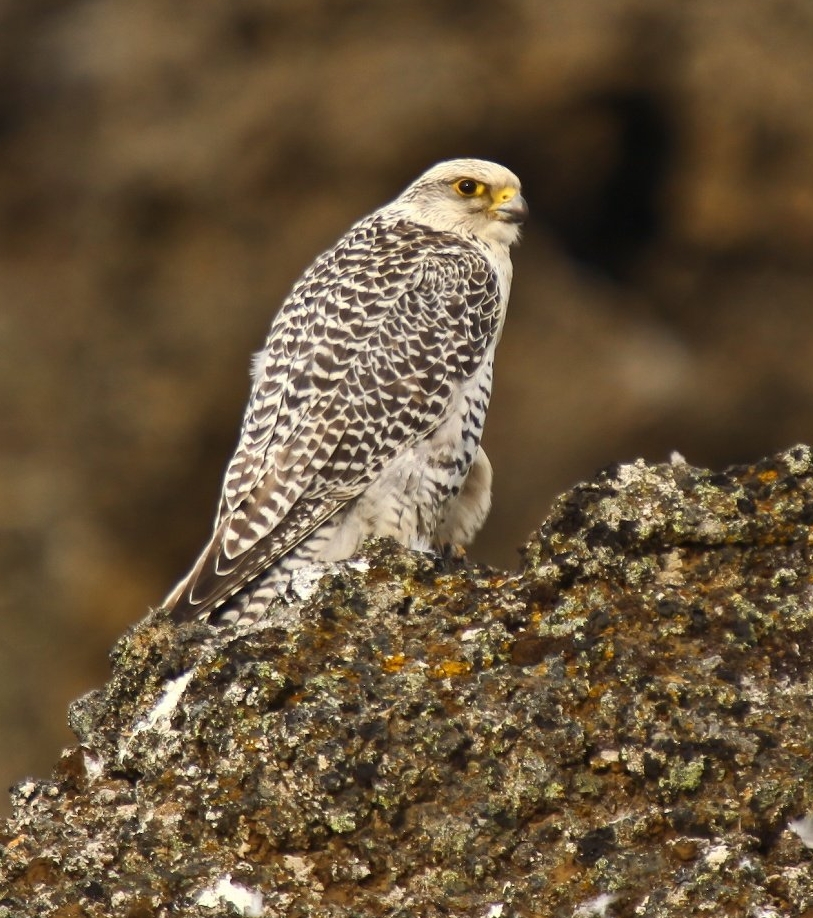
| - The gyrfalcon exhibits plumage colours ranging from entirely white to dark grey-brown. English Wikipedia
- The species has four principal colour morphs: white, silver, brown and black. English Wikipedia
- Juvenile gyrfalcons have darker and browner plumage than adults. English Wikipedia
- Adult gyrfalcons have yellow ceres, eye-rings and legs, whereas juveniles have blue versions of these features. animaldiversity.org
- The gyrfalcon has long pointed wings, a long tail and a notched bill. animaldiversity.org
- The Greenland population most commonly exhibits white plumage flecked with grey on the back and wings. English Wikipedia
|
|---|
| Size | No checked fact yet | |
|---|
| Habitat | - The Greater Kestrel inhabits open, arid environments. English Wikipedia
- The Greater Kestrel is frequently associated with acacia vegetation. English Wikipedia
- The Greater Kestrel prefers habitats where ground vegetation is less than 50 cm tall. English Wikipedia
- The Greater Kestrel occurs at elevations from sea level to 2,150 metres. English Wikipedia
- The Greater Kestrel inhabits semi-desert, grassland and arid savanna. ebird.org
| |
|---|
| Diet | - The Greater Kestrel feeds mainly on invertebrates, including grasshoppers, termites, beetles and solifugids. English Wikipedia
- The Greater Kestrel also eats lizards. English Wikipedia
- The Greater Kestrel occasionally consumes small birds, mammals and snakes. English Wikipedia
| |
|---|
| Behaviour | - The Greater Kestrel usually hunts from exposed perches such as trees or rocks. English Wikipedia
- The Greater Kestrel also hunts by hovering. English Wikipedia
- The Greater Kestrel mainly captures its prey on the ground. English Wikipedia
- The Greater Kestrel is attracted to fires and catches prey fleeing from the flames. English Wikipedia
- The Greater Kestrel sometimes stores surplus food beneath vegetation or stones. English Wikipedia
- The Greater Kestrel is usually silent but produces a shrill, repeated call. English Wikipedia
- Most Greater Kestrels are sedentary, although some individuals are nomadic or dispersive. English Wikipedia
| - Gyrfalcons may cache large prey items, including Arctic hares, between feeding periods during nesting. animaldiversity.org
- Gyrfalcons generally hunt, forage and roost alone outside the breeding season. animaldiversity.org
- Gyrfalcons are generally non-migratory but may disperse from their breeding range during winter. animaldiversity.org
|
|---|
| Reproduction | - In the southern part of its range, the Greater Kestrel's breeding season extends from July to April, peaking between September and December. English Wikipedia
- In Kenya and Tanzania, the Greater Kestrel can breed throughout the year, with breeding concentrated between April and July. English Wikipedia
- The Greater Kestrel's breeding season in Somalia lasts from April to August. English Wikipedia
- Greater Kestrels use abandoned nests built by other birds, including Cape crows and pied crows. English Wikipedia
- Greater Kestrel nests are typically located 2–20 metres above the ground in trees or sometimes on telegraph poles or pylons. English Wikipedia
- Greater Kestrels lay between two and seven eggs, with three or four being the most common clutch size. English Wikipedia
- Greater Kestrel eggs are incubated for 22–23 days, mainly by the female. English Wikipedia
- Young Greater Kestrels fledge 30–34 days after hatching. English Wikipedia
- Young Greater Kestrels remain dependent on their parents for at least another 26 days after fledging. English Wikipedia
| - Gyrfalcons generally nest on cliff faces and frequently reuse abandoned nests belonging to other birds. English Wikipedia
- Gyrfalcon clutches usually contain two to four eggs. English Wikipedia
- The average gyrfalcon egg measures approximately 58.46 × 45 mm. English Wikipedia
- Gyrfalcon eggs have an average incubation period of 35 days. English Wikipedia
- Gyrfalcon nestlings generally leave the nest at seven to eight weeks of age. English Wikipedia
- Immature gyrfalcons become independent of their parents at three to four months of age. English Wikipedia
- Gyrfalcons in the studied northern populations generally lay eggs near the end of April. animaldiversity.org
|
|---|
| Lifespan | No checked fact yet | |
|---|
| Distribution | - The Greater Kestrel occurs in southern and eastern Africa. English Wikipedia
- The Greater Kestrel has an estimated total geographic range of approximately 3.5 million square kilometres. English Wikipedia
- The Greater Kestrel is fairly common and widespread in the southern parts of its range but scarce and patchily distributed farther north. English Wikipedia
| |
|---|
| Conservation | - The Greater Kestrel population is described as stable. English Wikipedia
- The Greater Kestrel population is estimated at approximately 100,000–200,000 pairs. English Wikipedia
| - The gyrfalcon is classified as Least Concern on the IUCN Red List. English Wikipedia
- Pesticide pollution depressed gyrfalcon populations during the mid-twentieth century. English Wikipedia
- Improved environmental standards in developed countries have contributed to the recovery of gyrfalcon populations. English Wikipedia
|
|---|
| Uses | No checked fact yet | - The gyrfalcon is the official bird of Canada's Northwest Territories. English Wikipedia
|
|---|