Comparison
Rusty Fig vs Rubber Plant
Rusty Fig (Ficus rubiginosa) and Rubber Plant (Ficus elastica) both belong to the genus Ficus (fig) and part ways below it. Both are recorded in 3 countries.
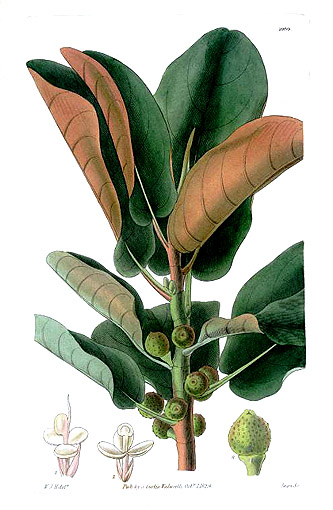


Side by side
| Rusty Fig | Rubber Plant | |
|---|---|---|
| Scientific name | Ficus rubiginosa Desf. ex Vent. | Ficus elastica Roxb. |
| English name | Rusty Fig | Rubber Plant |
| Group | Flowering plants | Flowering plants |
| Class | Magnoliopsida | Magnoliopsida |
| Order | Rosales | Rosales |
| Family | Moraceae Mulberry Family | Moraceae Mulberry Family |
| Genus | Ficus Fig | Ficus Fig |
| Red List category | Least Concern | Least Concern |
| Countries on record | 7 countries | 59 countries |
| GBIF occurrence records | 6,261 records | 3,188 records |
Rows where the two agree are shown in grey.
Where each is found
Both recorded in 3 countries
Only Rusty Fig (4)
Only Rubber Plant (56)
- Afghanistan
- Anguilla
- Bangladesh
- Barbados
- Belize
- Benin
- Bhutan
- Bolivia
- Brazil
- Cambodia
- Cameroon
- China
- Colombia
- Costa Rica
- Dominican Republic
- Ecuador
- El Salvador
- Fiji
- Grenada
- Guadeloupe
- Guam
- Guatemala
- Guinea
- Guyana
- Haiti
- Honduras
- Hong Kong
- India
- Indonesia
- Jamaica
- Japan
- Laos
- Macao
- Malaysia
- Mauritius
- Mexico
- Montserrat
- Mozambique
- Myanmar
- Nepal
- Nicaragua
- Pakistan
- Palau
- Panama
- Peru
- Philippines
- Pitcairn
- Portugal
- Puerto Rico
- Singapore
- South Korea
- Spain
- Sri Lanka
- Thailand
- Vanuatu
- Vietnam
From Catalogue of Life checklists and GBIF occurrence records. A country missing from a list means no record is held, which is not proof of absence.
Checked facts
| Rusty Fig | Rubber Plant | |
|---|---|---|
| Appearance |
|
|
| Size | No checked fact yet |
|
| Habitat |
|
|
| Diet |
| No checked fact yet |
| Behaviour |
| No checked fact yet |
| Reproduction |
|
|
| Distribution |
|
|
| Conservation |
| No checked fact yet |
| Uses | No checked fact yet |
|
| Name origin | No checked fact yet |
|
| Other | No checked fact yet |
|
In brief
Rusty Fig
Ficus rubiginosa grows naturally along Australia's eastern coast, from Cape York Peninsula in Queensland to near Bega in southern New South Wales, and extends westward to Porcupine Gorge National Park and the far western plains of New South Wales. Full profile
Rubber Plant
The natural range extends from Nepal to Indonesia. It has broad, glossy, leathery leaves, a dense canopy, and abundant milky white latex. Full profile
Compare something else
Page built on 27 November 2026 from the data on the two species pages, where every source is listed.
Cite this page
ScientificNames.org. (2026). Rusty Fig vs Rubber Plant. Retrieved November 27, 2026, from https://scientificnames.org/compare/rusty-fig-vs-rubber-plant
“Rusty Fig vs Rubber Plant.” ScientificNames.org, 2026, scientificnames.org/compare/rusty-fig-vs-rubber-plant. Accessed 27 Nov. 2026.
ScientificNames.org. “Rusty Fig vs Rubber Plant.” Accessed November 27, 2026. https://scientificnames.org/compare/rusty-fig-vs-rubber-plant.
@misc{scientificnames_rusty_fig_vs_rubber_plant,
  author = {{ScientificNames.org}},
  title = {Rusty Fig vs Rubber Plant},
  year = {2026},
  url = {https://scientificnames.org/compare/rusty-fig-vs-rubber-plant},
  note = {Accessed 2026-11-27}
}