Comparison
Forrest's Hemlock vs Eastern Hemlock
Forrest's Hemlock (Tsuga forrestii) and Eastern Hemlock (Tsuga canadensis) both belong to the genus Tsuga (hemlock) and part ways below it.

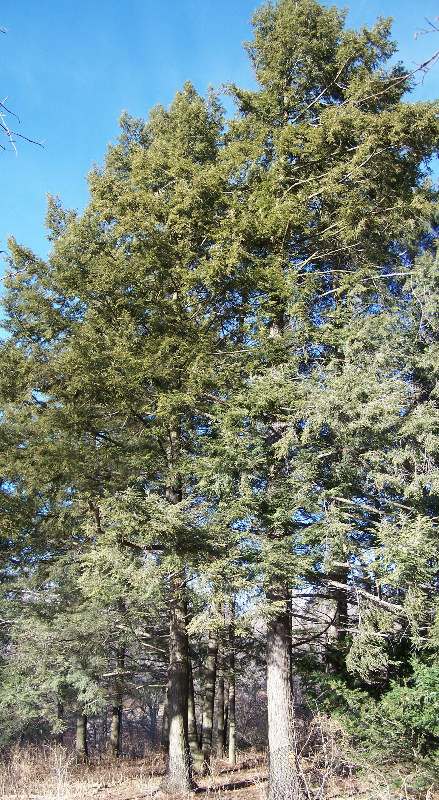


Side by side
| Forrest's Hemlock | Eastern Hemlock | |
|---|---|---|
| Scientific name | Tsuga forrestii Downie | Tsuga canadensis (L.) Carrière |
| English name | Forrest's Hemlock | Eastern Hemlock |
| Group | Conifers and allies | Conifers and allies |
| Class | Pinopsida Conifer | Pinopsida Conifer |
| Order | Pinales | Pinales |
| Family | Pinaceae Pine Family | Pinaceae Pine Family |
| Genus | Tsuga Hemlock | Tsuga Hemlock |
| Red List category | Vulnerable | Near Threatened |
| Countries on record | 1 country | 4 countries |
| GBIF occurrence records | 126 records | 68,238 records |
Rows where the two agree are shown in grey.
Where each is found
Only Forrest's Hemlock (1)
Only Eastern Hemlock (4)
From Catalogue of Life checklists and GBIF occurrence records. A country missing from a list means no record is held, which is not proof of absence.
Checked facts
| Forrest's Hemlock | Eastern Hemlock | |
|---|---|---|
| Appearance |
|
|
| Habitat |
|
|
| Diet | No checked fact yet |
|
| Reproduction | No checked fact yet |
|
| Distribution |
|
|
| Conservation |
|
|
| Uses | No checked fact yet |
|
| Similar species |
| No checked fact yet |
In brief
Forrest's Hemlock
Forrest's Hemlock is a conifer belonging to the Pinaceae family. It grows in mixed forests in mountainous areas and valleys in northeast Guizhou, southwest Sichuan, and northwest Yunnan, at elevations between 2,000 and 3,000 metres. Full profile
Eastern Hemlock
Tsuga canadensis is native to eastern North America, with a range extending from northeastern Minnesota through southern Quebec to Nova Scotia and south through the Appalachian Mountains to northern Georgia and Alabama. It has flattened needles typically arranged in two rows, with shiny green to yellow-green upper surfaces and two broad stomatal bands underneath. Full profile
Compare something else
Page built on 27 November 2026 from the data on the two species pages, where every source is listed.
Cite this page
ScientificNames.org. (2026). Forrest's Hemlock vs Eastern Hemlock. Retrieved November 27, 2026, from https://scientificnames.org/compare/forrests-hemlock-vs-eastern-hemlock
“Forrest's Hemlock vs Eastern Hemlock.” ScientificNames.org, 2026, scientificnames.org/compare/forrests-hemlock-vs-eastern-hemlock. Accessed 27 Nov. 2026.
ScientificNames.org. “Forrest's Hemlock vs Eastern Hemlock.” Accessed November 27, 2026. https://scientificnames.org/compare/forrests-hemlock-vs-eastern-hemlock.
@misc{scientificnames_forrests_hemlock_vs_eastern_hemlock,
  author = {{ScientificNames.org}},
  title = {Forrest's Hemlock vs Eastern Hemlock},
  year = {2026},
  url = {https://scientificnames.org/compare/forrests-hemlock-vs-eastern-hemlock},
  note = {Accessed 2026-11-27}
}