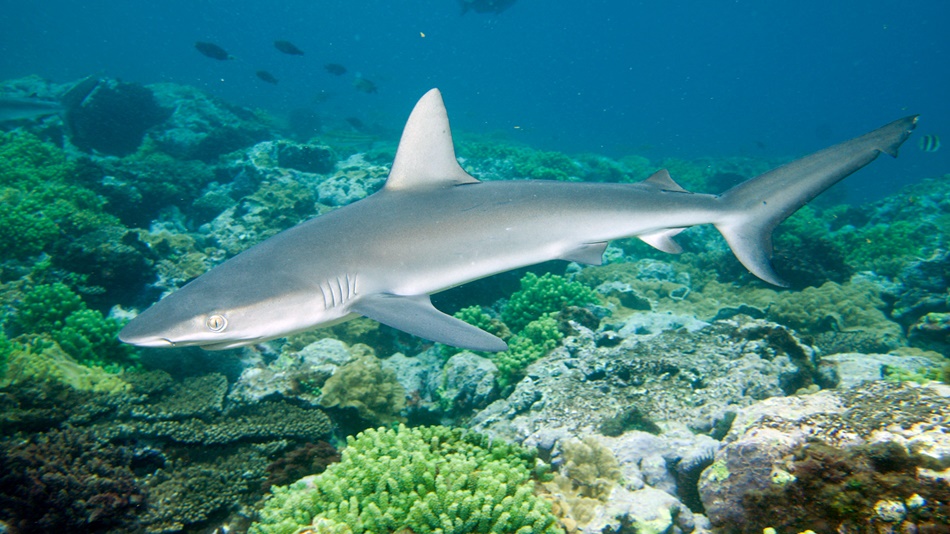
| Appearance | - The species has a slender, streamlined body with a wide, rounded snout and medium-sized round eyes. English Wikipedia
- Its upper body is brownish gray and its underside is white, with a faint white stripe along the sides. English Wikipedia
- The first dorsal fin is tall, moderately sickle-shaped, and positioned above the rear tips of the pectoral fins. English Wikipedia
- The species has large pectoral fins with pointed tips. English Wikipedia
- Its upper teeth are stout and triangular, while its lower teeth are narrower, and both have serrated edges. English Wikipedia
- A low ridge runs along the midline between the first and second dorsal fins. English Wikipedia
| - The bronze whaler has a slender, streamlined body with a slightly arched profile behind the head. English Wikipedia
- The species has a long, pointed snout and moderately large, round eyes. English Wikipedia
- The species generally lacks a prominent ridge between its dorsal fins. floridamuseum.ufl.edu
- Its dorsal surface is bronze to olive-gray with a metallic sheen, while its underside is white. English Wikipedia
- The white coloration of its underside extends onto its flanks as a prominent band. English Wikipedia
|
|---|
| Size | | No checked fact yet |
|---|
| Habitat | - The species prefers clear-water reef habitats around oceanic islands. English Wikipedia
- It commonly inhabits rugged reefs with strong converging currents near continental and island shelves. English Wikipedia
- The species also forms groups around rocky islets and seamounts. English Wikipedia
- Juveniles generally remain at depths shallower than 25 metres. English Wikipedia
- Adults have been recorded at depths of up to 180 metres. English Wikipedia
- It prefers clear tropical waters with strong currents over coral or rocky seabeds. floridamuseum.ufl.edu
| - The species inhabits temperate coastal waters and continental shelves. animaldiversity.org
- The species occupies habitats ranging from shallow bays and estuaries to offshore continental shelf waters. floridamuseum.ufl.edu
- Juveniles inhabit shallow coastal waters at depths below 30 m throughout the year. English Wikipedia
- The species can tolerate low and fluctuating salinity and occurs in estuaries and the lower reaches of large rivers. English Wikipedia
|
|---|
| Diet | - Its primary food consists of bottom-dwelling bony fishes, including eels, sea bass, flatfish, flatheads and triggerfish, as well as octopuses. English Wikipedia
- The species occasionally consumes surface-dwelling mackerel, flyingfish and squid. English Wikipedia
- Larger individuals consume rays, smaller sharks and crustaceans. English Wikipedia
- The species has been observed attacking Galapagos fur seals, sea lions and marine iguanas. English Wikipedia
- Its diet can include non-food items such as leaves, coral, rocks and garbage. English Wikipedia
| - The species feeds on cephalopods, including squid, cuttlefish, and octopus. English Wikipedia
- Its bony fish prey include sardines, mullets, tunas, and anchovies. English Wikipedia
- The species also consumes cartilaginous fishes, including stingrays, skates, and other sharks. English Wikipedia
- Young bronze whalers consume jellyfish and crustaceans such as mud shrimps and penaeid prawns. English Wikipedia
- The southern African pilchard constitutes 69–95% of the species' diet off South Africa. English Wikipedia
|
|---|
| Behaviour | - The species is an active predator that is frequently encountered in large groups. English Wikipedia
- It commonly forms loose aggregations rather than true schools. English Wikipedia
- When threatened, the species may arch its back, lower its pectoral fins, puff out its gills and perform exaggerated rolling swimming movements. English Wikipedia
- During interactions with blacktip sharks, Galapagos sharks are dominant, but they defer to similarly sized silvertip sharks. English Wikipedia
- Juveniles remain in shallow water partly to avoid predation by larger adults. English Wikipedia
- The species often swims just above the seabed and forms loose aggregations. floridamuseum.ufl.edu
| - Bronze whalers follow migrating sardine shoals during the sardine run along the South African coast. floridamuseum.ufl.edu
- Populations in both hemispheres undertake seasonal migrations associated with temperature, reproduction, and prey availability. English Wikipedia
- Individual sharks have been recorded traveling as far as 1,320 km during migrations. English Wikipedia
- The species returns to the same areas from year to year. English Wikipedia
|
|---|
| Reproduction | - Mating occurs between January and March. English Wikipedia
- The gestation period is estimated to be approximately one year. English Wikipedia
- Newborn pups have been reported to measure between 61 and 80 centimetres in length. English Wikipedia
- Males reach sexual maturity at approximately 2.1–2.5 metres in length and six to eight years of age. English Wikipedia
- Females reach sexual maturity at approximately 2.2–2.5 metres in length and seven to nine years of age. English Wikipedia
| |
|---|
| Distribution | No checked fact yet | - The species occurs in the northeastern and southwestern Atlantic, off southern Africa, in the northwestern and eastern Pacific, and around Australia and New Zealand. English Wikipedia
- In the Indo-Pacific, the species occurs from the East China Sea to Japan and southern Russia. English Wikipedia
- The species is common off Argentina, South Africa, Australia, and New Zealand but rare in many other areas. English Wikipedia
|
|---|
| Conservation | - The IUCN assesses the species as Least Concern. English Wikipedia
- Heavy fishing pressure occurs across the species' range. English Wikipedia
- The species' slow reproductive rate limits its ability to withstand population depletion. English Wikipedia
- Populations at the Kermadec and Galapagos Islands are protected within marine reserves. English Wikipedia
| - The species is assessed as vulnerable on the IUCN Red List in the first document's account. English Wikipedia
- Its low growth and reproductive rates make the species highly susceptible to population depletion. English Wikipedia
- Population declines in New Zealand have been attributed to overfishing. floridamuseum.ufl.edu
|
|---|
| Uses | - The species is caught by commercial fisheries operating across many parts of its range. English Wikipedia
- Its meat is described as being of excellent quality. English Wikipedia
| |
|---|