Comparison
Butterfly Kingfish vs Atlantic Bluefin Tuna
Butterfly Kingfish (Gasterochisma melampus) and Atlantic Bluefin Tuna (Thunnus thynnus) both belong to the family Scombridae (albacores) and part ways below it.
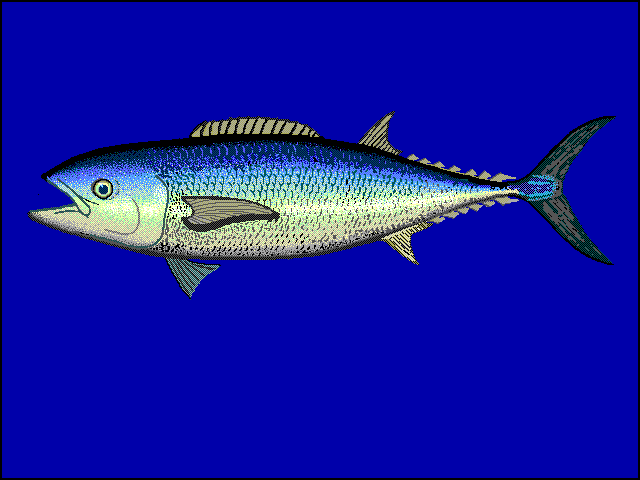


Atlantic Bluefin Tuna
Thunnus thynnus
Unknown authorUnknown author, Public domain, via Wikimedia Commons

Side by side
| Butterfly Kingfish | Atlantic Bluefin Tuna | |
|---|---|---|
| Scientific name | Gasterochisma melampus Richardson, 1845 | Thunnus thynnus (Linnaeus, 1758) |
| English name | Butterfly Kingfish | Atlantic Bluefin Tuna |
| Group | Fishes | Fishes |
| Class | Teleostei Teleost | Teleostei Teleost |
| Order | Scombriformes | Scombriformes |
| Family | Scombridae Albacores | Scombridae Albacores |
| Genus | Gasterochisma Butterfly Mackerels | Thunnus Tunas |
| Named in | 1845 | 1758 |
| Red List category | Least Concern | Least Concern |
| Environment | marine | brackish, marine |
| Countries on record | 4 countries | 38 countries |
| GBIF occurrence records | 1,349 records | 10,045 records |
Rows where the two agree are shown in grey.
Where each is found
Only Butterfly Kingfish (4)
Only Atlantic Bluefin Tuna (38)
- Albania
- Anguilla
- Bahamas
- Belgium
- Belize
- Canada
- Costa Rica
- Croatia
- Cuba
- Denmark
- France
- Germany
- Greece
- Guadeloupe
- Haiti
- Honduras
- Iceland
- Ireland
- Isle of Man
- Italy
- Jamaica
- Malta
- Martinique
- Mexico
- Monaco
- Montenegro
- Norway
- Portugal
- Puerto Rico
- Russia
- Saint Martin
- Saint Pierre and Miquelon
- Spain
- Sweden
- The Netherlands
- U.S. Virgin Islands
- United Kingdom
- United States
From Catalogue of Life checklists and GBIF occurrence records. A country missing from a list means no record is held, which is not proof of absence.
Checked facts
| Butterfly Kingfish | Atlantic Bluefin Tuna | |
|---|---|---|
| Appearance |
|
|
| Size | No checked fact yet |
|
| Habitat |
|
|
| Diet | No checked fact yet |
|
| Behaviour |
|
|
| Reproduction | No checked fact yet |
|
| Distribution |
|
|
| Conservation | No checked fact yet |
|
| Uses |
|
|
| Other |
| No checked fact yet |
In brief
Butterfly Kingfish
The Butterfly Kingfish is the sole member of its genus and subfamily. It has a circumglobal distribution in southern temperate waters and inhabits open-ocean waters at depths reaching 200 metres. It can raise its body temperature through endothermy and possesses a brain heater organ derived from the lateral rectus eye muscle. Full profile
Atlantic Bluefin Tuna
Thunnus thynnus is native to the western and eastern Atlantic Ocean and the Mediterranean Sea. It has a robust, torpedo-like body, dark blue upper coloring, and bright yellow caudal finlets. Full profile
Compare something else
Page built on 27 November 2026 from the data on the two species pages, where every source is listed.
Cite this page
ScientificNames.org. (2026). Butterfly Kingfish vs Atlantic Bluefin Tuna. Retrieved November 27, 2026, from https://scientificnames.org/compare/butterfly-kingfish-vs-atlantic-bluefin-tuna
“Butterfly Kingfish vs Atlantic Bluefin Tuna.” ScientificNames.org, 2026, scientificnames.org/compare/butterfly-kingfish-vs-atlantic-bluefin-tuna. Accessed 27 Nov. 2026.
ScientificNames.org. “Butterfly Kingfish vs Atlantic Bluefin Tuna.” Accessed November 27, 2026. https://scientificnames.org/compare/butterfly-kingfish-vs-atlantic-bluefin-tuna.
@misc{scientificnames_butterfly_kingfish_vs_atlantic_bluefin_tuna,
  author = {{ScientificNames.org}},
  title = {Butterfly Kingfish vs Atlantic Bluefin Tuna},
  year = {2026},
  url = {https://scientificnames.org/compare/butterfly-kingfish-vs-atlantic-bluefin-tuna},
  note = {Accessed 2026-11-27}
}