Comparison

Thicktail Chub vs Utah Chub

Thicktail Chub (Gila crassicauda) and Utah Chub (Gila atraria) both belong to the genus Gila (western chubs) and part ways below it. Both are recorded in 1 country.
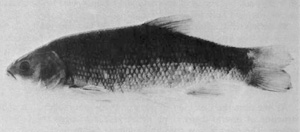
Thicktail Chub

Thicktail Chub

Gila crassicauda

California Department of Fish and Game, Public domain, via Wikimedia Commons

Utah Chub

Utah Chub

Gila atraria

David Starr Jordan, Public domain, via Wikimedia Commons

Side by side

Thicktail ChubUtah Chub
Scientific nameGila crassicauda (Baird & Girard, 1854)Gila atraria (Girard, 1856)
English nameThicktail ChubUtah Chub
GroupFishesFishes
ClassTeleostei TeleostTeleostei Teleost
OrderCypriniformesCypriniformes
FamilyCyprinidae CarpsCyprinidae Carps
GenusGila Western ChubsGila Western Chubs
Named in18541856
Red List categoryExtinctLeast Concern
Environmentfreshwaterfreshwater
Countries on record1 country1 country
GBIF occurrence records55 records1,447 records

Rows where the two agree are shown in grey.

Where each is found

Both recorded in 1 country

From Catalogue of Life checklists and GBIF occurrence records. A country missing from a list means no record is held, which is not proof of absence.

Checked facts

Thicktail ChubUtah Chub
Appearance
  • The thicktail chub had a heavy body, a thick tail, and a small, cone-shaped head. English Wikipedia
  • The thicktail chub's back ranged in color from greenish brown to purplish black. English Wikipedia
  • The thicktail chub had yellow sides and a yellow belly. English Wikipedia
  • The dorsal fin has nine rays and is positioned directly above the pelvic fins. English Wikipedia
  • The dorsal coloration generally ranges from olive-green to nearly black, sometimes with a bluish shade. English Wikipedia
  • The sides can be silvery, brassy, or golden. English Wikipedia
  • Males tend to have more golden coloration, particularly during spawning season. English Wikipedia
  • Males may develop a narrow golden stripe along their upper side. English Wikipedia
  • The fins can be olive-green, yellow, or golden. English Wikipedia
Size
Habitat
  • The thicktail chub inhabited lowlands and weedy backwaters of the Sacramento and San Joaquin Rivers in California's Central Valley. English Wikipedia
  • The thicktail chub inhabited lowland lakes, marshes, ponds, and slow-moving river stretches. English Wikipedia
  • During years of heavy runoff, the thicktail chub also inhabited surface waters of San Francisco Bay. English Wikipedia
  • The species inhabits irrigation ditches, large rivers, and lakes. English Wikipedia
  • Within aquatic systems, the species prefers areas with dense vegetation. English Wikipedia
  • The species tolerates environmental conditions involving high alkalinity. English Wikipedia
Diet
  • The thicktail chub was probably carnivorous and fed on small fish and invertebrates. English Wikipedia
BehaviourNo checked fact yet
ReproductionNo checked fact yet
  • The species reproduces through broadcast spawning in shallow water during late spring and summer. English Wikipedia
  • Spawning occurs when water temperatures are approximately 10–15 °C. English Wikipedia
  • Peak spawning activity occurs at approximately 16 °C. English Wikipedia
  • Between two and six males accompany each female during spawning. English Wikipedia
  • Fertilization occurs externally after eggs are deposited on the bottom of a lake or river. English Wikipedia
  • Eggs generally hatch in approximately one week, with the timing depending on water temperature. English Wikipedia
Distribution
  • The thicktail chub was native to the Central Valley of California, including the Sacramento and San Joaquin River systems. English Wikipedia
  • The native range includes the Snake River basin in Idaho and Wyoming. English Wikipedia
  • The native range includes the Bonneville basin in Utah and Idaho. English Wikipedia
Conservation
  • The thicktail chub became extinct, with its last known specimen caught on April 16, 1957. English Wikipedia
  • Agricultural conversion of the Central Valley was identified as the primary cause of the thicktail chub's extinction. English Wikipedia
  • Drainage of sloughs and marshes, dam construction, and irrigation-related water diversion destroyed much of the thicktail chub's habitat. English Wikipedia
  • Competition from exotic species contributed to the extinction of the thicktail chub. English Wikipedia
  • Utah chub populations are generally regarded as a nuisance because they compete with stocked gamefish such as rainbow trout. English Wikipedia
  • Introductions may threaten native fish through competition or disease introduction. English Wikipedia
  • Competitive interactions with Yellowstone cutthroat trout were not identified in Henrys Lake, Idaho. English Wikipedia
  • Utah and Wyoming have prohibited the use of live Utah chub as bait. English Wikipedia
  • Utah and New Mexico regulate this species. fws.gov
  • The species has been shown to suppress the growth of introduced sportfish when established outside its native range. fws.gov
  • Introduced populations may threaten native species through hybridization and competition, although further evidence is needed to confirm these effects. fws.gov
  • The history of invasiveness for this species is classified as data deficient. fws.gov
  • The overall risk assessment category for the species in the contiguous United States is uncertain. fws.gov
Uses
  • The thicktail chub was a favored food of Indigenous peoples living around Clear Lake and in the Central Valley. English Wikipedia
  • The thicktail chub was commercially exploited by fishermen supplying the San Francisco market. English Wikipedia
  • The thicktail chub represented 40% of fish remains in Native American middens. English Wikipedia
  • The species is occasionally used as bait for catching other predatory gamefish. English Wikipedia
  • Use of live individuals as bait has contributed to introductions outside the native range. English Wikipedia

In brief

Thicktail Chub

Gila crassicauda was native to the Central Valley of California, including the Sacramento and San Joaquin River systems. It had a heavy body, a thick tail, a small cone-shaped head, and yellow sides and belly. Full profile

Utah Chub

The native range includes the Snake River basin in Idaho and Wyoming and the Bonneville basin in Utah and Idaho. It has dorsal coloration ranging from olive-green to nearly black, with sides that can be silvery, brassy, or golden. Full profile

Compare something else

Page built on 29 November 2026 from the data on the two species pages, where every source is listed.

Cite this page

ScientificNames.org. (2026). Thicktail Chub vs Utah Chub. Retrieved November 29, 2026, from https://scientificnames.org/compare/thicktail-chub-vs-utah-chub