Comparison

Virgin Chub vs Thicktail Chub

Virgin Chub (Gila seminuda) and Thicktail Chub (Gila crassicauda) both belong to the genus Gila (western chubs) and part ways below it. Both are recorded in 1 country.

Virgin Chub

Gila seminuda
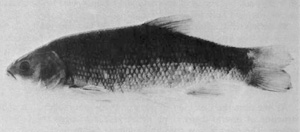
Thicktail Chub

Thicktail Chub

Gila crassicauda

California Department of Fish and Game, Public domain, via Wikimedia Commons

Side by side

Virgin ChubThicktail Chub
Scientific nameGila seminuda Cope & Yarrow, 1875Gila crassicauda (Baird & Girard, 1854)
English nameVirgin ChubThicktail Chub
GroupFishesFishes
ClassTeleostei TeleostTeleostei Teleost
OrderCypriniformesCypriniformes
FamilyCyprinidae CarpsCyprinidae Carps
GenusGila Western ChubsGila Western Chubs
Named in18751854
Red List categoryEndangeredExtinct
Environmentfreshwaterfreshwater
Countries on record1 country1 country
GBIF occurrence records148 records55 records

Rows where the two agree are shown in grey.

Where each is found

Both recorded in 1 country

From Catalogue of Life checklists and GBIF occurrence records. A country missing from a list means no record is held, which is not proof of absence.

Checked facts

Virgin ChubThicktail Chub
Appearance
  • Small scales are embedded in the back, breast, and part of the belly, although some individuals lack scales in these areas. English Wikipedia
  • The head-length to caudal-peduncle-depth ratio is typically between 4.0 and 5.0. English Wikipedia
  • The scales generally lack basal radii or have extremely faint lines. English Wikipedia
  • The thicktail chub had a heavy body, a thick tail, and a small, cone-shaped head. English Wikipedia
  • The thicktail chub's back ranged in color from greenish brown to purplish black. English Wikipedia
  • The thicktail chub had yellow sides and a yellow belly. English Wikipedia
Size
Habitat
  • The species inhabits generally warm, turbid, and saline main channels of the Virgin and Muddy Rivers. English Wikipedia
  • The species very rarely occurs at the immediate mouths of major river tributaries. English Wikipedia
  • The species is most common in deeper areas with swift but non-turbulent currents. English Wikipedia
  • The species is most often associated with boulders or other forms of cover. English Wikipedia
  • The thicktail chub inhabited lowlands and weedy backwaters of the Sacramento and San Joaquin Rivers in California's Central Valley. English Wikipedia
  • The thicktail chub inhabited lowland lakes, marshes, ponds, and slow-moving river stretches. English Wikipedia
  • During years of heavy runoff, the thicktail chub also inhabited surface waters of San Francisco Bay. English Wikipedia
DietNo checked fact yet
  • The thicktail chub was probably carnivorous and fed on small fish and invertebrates. English Wikipedia
BehaviourNo checked fact yet
Distribution
  • The species is restricted to the Virgin River in Arizona, Nevada, and Utah, and the upper and middle reaches of Nevada's Muddy River. English Wikipedia
  • The thicktail chub was native to the Central Valley of California, including the Sacramento and San Joaquin River systems. English Wikipedia
Conservation
  • The species' population continues to decline. English Wikipedia
  • An attempt in 1988 to remove red shiners from 35 km of Virgin River habitat failed to prevent continued declines in Virgin chub populations. English Wikipedia
  • Re-routing stream water and dewatering habitats are detrimental to the species. English Wikipedia
  • Stream impoundment and channelization are detrimental to the species. English Wikipedia
  • Domestic livestock grazing is identified as a detrimental activity for the species. English Wikipedia
  • Timber harvesting and mining are identified as detrimental activities for the species. English Wikipedia
  • Road construction and pollution are identified as detrimental to the species. English Wikipedia
  • Stocking non-native species is identified as a threat to Virgin chub populations. English Wikipedia
  • Agricultural water diversion threatens the species through habitat dewatering. English Wikipedia
  • Increased temperature, salinity, and turbidity in the Virgin River are identified as threats to the species. English Wikipedia
  • Introduced non-native fish and parasite species threaten the Virgin chub. English Wikipedia
  • Recommended management measures include protecting and improving habitat and maintaining water quantity and quality. English Wikipedia
  • Management recommendations include reducing the effects of non-native fish species in waters inhabited by the chub. English Wikipedia
  • Re-establishing additional populations is identified as a management need. English Wikipedia
  • The thicktail chub became extinct, with its last known specimen caught on April 16, 1957. English Wikipedia
  • Agricultural conversion of the Central Valley was identified as the primary cause of the thicktail chub's extinction. English Wikipedia
  • Drainage of sloughs and marshes, dam construction, and irrigation-related water diversion destroyed much of the thicktail chub's habitat. English Wikipedia
  • Competition from exotic species contributed to the extinction of the thicktail chub. English Wikipedia
UsesNo checked fact yet
  • The thicktail chub was a favored food of Indigenous peoples living around Clear Lake and in the Central Valley. English Wikipedia
  • The thicktail chub was commercially exploited by fishermen supplying the San Francisco market. English Wikipedia
  • The thicktail chub represented 40% of fish remains in Native American middens. English Wikipedia
Other
  • The Virgin chub likely originated through hybridization between the roundtail chub and the bonytail chub. English Wikipedia
  • Evidence supporting the proposed hybrid origin includes morphological and allozyme data. English Wikipedia
  • The mitochondrial DNA of the Virgin chub is nearly identical to that of Gila elegans. English Wikipedia
No checked fact yet

In brief

Virgin Chub

Gila seminuda lives in the Virgin River in Arizona, Nevada, and Utah, and the upper and middle reaches of Nevada's Muddy River. It likely originated through hybridization between the roundtail chub and the bonytail chub. Full profile

Thicktail Chub

Gila crassicauda was native to the Central Valley of California, including the Sacramento and San Joaquin River systems. It had a heavy body, a thick tail, a small cone-shaped head, and yellow sides and belly. Full profile

Compare something else

Page built on 27 November 2026 from the data on the two species pages, where every source is listed.

Cite this page

ScientificNames.org. (2026). Virgin Chub vs Thicktail Chub. Retrieved November 27, 2026, from https://scientificnames.org/compare/virgin-chub-vs-thicktail-chub