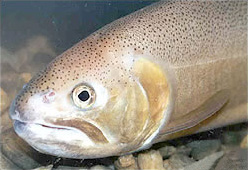
| Appearance | - Gila trout have yellow bodies marked with numerous small dark spots on the upper half. English Wikipedia
- Gila trout are distinguished from Apache trout by numerous small dark spots concentrated on the upper half of their bodies. English Wikipedia
- Adult Gila trout have small dark spots above the lateral line and a larger dark spot on the adipose fin. biokids.umich.edu
- The tips of the dorsal, pelvic, and anal fins are yellow or white. biokids.umich.edu
- Gila trout commonly have a pinkish lateral band that becomes darker in males during spawning season. biokids.umich.edu
- Juvenile parr marks frequently remain visible in adult Gila trout. biokids.umich.edu
- Most mature Gila trout have a yellow cutthroat mark. biokids.umich.edu
| - The chum salmon has a deeper body than most other salmonid species. English Wikipedia
- Ocean-stage adults have a silvery blue-green coloration with indistinct darker spots and a paler belly. English Wikipedia
- The body becomes dark olive green and the belly darkens when the fish enters freshwater. English Wikipedia
- Spawning males develop purple blotchy streaks near the caudal peduncle that become darker toward the tail. English Wikipedia
- Spawning males develop an elongated snout, white-tipped lower fins, and enlarged teeth. English Wikipedia
- Ocean-stage chum salmon have a highly forked, unspotted tail with silver streaks along the fin rays. adfg.alaska.gov
- Freshwater-resident fry have 8–12 dark vertical parr marks that generally do not extend below the lateral line. adfg.alaska.gov
- Spawning females develop a broad dark horizontal stripe along the lateral line. adfg.alaska.gov
|
|---|
| Size | | - Adult chum salmon typically weigh between 4.4 and 10.0 kg. English Wikipedia
- The average adult chum salmon length is approximately 60 cm. English Wikipedia
- Juvenile chum salmon generally measure 1–2 inches when they leave freshwater. adfg.alaska.gov
- Ocean-stage chum salmon can reach weights of 12 pounds or more during their marine growth period. adfg.alaska.gov
|
|---|
| Habitat | - Gila trout inhabit freshwater rivers and perennial streams at elevations between 1,650 and 2,800 m. biokids.umich.edu
- Most Gila trout habitat consists of cold headwater and moderate valley streams that rarely exceed 21°C. biokids.umich.edu
- Gila trout headwater habitats include steep streams with rocky cascades and pools and gradients reaching 12%. biokids.umich.edu
- Gila trout valley habitats typically contain meandering streams with cobble riffles and pools around woody debris and rocks. biokids.umich.edu
- Suitable Gila trout habitat predominantly has gravel substrates measuring 2–9 mm. biokids.umich.edu
- Gila trout occur in small mountain streams and confined pools. English Wikipedia
| - Chum salmon commonly spawn in small streams and intertidal zones. English Wikipedia
- Small to medium, slow-flowing, spring-fed side channels are frequently preferred spawning habitats. adfg.alaska.gov
- Chum salmon also spawn in muddy rivers, clear headwater streams, and river mouths below the high-tide line. adfg.alaska.gov
- Juvenile chum salmon initially inhabit shallow eelgrass beds near shore after entering the ocean. adfg.alaska.gov
- Adult chum salmon generally occupy the upper 50 metres of the open ocean. English Wikipedia
|
|---|
| Diet | - Gila trout feed opportunistically on aquatic insects and small fishes. English Wikipedia
| |
|---|
| Behaviour | No checked fact yet | - Chum salmon are anadromous and migrate from saltwater to freshwater to reproduce. adfg.alaska.gov
- Most chum salmon return to the same stream and spawning site where they originated. adfg.alaska.gov
- Chum salmon fry migrate to saltwater within days or weeks of hatching. adfg.alaska.gov
- Adult chum salmon stop feeding when they return to freshwater to spawn. adfg.alaska.gov
- Juvenile chum salmon remain near the coast for several months before dispersing into the open ocean. adfg.alaska.gov
|
|---|
| Reproduction | - Female Gila trout produce an average of approximately 150 eggs per spawning event. biokids.umich.edu
- The maximum observed egg production by a Gila trout female was 686 eggs. English Wikipedia
- Gila trout eggs incubate in gravel nests called redds. biokids.umich.edu
- Gila trout fry emerge approximately 8–10 weeks after eggs are laid. biokids.umich.edu
- Newly emerged Gila trout fry measure approximately 15–25 mm. biokids.umich.edu
- Female Gila trout reach sexual maturity between two and four years of age. biokids.umich.edu
- Male Gila trout reach sexual maturity between two and three years of age. biokids.umich.edu
- Female Gila trout construct spawning nests by rapidly beating their tails against the substrate. biokids.umich.edu
- Gila trout females cover their fertilized eggs with gravel after spawning. biokids.umich.edu
| - Chum salmon generally reproduce during the fall. adfg.alaska.gov
- Some chum salmon populations spawn in summer, while others spawn later in fall. adfg.alaska.gov
- Female chum salmon excavate gravel depressions in which they deposit their eggs. adfg.alaska.gov
- Female chum salmon can lay as many as 4,000 eggs. English Wikipedia
- Female chum salmon cover fertilized eggs with gravel and guard their nests until they become too weak to maintain their position. adfg.alaska.gov
- Chum salmon embryos hatch approximately 3–4 months after fertilization, depending on water temperature. adfg.alaska.gov
- Newly hatched chum salmon remain in gravel for another 60–90 days while absorbing nutrients from their yolk sacs. adfg.alaska.gov
|
|---|
| Distribution | - Gila trout are native to tributaries of the Gila River in Arizona and New Mexico. English Wikipedia
- Gila trout occur in the upper Gila River watershed in New Mexico and the Francisco River watershed in Arizona. biokids.umich.edu
- Five streams in the Gila National Forest in New Mexico have retained Gila trout populations. English Wikipedia
- The five streams retaining Gila trout populations include Iron, McKenna, Spruce, Main Diamond, and South Diamond creeks. English Wikipedia
| - Chum salmon occur throughout the North Pacific, including the coasts of Japan, Korea, Russia, Canada, and the United States. English Wikipedia
- Chum salmon occur along the Arctic Ocean coast from the Lena River in Russia to the Mackenzie and Anderson rivers in Canada. adfg.alaska.gov
- Chum salmon are generally distributed throughout Alaska but are scarce north of Kotzebue Sound. adfg.alaska.gov
|
|---|
| Conservation | - Gila trout were federally listed as endangered before being downlisted to threatened in July 2006. English Wikipedia
- Gila trout were listed by the U.S. Fish and Wildlife Service in 1967. English Wikipedia
- Competition and hybridization with introduced rainbow trout threaten Gila trout populations. English Wikipedia
- Habitat loss resulting from reduced water flow and the loss of shade-giving trees is a primary cause of declining Gila trout populations. English Wikipedia
- Gila trout restoration efforts have included removing introduced trout, repairing riparian vegetation, and restocking streams. English Wikipedia
- Gila trout have been introduced into ten new streams through conservation efforts. English Wikipedia
- Most existing Gila trout populations occur on federally managed lands and designated wilderness areas. biokids.umich.edu
| - The Hood Canal Summer Run and Lower Columbia River chum salmon populations are listed as threatened under the Endangered Species Act. English Wikipedia
- Some chum salmon stocks in Western Alaska have very low population levels. adfg.alaska.gov
- Hatchery fish account for more than half of the commercial chum salmon harvest in Southeast Alaska and Prince William Sound. adfg.alaska.gov
|
|---|
| Uses | No checked fact yet | - Chum salmon are traditionally used as a source of dried food. English Wikipedia
- Chum salmon are highly valued as dried winter food in Arctic, Northwestern, and Interior Alaska. adfg.alaska.gov
- Chum salmon are a potential aquaculture species for increasing domestic salmon production in Korea. pmc.ncbi.nlm.nih.gov
|
|---|
| Name origin | No checked fact yet | - The English name chum salmon derives from the Chinook Jargon word tsəm, meaning spotted or marked. English Wikipedia
|
|---|
| Other | | - Chum salmon are the most widely distributed species among Pacific salmon. adfg.alaska.gov
- Commercial chum salmon harvests in Alaska more than doubled after the 1980s. adfg.alaska.gov
|
|---|