Comparison

Asian Barred Owlet vs Ferruginous Pygmy Owl

Asian Barred Owlet (Glaucidium cuculoides) and Ferruginous Pygmy Owl (Glaucidium brasilianum) both belong to the genus Glaucidium (pygmy owl) and part ways below it.

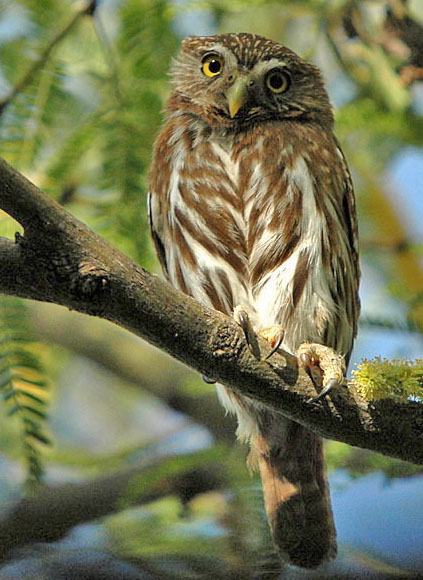
Asian Barred Owlet

Asian Barred Owlet

Glaucidium cuculoides

Himadrimondal, CC BY-SA 4.0, via Wikimedia Commons

Ferruginous Pygmy Owl

Ferruginous Pygmy Owl

Glaucidium brasilianum

User: Sky Jacobs, CC BY-SA 3.0, via Wikimedia Commons

Side by side

Asian Barred OwletFerruginous Pygmy Owl
Scientific nameGlaucidium cuculoides (Vigors, 1830)Glaucidium brasilianum (J. F. Gmelin, 1788)
English nameAsian Barred OwletFerruginous Pygmy Owl
GroupBirdsBirds
ClassAves BirdAves Bird
OrderStrigiformes OwlStrigiformes Owl
FamilyStrigidae OwlsStrigidae Owls
GenusGlaucidium Pygmy OwlGlaucidium Pygmy Owl
Named in18301788
Red List categoryLeast ConcernLeast Concern
EnvironmentNot recordedterrestrial
Countries on record14 countries23 countries
GBIF occurrence records66,363 records224,450 records

Rows where the two agree are shown in grey.

Where each is found

Only Asian Barred Owlet (14)

Only Ferruginous Pygmy Owl (23)

From Catalogue of Life checklists and GBIF occurrence records. A country missing from a list means no record is held, which is not proof of absence.

Checked facts

Asian Barred OwletFerruginous Pygmy Owl
Appearance
  • The species has a stocky body with disproportionately large feet and talons. English Wikipedia
  • Its crown has elongated white or buff streaks, while its wing coverts have white spots. English Wikipedia
  • Its underparts are heavily streaked with white. English Wikipedia
  • The species has prominent white supercilia above its facial disc. English Wikipedia
  • Two dark spots on the nape resemble false eyes. English Wikipedia
  • Its plumage varies from grey-brown with a black-and-white barred tail to rich rufous with a uniformly rufous tail. English Wikipedia
  • Females are slightly larger than males and are often more reddish. English Wikipedia
  • The species has a round head, black eyespots on the back, no ear tufts, and yellowish eyes. animaldiversity.org
  • Juveniles resemble adults but often have grayer heads and lighter eyespots. animaldiversity.org
Size
Habitat
  • The species inhabits pine and oak forests. English Wikipedia
  • It occurs in subtropical and tropical evergreen jungles at lower elevations. English Wikipedia
  • It inhabits foothill and submontane regions up to 2,100 m elevation. English Wikipedia
  • It sometimes inhabits gardens and parks near developed areas. English Wikipedia
  • In parts of its range, the species prefers secondary forests over primary forests. English Wikipedia
  • Its habitats include large parks and gardens. ebird.org
Diet
  • Its diet includes invertebrates, reptiles, amphibians, birds, and mammals. English Wikipedia
  • Recorded insect prey includes grasshoppers, crickets, cicadas, and scorpions. English Wikipedia
  • Recorded reptilian prey includes six-lined racerunners, four-lined skinks, and Texas spotted whiptails. English Wikipedia
  • Recorded avian prey includes creamy-bellied thrushes, pale-breasted thrushes, and eared doves. English Wikipedia
  • The species feeds mostly on insects but also consumes birds, reptiles, amphibians, and small mammals. animaldiversity.org
  • When consuming birds and some lizards, the species bites behind the prey's head. animaldiversity.org
Behaviour
  • Its flight often follows an undulating pattern. English Wikipedia
  • Its rhythmic whistled call consists of repeated hoo notes and is typically pitched in E flat. English Wikipedia
  • Small songbirds gather around perched individuals and mob them. English Wikipedia
  • Up to 40 individual birds from 11 species have been recorded mobbing one individual. English Wikipedia
  • The species is primarily active during twilight but also hunts frequently during daylight. English Wikipedia
  • The species is most active around dawn and dusk. animaldiversity.org
  • Individuals move through trees by walking and hopping between branches. animaldiversity.org
  • Paired adults, fledglings, and nestlings engage in allopreening. animaldiversity.org
  • When confronted by predators, individuals may adopt a vertical posture and move their tails back and forth. animaldiversity.org
Reproduction
  • In Thailand, its breeding season occurs from January to February. English Wikipedia
  • In other parts of its range, its breeding season extends from March to June. English Wikipedia
  • The species nests in unlined tree cavities and abandoned woodpecker and barbet nests. English Wikipedia
  • It sometimes uses abandoned nest cavities of collared scops owls. English Wikipedia
  • It has occasionally been recorded nesting on the ground in Thailand. English Wikipedia
  • A breeding pair produces one clutch of three to five white, rounded eggs per year. English Wikipedia
  • Both parents care for the chicks and bring food to the nest. English Wikipedia
  • Chicks can fledge as early as April in Thailand. English Wikipedia
  • In most other parts of its range, chicks can fledge as early as July. English Wikipedia
Distribution
  • The species occurs in northern parts of the Indian Subcontinent and parts of Southeast Asia. inaturalist.org
  • The species occurs from the southwestern United States through Mexico and Central America to South America. English Wikipedia
  • The species is recorded in Brazil, Bolivia, Paraguay, and Argentina. English Wikipedia
  • The species is described as the most widely distributed pygmy owl in Central and South America. English Wikipedia
  • The species is non-migratory. animaldiversity.org
Conservation
  • The species was most recently assessed for the IUCN Red List in 2024. iucnredlist.org
No checked fact yet
Similar speciesNo checked fact yet
  • The species resembles the northern pygmy-owl, but that species has spots rather than streaks, whiter tails, and different vocalizations. animaldiversity.org
OtherNo checked fact yet

In brief

Asian Barred Owlet

The Asian Barred Owlet (Glaucidium cuculoides) is a bird in the family Strigidae, order Strigiformes and class Aves. It occurs in northern parts of the Indian Subcontinent and parts of Southeast Asia. Adults have dark brown or olive-brown plumage, a white throat patch and dense barring, while juveniles have a streaked breast and a more ruddy-brown head. Full profile

Ferruginous Pygmy Owl

Glaucidium brasilianum occurs from the southwestern United States through Mexico and Central America to South America. It is distinguished by its stocky body, prominent white supercilia, heavily streaked underparts, and dark nape spots resembling false eyes. Full profile

Compare something else

Page built on 27 November 2026 from the data on the two species pages, where every source is listed.

Cite this page

ScientificNames.org. (2026). Asian Barred Owlet vs Ferruginous Pygmy Owl. Retrieved November 27, 2026, from https://scientificnames.org/compare/asian-barred-owlet-vs-ferruginous-pygmy-owl