Comparison

Amazonian Pygmy Owl vs Ferruginous Pygmy Owl

Amazonian Pygmy Owl (Glaucidium hardyi) and Ferruginous Pygmy Owl (Glaucidium brasilianum) both belong to the genus Glaucidium (pygmy owl) and part ways below it. Both are recorded in 7 countries.

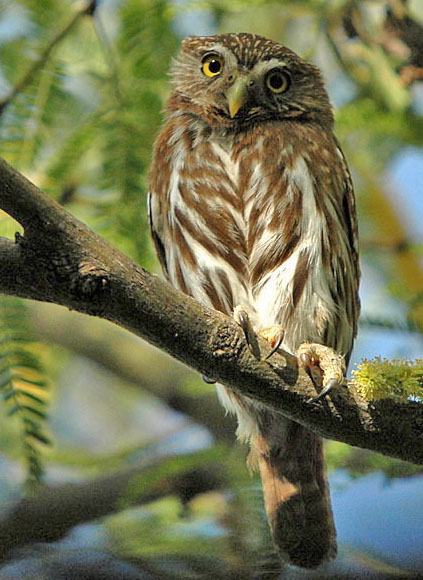
Amazonian Pygmy Owl

Amazonian Pygmy Owl

Glaucidium hardyi

Hector Bottai, CC BY-SA 4.0, via Wikimedia Commons

Ferruginous Pygmy Owl

Ferruginous Pygmy Owl

Glaucidium brasilianum

User: Sky Jacobs, CC BY-SA 3.0, via Wikimedia Commons

Side by side

Amazonian Pygmy OwlFerruginous Pygmy Owl
Scientific nameGlaucidium hardyi Vielliard, 1989Glaucidium brasilianum (J. F. Gmelin, 1788)
English nameAmazonian Pygmy OwlFerruginous Pygmy Owl
GroupBirdsBirds
ClassAves BirdAves Bird
OrderStrigiformes OwlStrigiformes Owl
FamilyStrigidae OwlsStrigidae Owls
GenusGlaucidium Pygmy OwlGlaucidium Pygmy Owl
Named in19891788
Red List categoryLeast ConcernLeast Concern
EnvironmentNot recordedterrestrial
Countries on record7 countries23 countries
GBIF occurrence records9,605 records224,450 records

Rows where the two agree are shown in grey.

Where each is found

Both recorded in 7 countries

Only Ferruginous Pygmy Owl (16)

From Catalogue of Life checklists and GBIF occurrence records. A country missing from a list means no record is held, which is not proof of absence.

Checked facts

Amazonian Pygmy OwlFerruginous Pygmy Owl
Appearance
  • Adult Amazonian pygmy owls have large, round heads marked with black spots that resemble eyes. English Wikipedia
  • The adult crown is gray-brown with very small white spots. English Wikipedia
  • The tail and flight feathers are dark brown with three irregular bars of large white spots. English Wikipedia
  • The underparts are white with broad brown or rufous-brown streaks. English Wikipedia
  • Adults have bright golden-yellow irises, greenish-yellow bills, and pale-yellow ceres. English Wikipedia
  • The species has a zygodactyl arrangement of its talons. English Wikipedia
  • Juveniles resemble adults but have unspotted crowns and less distinct underpart streaking. English Wikipedia
  • The species has a stocky body with disproportionately large feet and talons. English Wikipedia
  • Its crown has elongated white or buff streaks, while its wing coverts have white spots. English Wikipedia
  • Its underparts are heavily streaked with white. English Wikipedia
  • The species has prominent white supercilia above its facial disc. English Wikipedia
  • Two dark spots on the nape resemble false eyes. English Wikipedia
  • Its plumage varies from grey-brown with a black-and-white barred tail to rich rufous with a uniformly rufous tail. English Wikipedia
  • Females are slightly larger than males and are often more reddish. English Wikipedia
  • The species has a round head, black eyespots on the back, no ear tufts, and yellowish eyes. animaldiversity.org
  • Juveniles resemble adults but often have grayer heads and lighter eyespots. animaldiversity.org
Size
  • The species is described as a tiny owl of the Amazonian lowlands. ebird.org
Habitat
  • The species inhabits the canopy and subcanopy of tall, humid, tropical evergreen forests. English Wikipedia
  • The species occurs in forest edges and mature rainforest. ebird.org
  • The species has been observed from lowland elevations to above 1,100 meters. English Wikipedia
Diet
  • The species is presumed to prey on large arthropods and small vertebrates. English Wikipedia
  • Adults have been documented bringing a large cicada and a small unidentified bird to their young. English Wikipedia
  • Its diet includes invertebrates, reptiles, amphibians, birds, and mammals. English Wikipedia
  • Recorded insect prey includes grasshoppers, crickets, cicadas, and scorpions. English Wikipedia
  • Recorded reptilian prey includes six-lined racerunners, four-lined skinks, and Texas spotted whiptails. English Wikipedia
  • Recorded avian prey includes creamy-bellied thrushes, pale-breasted thrushes, and eared doves. English Wikipedia
  • The species feeds mostly on insects but also consumes birds, reptiles, amphibians, and small mammals. animaldiversity.org
  • When consuming birds and some lizards, the species bites behind the prey's head. animaldiversity.org
Behaviour
  • The species is diurnal. English Wikipedia
  • Individuals can perch quietly in one location for extended periods. English Wikipedia
  • Sightings are rare even during daylight hours. English Wikipedia
  • Observations suggest that the species is socially monogamous. English Wikipedia
  • The species is frequently subjected to mobbing by its prey as a defensive response. English Wikipedia
  • Adults attending a documented nest frequently sang a soft, descending, high-pitched trill. English Wikipedia
  • Adults attending a nest were observed panting with their beaks half open during the hottest hours. English Wikipedia
  • Adults attending a nest left to forage for periods shorter than 15 minutes. English Wikipedia
  • Its flight often follows an undulating pattern. English Wikipedia
  • Its rhythmic whistled call consists of repeated hoo notes and is typically pitched in E flat. English Wikipedia
  • Small songbirds gather around perched individuals and mob them. English Wikipedia
  • Up to 40 individual birds from 11 species have been recorded mobbing one individual. English Wikipedia
  • The species is primarily active during twilight but also hunts frequently during daylight. English Wikipedia
  • The species is most active around dawn and dusk. animaldiversity.org
  • Individuals move through trees by walking and hopping between branches. animaldiversity.org
  • Paired adults, fledglings, and nestlings engage in allopreening. animaldiversity.org
  • When confronted by predators, individuals may adopt a vertical posture and move their tails back and forth. animaldiversity.org
Reproduction
Distribution
  • The species occurs in the central and southwestern parts of the Amazonia region. English Wikipedia
  • Its presence has been confirmed in northern Bolivia. English Wikipedia
  • The species occurs in both the Amazonian region of Peru and areas north of the Amazon. English Wikipedia
  • Its range extends eastward to eastern Venezuela, Guyana, Suriname, and French Guiana. English Wikipedia
  • The species occurs from the southwestern United States through Mexico and Central America to South America. English Wikipedia
  • The species is recorded in Brazil, Bolivia, Paraguay, and Argentina. English Wikipedia
  • The species is described as the most widely distributed pygmy owl in Central and South America. English Wikipedia
  • The species is non-migratory. animaldiversity.org
Conservation
  • The species is classified as Least Concern by the IUCN. English Wikipedia
  • The IUCN lists the species' population trend as decreasing. English Wikipedia
  • The population size has not been quantified. English Wikipedia
  • Selective logging has caused canopy loss and forest fragmentation in the Amazon Basin. English Wikipedia
  • The species is considered likely to be affected by Amazonian canopy changes because it inhabits the canopy. English Wikipedia
No checked fact yet
Similar species
  • The Amazonian pygmy owl was formerly treated as conspecific with the least pygmy owl until 1989. English Wikipedia
  • Some phylogenetic analyses suggest that the species is closely related to the Andean pygmy owl and Yungas pygmy owl. English Wikipedia
  • The species resembles the northern pygmy-owl, but that species has spots rather than streaks, whiter tails, and different vocalizations. animaldiversity.org
OtherNo checked fact yet

In brief

Amazonian Pygmy Owl

The Amazonian Pygmy Owl is a tiny owl of the Amazonian lowlands. It inhabits the canopy and subcanopy of tall, humid, tropical evergreen forests, including forest edges and mature rainforest. Adults have large, round heads marked with black spots resembling eyes, bright golden-yellow irises, and white underparts with broad brown or rufous-brown streaks. Full profile

Ferruginous Pygmy Owl

Glaucidium brasilianum occurs from the southwestern United States through Mexico and Central America to South America. It is distinguished by its stocky body, prominent white supercilia, heavily streaked underparts, and dark nape spots resembling false eyes. Full profile

Compare something else

Page built on 30 November 2026 from the data on the two species pages, where every source is listed.

Cite this page

ScientificNames.org. (2026). Amazonian Pygmy Owl vs Ferruginous Pygmy Owl. Retrieved November 30, 2026, from https://scientificnames.org/compare/amazonian-pygmy-owl-vs-ferruginous-pygmy-owl