Comparison

Pernambuco Pygmy Owl vs Ferruginous Pygmy Owl

Pernambuco Pygmy Owl (Glaucidium mooreorum) and Ferruginous Pygmy Owl (Glaucidium brasilianum) both belong to the genus Glaucidium (pygmy owl) and part ways below it.

Pernambuco Pygmy Owl

Glaucidium mooreorum
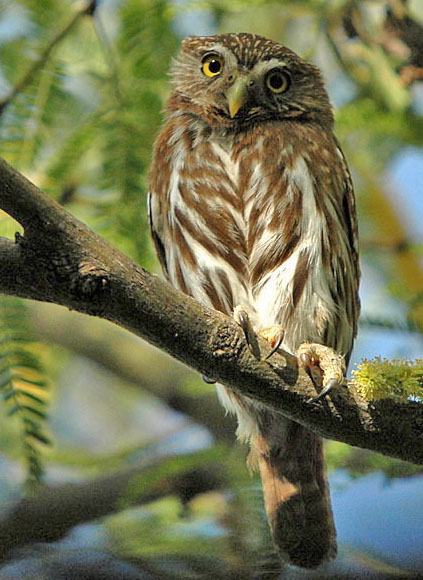
Ferruginous Pygmy Owl

Ferruginous Pygmy Owl

Glaucidium brasilianum

User: Sky Jacobs, CC BY-SA 3.0, via Wikimedia Commons

Side by side

Pernambuco Pygmy OwlFerruginous Pygmy Owl
Scientific nameGlaucidium mooreorum Cardoso da Silva, Coelho & Gonzaga, 2003Glaucidium brasilianum (J. F. Gmelin, 1788)
English namePernambuco Pygmy OwlFerruginous Pygmy Owl
GroupBirdsBirds
ClassAves BirdAves Bird
OrderStrigiformes OwlStrigiformes Owl
FamilyStrigidae OwlsStrigidae Owls
GenusGlaucidium Pygmy OwlGlaucidium Pygmy Owl
Named in20031788
Red List categoryCritically EndangeredLeast Concern
EnvironmentNot recordedterrestrial
Countries on recordNot recorded23 countries
GBIF occurrence recordsNot recorded224,450 records

Rows where the two agree are shown in grey.

Where each is found

Only Ferruginous Pygmy Owl (23)

From Catalogue of Life checklists and GBIF occurrence records. A country missing from a list means no record is held, which is not proof of absence.

Checked facts

Pernambuco Pygmy OwlFerruginous Pygmy Owl
Appearance
  • The adult has a facial pattern consisting of whitish and brownish streaks. English Wikipedia
  • The adult's head is raw umber with small white dots. English Wikipedia
  • The adult has chestnut upperparts. English Wikipedia
  • The adult's tail is blackish brown with white spots arranged in broken bars. English Wikipedia
  • The adult has white underparts, brown sides of the chest, and brown-streaked flanks. English Wikipedia
  • The juvenile plumage of the species is unknown. English Wikipedia
  • The species has a light grey-chestnut crown and head marked with conspicuous white spots extending to the lower nape. English Wikipedia
  • The species has a white collar and white underparts streaked with rufous. English Wikipedia
  • The species has a stocky body with disproportionately large feet and talons. English Wikipedia
  • Its crown has elongated white or buff streaks, while its wing coverts have white spots. English Wikipedia
  • Its underparts are heavily streaked with white. English Wikipedia
  • The species has prominent white supercilia above its facial disc. English Wikipedia
  • Two dark spots on the nape resemble false eyes. English Wikipedia
  • Its plumage varies from grey-brown with a black-and-white barred tail to rich rufous with a uniformly rufous tail. English Wikipedia
  • Females are slightly larger than males and are often more reddish. English Wikipedia
  • The species has a round head, black eyespots on the back, no ear tufts, and yellowish eyes. animaldiversity.org
  • Juveniles resemble adults but often have grayer heads and lighter eyespots. animaldiversity.org
Size
Habitat
Diet
  • At least one individual has been observed eating a large cicada. English Wikipedia
  • The species' presumed diet includes other invertebrates, small mammals, and small reptiles. English Wikipedia
  • Its diet includes invertebrates, reptiles, amphibians, birds, and mammals. English Wikipedia
  • Recorded insect prey includes grasshoppers, crickets, cicadas, and scorpions. English Wikipedia
  • Recorded reptilian prey includes six-lined racerunners, four-lined skinks, and Texas spotted whiptails. English Wikipedia
  • Recorded avian prey includes creamy-bellied thrushes, pale-breasted thrushes, and eared doves. English Wikipedia
  • The species feeds mostly on insects but also consumes birds, reptiles, amphibians, and small mammals. animaldiversity.org
  • When consuming birds and some lizards, the species bites behind the prey's head. animaldiversity.org
Behaviour
  • Its flight often follows an undulating pattern. English Wikipedia
  • Its rhythmic whistled call consists of repeated hoo notes and is typically pitched in E flat. English Wikipedia
  • Small songbirds gather around perched individuals and mob them. English Wikipedia
  • Up to 40 individual birds from 11 species have been recorded mobbing one individual. English Wikipedia
  • The species is primarily active during twilight but also hunts frequently during daylight. English Wikipedia
  • The species is most active around dawn and dusk. animaldiversity.org
  • Individuals move through trees by walking and hopping between branches. animaldiversity.org
  • Paired adults, fledglings, and nestlings engage in allopreening. animaldiversity.org
  • When confronted by predators, individuals may adopt a vertical posture and move their tails back and forth. animaldiversity.org
Reproduction
  • The species was vocally active during April and May, corresponding to the rainy season. English Wikipedia
  • The breeding phenology of the species remains undocumented. English Wikipedia
Distribution
  • The species was described from the Reserva Biológica de Saltinho in Pernambuco, Brazil. datazone.birdlife.org
  • The species occurs from the southwestern United States through Mexico and Central America to South America. English Wikipedia
  • The species is recorded in Brazil, Bolivia, Paraguay, and Argentina. English Wikipedia
  • The species is described as the most widely distributed pygmy owl in Central and South America. English Wikipedia
  • The species is non-migratory. animaldiversity.org
Conservation
  • The IUCN classifies the Pernambuco pygmy owl as Critically Endangered and Possibly Extinct. English Wikipedia
  • The species has not been recorded since 2001 despite extensive targeted searches. English Wikipedia
  • If the species survives, its population is believed to be very small and declining within an extremely restricted range. English Wikipedia
  • The remaining adult population is estimated to number fewer than 50 individuals. English Wikipedia
  • A 2018 study recommended classifying the species as Critically Endangered and Possibly Extinct because of bird extinction patterns and extensive habitat destruction. English Wikipedia
No checked fact yet
Similar speciesNo checked fact yet
  • The species resembles the northern pygmy-owl, but that species has spots rather than streaks, whiter tails, and different vocalizations. animaldiversity.org

In brief

Pernambuco Pygmy Owl

Glaucidium mooreorum has a raw umber head with small white dots, chestnut upperparts, and a blackish brown tail with white spots arranged in broken bars. Full profile

Ferruginous Pygmy Owl

Glaucidium brasilianum occurs from the southwestern United States through Mexico and Central America to South America. It is distinguished by its stocky body, prominent white supercilia, heavily streaked underparts, and dark nape spots resembling false eyes. Full profile

Compare something else

Page built on 28 November 2026 from the data on the two species pages, where every source is listed.

Cite this page

ScientificNames.org. (2026). Pernambuco Pygmy Owl vs Ferruginous Pygmy Owl. Retrieved November 28, 2026, from https://scientificnames.org/compare/pernambuco-pygmy-owl-vs-ferruginous-pygmy-owl