Comparison

Long-finned Pilot Whale vs False Killer Whale

Long-finned Pilot Whale (Globicephala melas) and False Killer Whale (Pseudorca crassidens) both belong to the family Delphinidae (oceanic dolphin) and part ways below it. Both are recorded in 14 countries.

Long-finned Pilot Whale

Globicephala melas
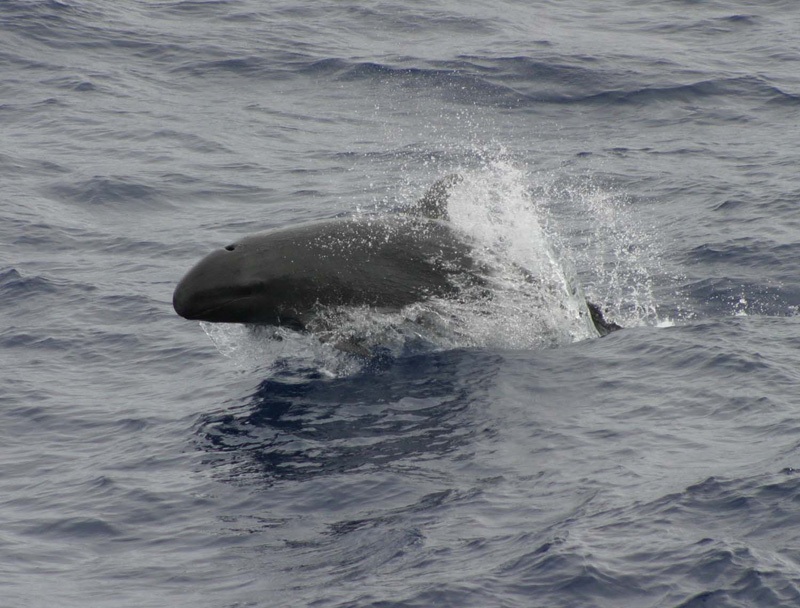
False Killer Whale

False Killer Whale

Pseudorca crassidens

Unknown author, Public domain, via Wikimedia Commons

Side by side

Long-finned Pilot WhaleFalse Killer Whale
Scientific nameGlobicephala melas (Traill, 1809)Pseudorca crassidens (Owen, 1846)
English nameLong-finned Pilot WhaleFalse Killer Whale
GroupMammalsMammals
ClassMammalia MammalMammalia Mammal
OrderCetacea CetaceanCetacea Cetacean
FamilyDelphinidae Oceanic DolphinDelphinidae Oceanic Dolphin
GenusGlobicephala Pilot WhalesPseudorca False Killer Whales
Named in18091846
Red List categoryNot recordedNear Threatened
Environmentmarinemarine
Countries on record27 countries32 countries
GBIF occurrence records26,281 records9,197 records

Rows where the two agree are shown in grey.

Where each is found

Both recorded in 14 countries

Only Long-finned Pilot Whale (13)

Only False Killer Whale (18)

From Catalogue of Life checklists and GBIF occurrence records. A country missing from a list means no record is held, which is not proof of absence.

Checked facts

Long-finned Pilot WhaleFalse Killer Whale
Appearance
  • The long-finned pilot whale is generally dark grey, brown, or black, with lighter markings on parts of its body. English Wikipedia
  • The species has a robust body and a distinctive large, bulbous melon. English Wikipedia
  • Its dorsal fin is positioned forward on its back and curves backward. English Wikipedia
  • Its flippers are long and sickle-shaped, and its tail stocks are flattened from side to side. English Wikipedia
  • Adult males develop more circular melons than females. English Wikipedia
  • The false killer whale has a slender, dark gray or black body with a slightly lighter underside. English Wikipedia
  • The species has an elongated, tapered head without a distinct beak. English Wikipedia
  • Its dorsal fin is sickle-shaped. English Wikipedia
  • Its flippers are narrow, short and pointed, with a distinctive bulge along their leading edges. English Wikipedia
  • Its teeth are conical, with 14–21 teeth in the upper jaw and 16–24 in the lower jaw. English Wikipedia
  • The melon organ in its forehead is larger in males than in females. English Wikipedia
SizeNo checked fact yet
Habitat
  • The species inhabits colder waters than the short-finned pilot whale. English Wikipedia
  • The species inhabits tropical and subtropical marine waters. English Wikipedia
  • It generally inhabits open-ocean and deep-water environments but sometimes occurs near oceanic islands. English Wikipedia
  • The species prefers deep water in the open ocean away from land. australian.museum
Diet
  • The species feeds primarily on squid. English Wikipedia
  • Its diet includes demersal fish such as cod and turbot. English Wikipedia
  • Fish consumed in the northwest Atlantic include Atlantic cod, Greenland turbot, Atlantic mackerel, Atlantic herring, hake, and spiny dogfish. English Wikipedia
  • Long-finned pilot whales in the Faroe Islands eat squid and fish including greater argentine and blue whiting. English Wikipedia
Behaviour
  • The species is highly social and may remain with its birth pod throughout its lifetime. English Wikipedia
  • Long-finned pilot whales generally live in groups of 10–30 individuals, although some groups contain 100 or more. English Wikipedia
  • Their pods have stable membership and close matrilineal relationships. English Wikipedia
  • Adult females generally outnumber adult males within pods. English Wikipedia
  • Members of different pods temporarily aggregate, potentially allowing social interaction, mating, and mutual protection. English Wikipedia
  • Individuals generally remain in their mother's pod throughout their lives. English Wikipedia
  • The species makes seasonal movements between inshore and offshore waters in response to prey distribution. English Wikipedia
  • Long-finned pilot whales can dive to depths of 600 metres, although most dives reach only 30–60 metres. English Wikipedia
  • Their feeding dives can last longer than ten minutes. English Wikipedia
  • A GPS-equipped long-finned pilot whale recorded in 2024 reached a diving depth exceeding 1,100 metres. English Wikipedia
  • The species produces echolocation clicks for foraging and whistles and burst pulses for social communication. English Wikipedia
  • Long-finned pilot whales have relatively low-frequency calls with narrow frequency ranges compared with short-finned pilot whales. English Wikipedia
  • Long-finned pilot whales off southern Australia have been observed mimicking orca calls while scavenging for food. English Wikipedia
  • The species is highly social and commonly travels in groups of 10–20 individuals. English Wikipedia
  • Large groups can contain more than 500 individuals. English Wikipedia
  • Feeding groups may divide into smaller family groups containing four to six individuals. English Wikipedia
  • Individuals have been recorded remaining with the same pod for as long as 15 years. English Wikipedia
  • It can interact sexually with bottlenose dolphins and pilot whales. English Wikipedia
  • The species uses echolocation to navigate and locate prey. English Wikipedia
  • The species is an efficient pack hunter. australian.museum
Reproduction
  • Long-finned pilot whales give birth approximately once every three to five years. English Wikipedia
  • Most mating and calving among long-finned pilot whales occurs during summer. English Wikipedia
  • Gestation in long-finned pilot whales lasts approximately 12–16 months. English Wikipedia
  • Long-finned pilot whale calves nurse for approximately 36–42 months. English Wikipedia
  • Females reach sexual maturity at approximately eight years of age. English Wikipedia
  • Males reach sexual maturity at approximately 12 years of age. English Wikipedia
Distribution
  • The species has a Southern Ocean population distributed in a circumpolar band between approximately 20°S and 65°S. English Wikipedia
  • Its Southern Ocean population occurs off Chile, Argentina, South Africa, Australia, and New Zealand. English Wikipedia
  • The species has a second, larger population in the North Atlantic Ocean. English Wikipedia
  • The North Atlantic population extends southward to South Carolina, the Azores, and Morocco. English Wikipedia
  • The North Atlantic population extends northward from Newfoundland to Greenland, Iceland, and northern Norway. English Wikipedia
  • The species is also found in the western half of the Mediterranean Sea. English Wikipedia
No checked fact yet
ConservationNo checked fact yet
  • The IUCN classifies the species as Near Threatened. English Wikipedia
  • The Hawaiian population was recognized as endangered by the United States National Oceanic and Atmospheric Administration in November 2012. English Wikipedia
  • Incidental deaths associated with fishing operations are a threat to the species. australian.museum
  • Some populations, particularly those off Japan and parts of Asia, are deliberately hunted. australian.museum
  • The species is captured for the oceanarium trade. australian.museum
  • Fishing-gear entanglement can cause drowning, restricted circulation and impaired hunting ability. English Wikipedia
  • The species is covered by the Agreement on the Conservation of Small Cetaceans of the Baltic, North East Atlantic, Irish and North Seas. English Wikipedia
Uses
  • Long-finned pilot whales are hunted for their meat, particularly in the Faroe Islands. animaldiversity.org
  • False killer whales have been kept in public aquariums in Japan, the United States, the Netherlands, Hong Kong and Australia. English Wikipedia
Similar speciesNo checked fact yet
  • The false killer whale's closest living relatives include Risso's dolphin, the melon-headed whale, the pygmy killer whale and pilot whales. English Wikipedia
  • The species can hybridize with the common bottlenose dolphin to produce fertile offspring known as wholphins. English Wikipedia
Name originNo checked fact yet
  • The common name refers to the resemblance between the species' skull and that of the killer whale. English Wikipedia
OtherNo checked fact yet

In brief

Long-finned Pilot Whale

Globicephala melas inhabits colder waters and has populations in the Southern Ocean, North Atlantic Ocean, and western half of the Mediterranean Sea. It has a robust body, a large bulbous melon, and long sickle-shaped flippers. Full profile

False Killer Whale

Pseudorca crassidens inhabits tropical and subtropical marine waters, primarily in open-ocean and deep-water environments. It has a slender, dark gray or black body, an elongated tapered head without a distinct beak and a sickle-shaped dorsal fin. Full profile

Compare something else

Page built on 28 November 2026 from the data on the two species pages, where every source is listed.

Cite this page

ScientificNames.org. (2026). Long-finned Pilot Whale vs False Killer Whale. Retrieved November 28, 2026, from https://scientificnames.org/compare/long-finned-pilot-whale-vs-false-killer-whale