Comparison

Glossy Snake vs Boomslang

Glossy Snake (Arizona elegans) and Boomslang (Dispholidus typus) both belong to the subfamily Colubrinae and part ways below it.
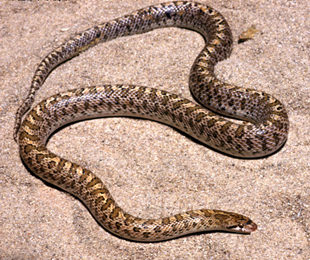
Glossy Snake

Glossy Snake

Arizona elegans

Unknown author, Public domain, via Wikimedia Commons

Boomslang

Boomslang

Dispholidus typus

William Warby from London, England, CC BY 2.0, via Wikimedia Commons

Side by side

Glossy SnakeBoomslang
Scientific nameArizona elegans Kennicott, 1859Dispholidus typus (Smith, 1828)
English nameGlossy SnakeBoomslang
GroupReptilesReptiles
ClassReptilia ReptileReptilia Reptile
OrderSquamata SnakesSquamata Snakes
FamilyColubridae ColubridColubridae Colubrid
GenusArizona Glossy SnakesDispholidus Boomslangs
Named in18591828
Red List categoryLeast ConcernLeast Concern
Countries on record2 countries37 countries
GBIF occurrence records7,179 records5,243 records

Rows where the two agree are shown in grey.

Where each is found

Only Glossy Snake (2)

Only Boomslang (37)

From Catalogue of Life checklists and GBIF occurrence records. A country missing from a list means no record is held, which is not proof of absence.

Checked facts

Glossy SnakeBoomslang
Appearance
  • Arizona elegans has smooth, glossy scales with spotted patterns in shades of tan, brown, and gray. English Wikipedia
  • The species has a narrow, pointed head and a pale appearance. English Wikipedia
  • The underside is white or cream-colored and lacks markings. English Wikipedia
  • Juveniles have darker markings than adults, which become lighter as they grow. animaldiversity.org
  • The species has a countersunk lower jaw that helps prevent sand from entering its mouth while burrowing. animaldiversity.org
  • Distinguishing features include a prominent eye stripe, lidless eyes with slightly vertical pupils, and a single anal scale. animaldiversity.org
  • Adult males exhibit colours ranging from bright green to rust-red, sometimes combining black and yellow. sanbi.org
  • Adult females generally have dull olive-brown or grey coloration. sanbi.org
  • Juveniles have emerald-green eyes, white throats and cryptically coloured bodies resembling twigs. sanbi.org
Size
Habitat
  • The species inhabits semi-arid grasslands in the southwestern United States. English Wikipedia
  • The species occupies barren sandy deserts, scrub, and rocky washes in addition to semi-arid grasslands. animaldiversity.org
  • The species prefers open areas with sandy or loamy soil. animaldiversity.org
  • The species occurs from below sea level to approximately 2,220 meters in elevation. animaldiversity.org
  • The species uses crevices and rodent burrows as daytime retreats. animaldiversity.org
  • The boomslang inhabits Karoo shrubland, arid savannas, moist savannas, lowland forests, grasslands and fynbos. sanbi.org
  • The species mainly occupies trees and shrubs but also descends to the ground to bask or search for food. sanbi.org
  • Boomslangs sometimes shelter underground during harsh weather. English Wikipedia
Diet
  • The boomslang feeds on birds, nestlings, frogs, lizards and occasionally small mammals. sanbi.org
  • Its diet includes chameleons and other arboreal lizards. English Wikipedia
  • The boomslang sometimes consumes eggs from nesting birds and reptiles. English Wikipedia
  • The species sometimes eats other snakes, including members of its own species. English Wikipedia
Behaviour
  • The boomslang is primarily arboreal and active during daylight hours. English Wikipedia
  • Boomslangs are solitary and may prey upon members of their own species. animaldiversity.org
  • When threatened, the boomslang can inflate its neck and adopt an S-shaped striking posture. English Wikipedia
  • Boomslangs use side-to-side head movements while remaining motionless to imitate vegetation moving in the wind. sanbi.org
Reproduction
  • Egg incubation takes approximately three months on average. English Wikipedia
  • The mating season has been observed during December and January. animaldiversity.org
  • Females generally lay their eggs four to eight weeks after mating. animaldiversity.org
  • Newly hatched boomslangs measure approximately 29–38 cm in length. English Wikipedia
  • Female boomslangs generally leave their eggs after laying and do not return to inspect their offspring. animaldiversity.org
Distribution
  • The species is native to the southwestern United States and northern Mexico. English Wikipedia
No checked fact yet
Conservation
  • The boomslang is classified as Least Concern in South Africa. sanbi.org
Uses
  • The species provides an ecological benefit by controlling populations of small rodents, reptiles, and mammals. animaldiversity.org
  • The species contributes to soil aeration through its burrowing activity. animaldiversity.org
  • The boomslang acts as a biological controller of bird, frog, lizard and small mammal populations. sanbi.org
Similar speciesNo checked fact yet
  • The boomslang is sometimes confused with black and green mambas, rufous-beaked snakes and harmless green snakes of the genus Philothamnus. sanbi.org
Other
  • The boomslang possesses haemotoxic venom that disrupts blood clotting and can cause internal and external bleeding. sanbi.org
  • Boomslang venom is slow-acting, and serious symptoms may take 24–48 hours to develop. sanbi.org

In brief

Glossy Snake

Arizona elegans is native to the southwestern United States and northern Mexico. It has smooth, glossy scales with spotted patterns in shades of tan, brown, and gray, a narrow pointed head, and a pale appearance. Full profile

Boomslang

The Boomslang possesses haemotoxic venom that disrupts blood clotting and can cause internal and external bleeding. Full profile

Compare something else

Page built on 28 November 2026 from the data on the two species pages, where every source is listed.

Cite this page

ScientificNames.org. (2026). Glossy Snake vs Boomslang. Retrieved November 28, 2026, from https://scientificnames.org/compare/glossy-snake-vs-boomslang