Comparison
African-marbled Skipper vs Silver-spotted Skipper
African-marbled Skipper (Gomalia elma) and Silver-spotted Skipper (Epargyreus clarus) both belong to the subfamily Pyrginae and part ways below it.

African-marbled Skipper
Gomalia elma
Image taken by Praveen J (paintedstork(at)gmail(dot)com., CC BY-SA 2.5 in, via Wikimedia Commons

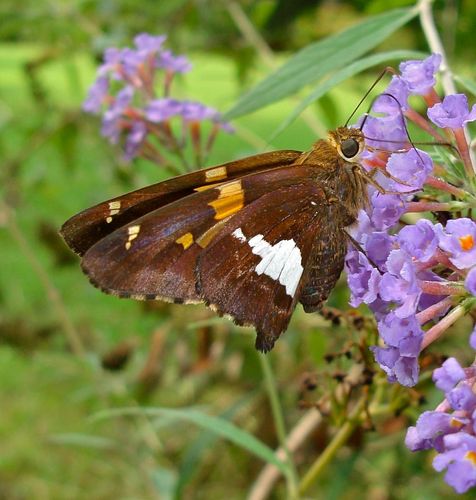
Silver-spotted Skipper
Epargyreus clarus
no rights reserved, uploaded by Elin Pierce, CC0, via iNaturalist
Side by side
| African-marbled Skipper | Silver-spotted Skipper | |
|---|---|---|
| Scientific name | Gomalia elma (Trimen, 1862) | Epargyreus clarus (Cramer, 1775) |
| English name | African-marbled Skipper | Silver-spotted Skipper |
| Group | Insects | Insects |
| Class | Insecta Insect | Insecta Insect |
| Order | Lepidoptera | Lepidoptera |
| Family | Hesperiidae Skipper | Hesperiidae Skipper |
| Genus | Gomalia Marbled Skippers | Epargyreus Silverdrops |
| Named in | 1862 | 1775 |
| Red List category | Least Concern | Not recorded |
| Countries on record | 20 countries | 3 countries |
| GBIF occurrence records | 1,289 records | 100,908 records |
Rows where the two agree are shown in grey.
Where each is found
Only African-marbled Skipper (20)
- Botswana
- Democratic Republic of the Congo
- Eswatini
- Ghana
- India
- Israel
- Kenya
- Malawi
- Mozambique
- Namibia
- Nigeria
- Oman
- Pakistan
- South Africa
- Sri Lanka
- Tanzania
- Uganda
- United Arab Emirates
- Zambia
- Zimbabwe
Only Silver-spotted Skipper (3)
From Catalogue of Life checklists and GBIF occurrence records. A country missing from a list means no record is held, which is not proof of absence.
Checked facts
| African-marbled Skipper | Silver-spotted Skipper | |
|---|---|---|
| Appearance |
|
|
| Size |
|
|
| Habitat | No checked fact yet |
|
| Diet | No checked fact yet |
|
| Behaviour | No checked fact yet |
|
| Reproduction | No checked fact yet |
|
| Distribution |
|
|
| Uses | No checked fact yet |
|
| Similar species | No checked fact yet |
|
In brief
African-marbled Skipper
The species occurs in Africa and parts of Asia, including the Cape region and Free State in South Africa, the United Arab Emirates and Baluchistan, Pakistan. The male is distinguished by three joined white spots near the forewing apex and a white central band on the hindwing. Full profile
Silver-spotted Skipper
Epargyreus clarus inhabits fields, gardens, forest edges, swamps, brushy areas, and riparian habitats at lower elevations. Full profile
Compare something else
Page built on 27 November 2026 from the data on the two species pages, where every source is listed.
Cite this page
ScientificNames.org. (2026). African-marbled Skipper vs Silver-spotted Skipper. Retrieved November 27, 2026, from https://scientificnames.org/compare/african-marbled-skipper-vs-silver-spotted-skipper
“African-marbled Skipper vs Silver-spotted Skipper.” ScientificNames.org, 2026, scientificnames.org/compare/african-marbled-skipper-vs-silver-spotted-skipper. Accessed 27 Nov. 2026.
ScientificNames.org. “African-marbled Skipper vs Silver-spotted Skipper.” Accessed November 27, 2026. https://scientificnames.org/compare/african-marbled-skipper-vs-silver-spotted-skipper.
@misc{scientificnames_african_marbled_skipper_vs_silver_spotted_skipper,
  author = {{ScientificNames.org}},
  title = {African-marbled Skipper vs Silver-spotted Skipper},
  year = {2026},
  url = {https://scientificnames.org/compare/african-marbled-skipper-vs-silver-spotted-skipper},
  note = {Accessed 2026-11-27}
}