Comparison
Cagle's Map Turtle vs Barbour's Map Turtle
Cagle's Map Turtle (Graptemys caglei) and Barbour's Map Turtle (Graptemys barbouri) both belong to the genus Graptemys (map turtles) and part ways below it. Both are recorded in 1 country.
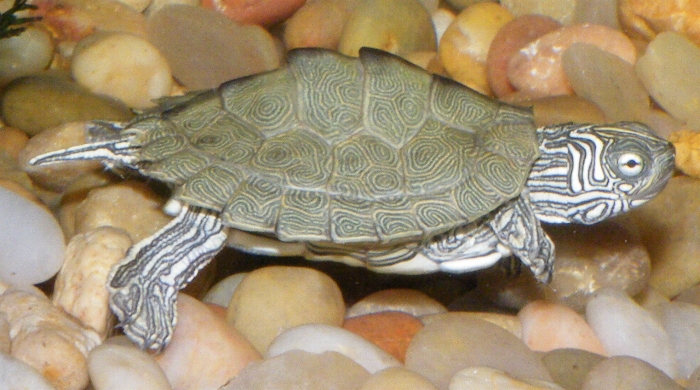


Side by side
| Cagle's Map Turtle | Barbour's Map Turtle | |
|---|---|---|
| Scientific name | Graptemys caglei Haynes & Mckown, 1974 | Graptemys barbouri Carr & Marchand, 1942 |
| English name | Cagle's Map Turtle | Barbour's Map Turtle |
| Group | Reptiles | Reptiles |
| Class | Reptilia Reptile | Reptilia Reptile |
| Order | Testudines Turtle | Testudines Turtle |
| Family | Emydidae Terrapins | Emydidae Terrapins |
| Genus | Graptemys Map Turtles | Graptemys Map Turtles |
| Named in | 1974 | 1942 |
| Red List category | Endangered | Near Threatened |
| Countries on record | 1 country | 1 country |
| GBIF occurrence records | 626 records | 572 records |
Rows where the two agree are shown in grey.
Where each is found
Both recorded in 1 country
From Catalogue of Life checklists and GBIF occurrence records. A country missing from a list means no record is held, which is not proof of absence.
Checked facts
| Cagle's Map Turtle | Barbour's Map Turtle | |
|---|---|---|
| Appearance |
|
|
| Size |
|
|
| Habitat |
|
|
| Diet |
|
|
| Behaviour |
|
|
| Reproduction |
|
|
| Lifespan | No checked fact yet |
|
| Distribution |
|
|
| Conservation |
|
|
| Uses | No checked fact yet |
|
In brief
Cagle's Map Turtle
Graptemys caglei is endemic to Texas, where it occurs in the Guadalupe, San Antonio, and San Marcos Rivers. It has a somewhat flattened, patterned shell with a serrated posterior edge and a prominent V-shaped marking on the head extending toward the eyes. Full profile
Barbour's Map Turtle
Graptemys barbouri occurs in southeastern Alabama, southwestern Georgia, and the western panhandle of Florida, inhabiting the Apalachicola and Chipola Rivers and their tributaries. It is distinguished by a highly domed green to olive green carapace with a prominent vertebral keel and laterally compressed dark spines. Full profile
Compare something else
Page built on 27 November 2026 from the data on the two species pages, where every source is listed.
Cite this page
ScientificNames.org. (2026). Cagle's Map Turtle vs Barbour's Map Turtle. Retrieved November 27, 2026, from https://scientificnames.org/compare/cagles-map-turtle-vs-barbours-map-turtle
“Cagle's Map Turtle vs Barbour's Map Turtle.” ScientificNames.org, 2026, scientificnames.org/compare/cagles-map-turtle-vs-barbours-map-turtle. Accessed 27 Nov. 2026.
ScientificNames.org. “Cagle's Map Turtle vs Barbour's Map Turtle.” Accessed November 27, 2026. https://scientificnames.org/compare/cagles-map-turtle-vs-barbours-map-turtle.
@misc{scientificnames_cagles_map_turtle_vs_barbours_map_turtle,
  author = {{ScientificNames.org}},
  title = {Cagle's Map Turtle vs Barbour's Map Turtle},
  year = {2026},
  url = {https://scientificnames.org/compare/cagles-map-turtle-vs-barbours-map-turtle},
  note = {Accessed 2026-11-27}
}