| Appearance | - The Gray-cheeked Thrush has a grayish face, a partial pale eye ring, gray-brown upperparts, and extensively dusky flanks. English Wikipedia
- The species has a white-dark-white underwing pattern. English Wikipedia
- The Newfoundland subspecies has browner coloration and a buff-colored wash on its breast compared with the northern subspecies. English Wikipedia
- The Newfoundland subspecies has a brighter yellow area at the base of the lower bill. English Wikipedia
- The northern subspecies has grayish olive upperparts and flanks, a lightly washed cream breast, and a duller lower bill. English Wikipedia
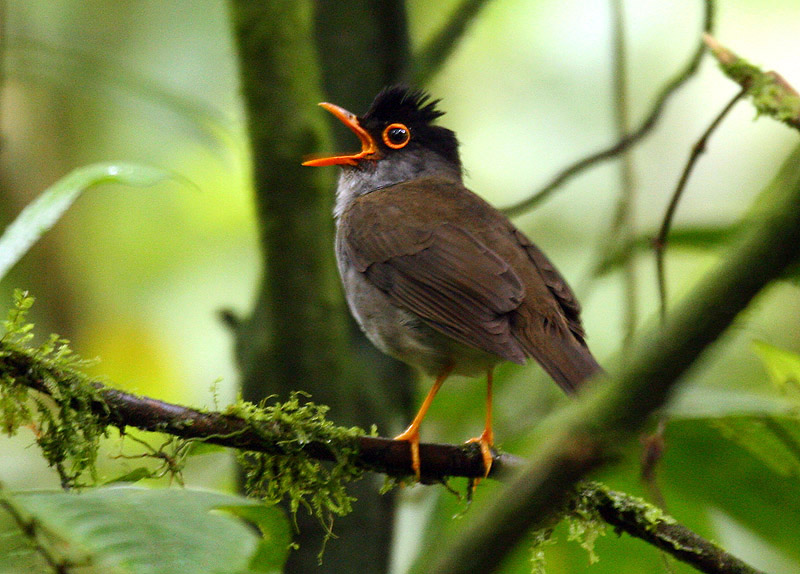
| - Adult males of the nominate subspecies have a black crown, dark gray face, bright orange eye-ring, and olive-brown upperparts. English Wikipedia
- Adult males have a white throat with faint dark streaks, pale grayish brown breast and flanks, and a white belly and vent. English Wikipedia
- Adult females have a browner head and breast than adult males. English Wikipedia
- All subspecies have bright orange bills, legs, and feet. English Wikipedia
- The species has a plain breast. ebird.org
- The C. m. cantator subspecies has a grayer face and throat and an olive wash on its breast compared with the nominate subspecies. English Wikipedia
- The C. m. yaegeri subspecies has a pronounced reddish wash on its back. English Wikipedia
- The C. m. carrikeri subspecies has dark reddish upperparts and the darkest gray underparts among the subspecies. English Wikipedia
|
|---|
| Size | | |
|---|
| Habitat | - The species breeds in dense coniferous and broadleaf shrub thickets. English Wikipedia
- The species occupies low Arctic willow and alder beds beyond the northern treeline. English Wikipedia
- Preferred breeding habitats include young regenerating forests and open-canopy old-growth forests with dense understory shrubs and small conifers. English Wikipedia
- The species also inhabits dense, stunted spruce and fir forests on windblown sites and near the treeline. English Wikipedia
- The species can occur in wooded habitats outside its preferred breeding habitats. English Wikipedia
| - The species primarily inhabits lowland and montane evergreen forests in tropical and subtropical zones. English Wikipedia
- The species also occurs in pine-oak forests in Guatemala and Honduras. English Wikipedia
- The species inhabits evergreen forests in foothills and highlands. ebird.org
- One reported elevational range for the species is 600–1,800 m. English Wikipedia
- In Guatemala and Honduras, the reported elevational range is 750–1,800 m. English Wikipedia
- In Costa Rica, the species occurs at elevations of 300–1,000 m on the Caribbean slope. English Wikipedia
- In Costa Rica, the species occurs at elevations of 700–1,300 m on the Pacific slope. English Wikipedia
|
|---|
| Diet | - The Gray-cheeked Thrush primarily consumes insects, including beetles, weevils, ants, wasps, and caterpillars. English Wikipedia
- Its diet also includes arachnids, fruits, and berries. English Wikipedia
- Recorded berry foods include wild cherries, blackberries, and raspberries. English Wikipedia
- The species also eats crayfish, sow bugs, and earthworms. English Wikipedia
| |
|---|
| Behaviour | - The species undertakes long-distance migrations averaging approximately 3,000 km. English Wikipedia
- The species is more often detected through its nocturnal flight call during migration than observed on the ground. English Wikipedia
- Its song consists of complex, burry, flute-like notes that usually descend in pitch toward the end. English Wikipedia
- Its flight call is a high-pitched, penetrating, nasal sound. English Wikipedia
- The species exhibits secretive behaviour during the breeding season. English Wikipedia
- Breeding pairs generally maintain well-spaced territories and rarely occur at high densities. English Wikipedia
| - The species forages in the forest understory and on the ground by turning over leaf litter. English Wikipedia
- The species is usually elusive and is heard more frequently than it is seen. ebird.org
- The species is mostly resident throughout the year. English Wikipedia
- Individuals in the northernmost part of the range show evidence of moving south during winter. English Wikipedia
- Elevational movements have been recorded in Veracruz. English Wikipedia
- The species sings mainly at dawn, dusk, and during the afternoon. English Wikipedia
- The species produces a rapid, thin, flute-like song with slightly tinny and fuzzy phrases. English Wikipedia
- The species gives harsh, complaining, upward-slurred calls. English Wikipedia
- The species produces a dry rattle or trill when agitated. English Wikipedia
- The species behaves aggressively toward ruddy-capped nightingale-thrushes. English Wikipedia
|
|---|
| Reproduction | | - The breeding season includes April and May in Mexico. English Wikipedia
- The breeding season extends from March through July in Costa Rica. English Wikipedia
- The species constructs a large cup-shaped nest from mosses, bark strips, and rootlets, lined with finer plant material. English Wikipedia
- The nest is typically placed in an understory plant fork approximately 1–3 m above the ground. English Wikipedia
- The species often places its nest near a stream. English Wikipedia
- The clutch contains two or three eggs. English Wikipedia
- The eggs range from pinkish white to bluish white and have reddish-brown speckles. English Wikipedia
|
|---|
| Distribution | - The northern subspecies breeds from Labrador westward to Siberia. English Wikipedia
- The Newfoundland subspecies breeds on Newfoundland and possibly in adjacent parts of southern coastal Labrador. English Wikipedia
- The species is believed to spend the winter in the Amazon Basin. English Wikipedia
- The species crosses the Caribbean Sea and Gulf of Mexico during its spring migration. English Wikipedia
| - The species occurs in Costa Rica, Guatemala, Honduras, Mexico, Nicaragua, and Panama. English Wikipedia
- The species has been recorded as a vagrant in Texas. English Wikipedia
- An individual of the nominate subspecies spent much of 2004 in Hidalgo County, Texas. English Wikipedia
|
|---|
| Conservation | No checked fact yet | - The species is classified as Least Concern by the IUCN. English Wikipedia
- The species has a large geographic range, although its population size is unknown and believed to be decreasing. English Wikipedia
- No immediate threats have been identified for the species. English Wikipedia
- The species is considered common in Oaxaca and locally fairly common in Panama. English Wikipedia
- The species is rare and local in Guatemala but common in Honduras. English Wikipedia
- The species is common on Costa Rica's Caribbean slope and uncommon on its Pacific slope. English Wikipedia
|
|---|
| Uses | - The species benefits humans by consuming insects that cause annoyance or harm. animaldiversity.org
| No checked fact yet |
|---|
| Similar species | - The Gray-cheeked Thrush forms a cryptic species pair with Bicknell's Thrush. English Wikipedia
- The Gray-cheeked Thrush is nearly indistinguishable from Bicknell's Thrush except for its slightly larger size and different song. English Wikipedia
- The Gray-cheeked Thrush and Bicknell's Thrush were formerly treated as one species. English Wikipedia
| No checked fact yet |
|---|