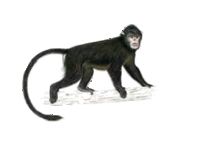
| Appearance | - Adult gray snub-nosed monkeys have long, fine fur that generally transitions from brown on the upper body to gray on the lower body. English Wikipedia
- Adults have a white patch between their shoulder blades. English Wikipedia
- The head, neck, and extremities are black, apart from a golden brow. English Wikipedia
- The species has a golden chest and chestnut fur on the inner knees and inner upper arms. English Wikipedia
- Its face has bare bluish-white skin with pink coloration around the eyes and mouth. English Wikipedia
- Its reduced nasal bones and shelf-like brow contribute to its distinctive snub-nosed appearance. English Wikipedia
- Adult males are more brightly colored than adult females. English Wikipedia
- Juveniles have gray coloration and patterns that change as they age. English Wikipedia
- Adult males have white skin on their prominent nipples. English Wikipedia
- The species is gray overall, with golden hairs on its shoulders, upper arms, and head. pmc.ncbi.nlm.nih.gov
| |
|---|
| Size | | |
|---|
| Habitat | - The species inhabits mixed deciduous and evergreen broadleaf forests, including secondary forests. English Wikipedia
- Its habitat does not include coniferous forests. English Wikipedia
- Its forests include stands of Asian oak and beech. English Wikipedia
- Its mixed-species forest habitat includes cherry, maple, rhododendron, and birch trees. English Wikipedia
- The species inhabits elevations of approximately 1,400–2,300 m during summer. English Wikipedia
- During periods of heavy snow cover, the species sometimes descends to elevations of 570 m. English Wikipedia
- The species' main reported elevation range is 1,200–2,100 m above sea level. pmc.ncbi.nlm.nih.gov
- Temperature and food availability have been identified as major factors determining the species' geographic range. pmc.ncbi.nlm.nih.gov
- Altitude, temperature, and vegetation have been identified as major constraints on the species' habitat selection. pmc.ncbi.nlm.nih.gov
| - The species inhabits temperate mixed forests at higher elevations during summer. English Wikipedia
- The species descends to lower elevations during winter to avoid snow. English Wikipedia
- The species inhabits humid mixed evergreen broad-leaved, coniferous, and bamboo forests. pmc.ncbi.nlm.nih.gov
- Its documented habitat includes elevations between 1,700 and 3,200 metres above sea level. English Wikipedia
- The species occupies montane forest environments. animaldiversity.org
- Its evaluated habitat covers approximately 3,670 km² along the Sino-Myanmar border. English Wikipedia
- The evaluated core habitat covers approximately 1,420 km². English Wikipedia
|
|---|
| Diet | - The species consumes young leaves, leaf buds, flower buds, bark, fruits, seeds, certain petioles, and insect larvae. English Wikipedia
- Leaves may account for 7% of the diet during the first three months of the year and 93% during the following three months. English Wikipedia
- Fruits and seeds can account for 35% of the species' diet between July and September. English Wikipedia
- Magnolia, Morinda, Viburnum, Tetradium, and Eurya were the five most abundant plant genera identified in its winter diet. pmc.ncbi.nlm.nih.gov
- Winter dietary analysis found that the species predominantly consumed shrubs, herbs, and plants classified as shrubs or trees. pmc.ncbi.nlm.nih.gov
- Psychodidae, Trichinellidae, Staphylinidae, Scarabaeidae, and Trichoceridae were the five most abundant animal families detected in its winter diet. pmc.ncbi.nlm.nih.gov
- Its winter diet includes plants from the Magnoliaceae and Rubiaceae families, insects from the Diptera and Coleoptera orders, and fungi from the order Agaricales. pmc.ncbi.nlm.nih.gov
| |
|---|
| Behaviour | - The species is diurnal. English Wikipedia
- The species is semi-terrestrial but primarily inhabits trees where they are available. English Wikipedia
- Its locomotion includes quadrupedal walking, climbing, leaping, semi-brachiation, and occasional full brachiation. English Wikipedia
- The species moves to forested river valleys during winter. animaldiversity.org
- Its social organization consists of small groups that combine into larger troops. English Wikipedia
- Its larger troops may contain 400 or more individuals. English Wikipedia
- Typical social groups contain five to ten individuals, including one dominant male, several females, and their offspring. English Wikipedia
- All-male bachelor groups consist of two to five adult or subadult males. English Wikipedia
- The species' social groups divide into larger or smaller bands depending on the season. English Wikipedia
| - The species is highly arboreal and spends much of its time in trees. English Wikipedia
- Local reports describe individuals sitting with their heads directed downwards and their faces between their knees during rain. English Wikipedia
- The species reportedly sneezes when exposed to rain. English Wikipedia
- The sex ratio in observed populations was approximately one male to 2.1 females. English Wikipedia
|
|---|
| Distribution | - The species is endemic to China. English Wikipedia
- Its confirmed distribution is restricted to Fanjingshan National Nature Reserve in the Wuling Mountains of Guizhou Province, China. English Wikipedia
- There is unpublished evidence that approximately 20 individuals moved from Fanjingshan National Nature Reserve into the neighboring Lijiadashan community forest. English Wikipedia
- Unconfirmed anecdotal reports have suggested that a population occurs in Jinfoshan Nature Reserve. English Wikipedia
- The species is known to occur only within Fanjingshan National Nature Reserve, although its range may extend into the nearby Yangxi Provincial Nature Preserve. animaldiversity.org
- The Fanjingshan National Nature Reserve encompasses 419 square kilometers. pmc.ncbi.nlm.nih.gov
| |
|---|
| Conservation | - The species is threatened by habitat loss. English Wikipedia
- The gray snub-nosed monkey is the most threatened of China's three snub-nosed monkey species. English Wikipedia
- Its population was estimated to number fewer than 400 individuals. English Wikipedia
- A 2008 census recorded approximately 750 individuals, consistent with the 2005 census. English Wikipedia
- A 2020 habitat study estimated that the remaining population could be as small as 125–336 individuals. English Wikipedia
- Threats include forest clearing, illegal mining, non-targeted hunting, and accidental snare trapping. English Wikipedia
- Fanjingshan National Nature Reserve was established in 1978 and covers the species' entire known range. English Wikipedia
- The reserve was designated a UNESCO Biosphere Reserve in 1986. English Wikipedia
- Fanjingshan received World Heritage Site designation in 2018. English Wikipedia
- The species is legally protected. English Wikipedia
| - The species is classified as Critically Endangered by the IUCN. English Wikipedia
- The known Burmese population was estimated at 260–330 individuals. English Wikipedia
- The population in China was believed to number fewer than 200 individuals. English Wikipedia
- Deforestation caused by logging operations is identified as a threat to the species. English Wikipedia
- Hunting by local people for food is identified as a threat to the species. English Wikipedia
- Imawbum National Park covers 386,176 acres. English Wikipedia
|
|---|
| Similar species | - Rhinopithecus brelichi is phylogenetically closest to the golden snub-nosed monkey (Rhinopithecus roxellana). pmc.ncbi.nlm.nih.gov
- Rhinopithecus brelichi and Rhinopithecus roxellana diverged approximately 1.01 million years ago. pmc.ncbi.nlm.nih.gov
- Rhinopithecus brelichi is smaller than the golden snub-nosed monkey. pmc.ncbi.nlm.nih.gov
| No checked fact yet |
|---|