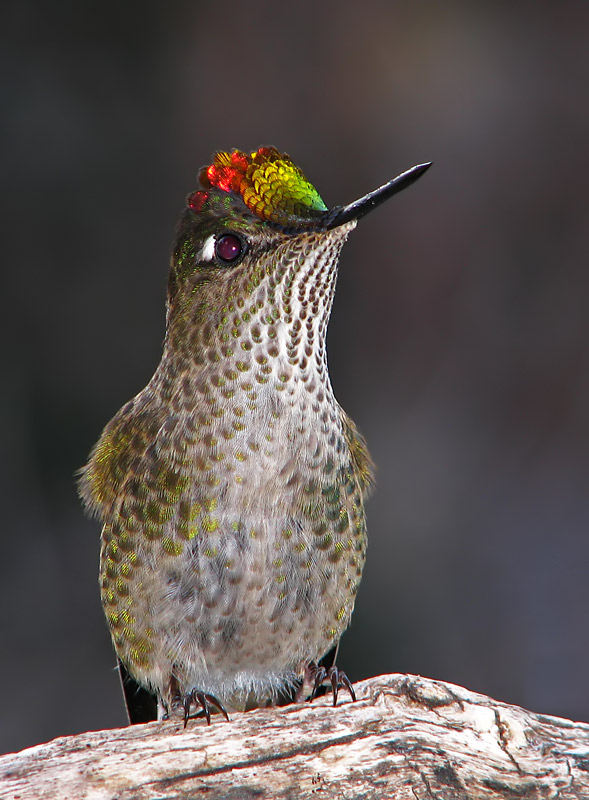
| Appearance | - The species exhibits sexual dimorphism, with males being larger and having shorter bills than females. English Wikipedia
- Adults of both sexes have bronzy green upperparts, slaty green wings and tails, and pale buff underparts marked with black and green spots. English Wikipedia
- Adult males have an iridescent red-yellow crown. English Wikipedia
- Juveniles of both sexes have rusty feather edges on their heads and cinnamon-toned underparts. English Wikipedia
- Juveniles are sexually monochromatic, making their sex difficult to determine. English Wikipedia
- The species often appears simply dark and green overall. ebird.org
| - Adults have metallic green upperparts, grayish-white underparts, and nearly black wings. English Wikipedia
- Adult males have an iridescent ruby-red throat patch bordered by velvety black along its upper margin. English Wikipedia
- Adult females have a white throat that may be plain or marked with faint dark streaks or spots. English Wikipedia
- Females have notched tails with outer feathers patterned in green, black, and white. English Wikipedia
- The bill is straight, slender, and can reach 2 cm in length. English Wikipedia
- Males are smaller than females and have slightly shorter bills. English Wikipedia
- The species undergoes one annual plumage molt on its wintering grounds, beginning in early fall and finishing by late winter. English Wikipedia
|
|---|
| Size | | - Adults measure 7–9 cm in body length and have a wingspan of 8–11 cm. English Wikipedia
- Adult body weight ranges from 2 to 6 g, with females averaging 3.8 g and males averaging 3.4 g. English Wikipedia
|
|---|
| Habitat | - The species inhabits forest edges, introduced Eucalyptus plantations, clearings, thickets, and gardens. English Wikipedia
- Its elevational range extends from sea level to above 2,000 m. English Wikipedia
| - Its breeding habitats include deciduous and pine forests, forest edges, orchards, and gardens in eastern North America. English Wikipedia
- During summer, the species also occupies old fields, meadows, and stream borders across eastern North America. extension.rutgers.edu
- Winter habitats include tropical deciduous forests, dry forests, second-growth scrub, pastures, and forest-edge environments. extension.rutgers.edu
|
|---|
| Diet | - The species feeds on nectar from native and introduced flowering plants. English Wikipedia
- Its favored nectar sources include plants belonging to the genera Abutilon, Embothrium, and Fuchsia. English Wikipedia
| - Its principal foods are flower nectar, nectar from flowering trees, small insects, and spiders. English Wikipedia
- The species occasionally consumes sugar-rich tree sap from sapsucker wells. English Wikipedia
- It shows a slight preference for red, orange, and bright-pink tubular flowers as nectar sources. English Wikipedia
- It obtains insects by catching them in flight or collecting them from flowers, leaves, bark, and spider webs. English Wikipedia
- Adult hummingbirds obtain protein, minerals, and vitamins from small arthropods. English Wikipedia
- Nestlings receive insects because nectar alone does not provide sufficient protein for their growth. English Wikipedia
|
|---|
| Behaviour | - The species is resident in the Chilean matorral south of the Atacama Region to approximately the Los Lagos Region and in adjoining western Argentina. English Wikipedia
- During the non-breeding season, mainland birds winter in the lowlands of central Argentina as far east as the Atlantic coast. English Wikipedia
- The Juan Fernández Islands population is believed to be sedentary. English Wikipedia
- The species sometimes perches on flowers while feeding instead of hovering. English Wikipedia
- The species can remember nectar locations among identical flowers and distinguish the most rewarding nectar locations among less rewarding flowers. English Wikipedia
- The species is intensely territorial and has been observed chasing birds as large as caracaras. English Wikipedia
- The typical song consists of high-pitched notes interspersed with gravelly trills and squeaky notes. English Wikipedia
- The species' call is a single psee or skee note. English Wikipedia
| - The species is generally solitary outside its brief courtship interactions. English Wikipedia
- Both sexes aggressively defend feeding territories by chasing and attacking other hummingbirds. English Wikipedia
- The species can hover in mid-air and fly both forwards and backwards. English Wikipedia
- Its wings can beat up to 80 times per second during hovering. English Wikipedia
- The species may enter hypothermic torpor during cold nights to conserve energy. English Wikipedia
- During torpor, individuals can reduce their metabolic rate for up to 12 hours. extension.rutgers.edu
- Its wings produce a distinctive humming sound while beating 50–70 times per second. extension.rutgers.edu
- Its vocalizations include sharp chattering and buzzing noises, particularly during courtship and territorial disputes. extension.rutgers.edu
|
|---|
| Reproduction | | - Males leave after mating, while females undertake all parental care. English Wikipedia
- Females construct nests approximately 3.1–12.2 m above the ground, usually on small downward-sloping tree limbs. English Wikipedia
- The nest is constructed from bud scales, plant fibers, and animal hair, with spider silk binding its components and lichen covering the exterior. English Wikipedia
- Females generally lay two white eggs, although clutch sizes range from one to three. English Wikipedia
- Individual eggs measure approximately 12.9 by 8.5 mm. English Wikipedia
- Females produce one or two broods during each summer. English Wikipedia
- Females incubate their eggs for approximately 12–14 days. extension.rutgers.edu
- Young birds leave the nest and make their first flight at approximately 18–22 days of age. English Wikipedia
|
|---|
| Distribution | - The species occurs in Argentina, mainland Chile, and the Juan Fernández Islands. English Wikipedia
- In Chile, the species occurs from south of the Atacama Region to the southern tip of South America. English Wikipedia
- Its mainland range extends into adjoining southern Argentina and eastward across central Argentina to the Atlantic coast. English Wikipedia
- An isolated population occurs on Robinson Crusoe and Alejandro Selkirk Islands in the Juan Fernández group. English Wikipedia
- The Juan Fernández Islands population is located approximately 770 km off the Chilean coast. English Wikipedia
- The species has been recorded as a vagrant on the Falkland Islands. English Wikipedia
- The species nests from the Los Lagos Region to the southern tip of South America in Chile and adjoining Argentina. English Wikipedia
| - Its breeding range covers most of the eastern United States and south-central and southeastern Canada. English Wikipedia
- Its wintering range includes Florida, southern Mexico, Central America, and the West Indies. English Wikipedia
|
|---|
| Conservation | - The species is classified as Least Concern by the IUCN. English Wikipedia
- The population size is unknown and is believed to be decreasing. English Wikipedia
- The species is locally common and does well in human-altered landscapes such as city parks and gardens. English Wikipedia
- The Juan Fernández Islands population is estimated at approximately 5,000 birds. English Wikipedia
- The species occurs in several protected areas on the mainland. English Wikipedia
- No immediate threats have been identified for the species. English Wikipedia
| - The spread of invasive plants and use of non-native landscaping plants threaten habitat quality and food availability. extension.rutgers.edu
|
|---|
| Similar species | - The only other species in its genus is the Juan Fernandez firecrown (Sephanoides fernandensis). English Wikipedia
| No checked fact yet |
|---|
| Name origin | - The specific epithet is sometimes misspelled as sephanoides to match the genus name. English Wikipedia
| No checked fact yet |
|---|
| Other | - The green-backed firecrown is a hummingbird belonging to the tribe Lesbiini and subfamily Lesbiinae. English Wikipedia
- The species is monotypic. English Wikipedia
- The species is an important pollinator in the temperate rainforest regions of southern South America. English Wikipedia
- The species can be fairly common in some locations. inaturalist.org
| - Carl Linnaeus formally described the species in 1758 under the name Trochilus colubris. English Wikipedia
|
|---|