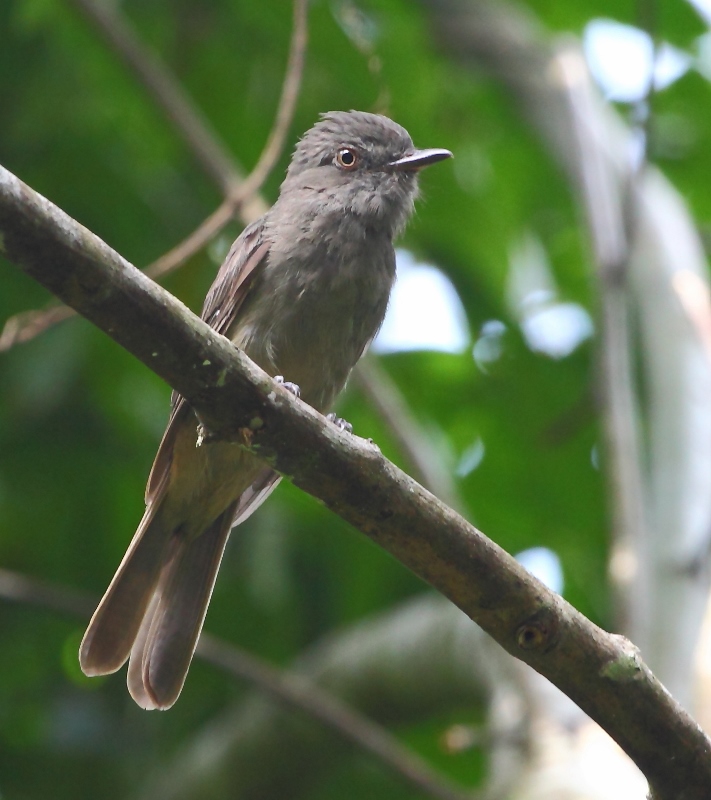
| Appearance | - Males of the nominate subspecies have a gray head with a slight crest at the rear of the crown. English Wikipedia
- The upperparts, wings, and tail are gray, with a brown tinge on the wings and tail. English Wikipedia
- The throat is light gray, while the underparts are slightly darker gray and the belly has a slight yellowish-green tinge. English Wikipedia
- Females resemble males but have fulvous edges on their wing and tail feathers. English Wikipedia
- The subspecies Rhytipterna simplex frederici is darker overall than the nominate subspecies. English Wikipedia
- Both subspecies have dark red to reddish-brown irises, slightly hooked black bills that are often pink at the base, and black legs and feet. English Wikipedia
| - Adult males and females have the same plumage. English Wikipedia
- Adults of the nominate subspecies have a dark brownish crown with a partially concealed yellow central patch. English Wikipedia
- Adults of the nominate subspecies have olive-brown upperparts. English Wikipedia
- Adults of the nominate subspecies have cinnamon-rufous throat and underparts, with a lighter belly. English Wikipedia
- Adults of the nominate subspecies have black wings with broad rufous edges on the flight feathers. English Wikipedia
- Adults of the nominate subspecies have two visible wing bars formed by broad rufous covert tips. English Wikipedia
- The species has a dark iris and a broad black bill. English Wikipedia
- Juveniles are browner than adults and lack the crown patch. English Wikipedia
|
|---|
| Size | | |
|---|
| Habitat | - The species primarily inhabits the middle and upper forest layers of humid terra firme forest. English Wikipedia
- The species occasionally occupies transition zones between humid terra firme forest and other forest types. English Wikipedia
- In Brazil, the species is mostly found from sea level to 800 m elevation, sometimes occurring higher. English Wikipedia
- In Colombia and Ecuador, the species occurs up to 700 m elevation. English Wikipedia
- In Peru, the species occurs up to 1,400 m elevation. English Wikipedia
- In Venezuela, the species occurs up to 1,300 m elevation. English Wikipedia
- The species is also associated with subtropical or tropical moist lowland forests. inaturalist.org
| - The species inhabits foothill and montane forests in subtropical and temperate zones. English Wikipedia
- The species favors brushy clearings and forest edges, including those along roads. English Wikipedia
- In Colombia, the species is often found near rock faces. English Wikipedia
- In Venezuela, the species occurs at elevations between 700 and 2,900 m. English Wikipedia
- In Colombia, the species occurs at elevations between 1,500 and 3,000 m. English Wikipedia
- In Ecuador, the species occurs at elevations between 1,200 and 3,000 m. English Wikipedia
- In Peru, the species occurs at elevations between 900 and 3,400 m. English Wikipedia
|
|---|
| Diet | | |
|---|
| Behaviour | - The species typically forages alone or in pairs. English Wikipedia
- The Greyish Mourner regularly joins mixed-species feeding flocks. English Wikipedia
- While foraging, the bird perches upright on exposed branches and sallies out to glean prey and fruit from vegetation, briefly hovering. English Wikipedia
- The Greyish Mourner is a year-round resident. English Wikipedia
- Its song is variable in tempo and normally consists of rising sharp notes ending in loud, explosive notes. English Wikipedia
- The species also produces slowly ascending series of clear, whistled notes. English Wikipedia
| - The species typically forages in pairs. English Wikipedia
- The species joins mixed-species feeding flocks but does not follow them beyond its territory. English Wikipedia
- The species typically perches on exposed branches from near ground level to approximately 15 m above the ground. English Wikipedia
- The species captures prey in mid-air using short sallies from a perch. English Wikipedia
- After capturing prey, the species usually returns to the same perch. English Wikipedia
- The species is mostly resident throughout the year but apparently leaves Argentina during the austral winter. English Wikipedia
|
|---|
| Reproduction | | - The breeding season includes April and May in northern Venezuela and December in Argentina. English Wikipedia
- The species builds an open-cup nest from moss and lichen. English Wikipedia
- The species places its nest in rock crevices or niches, on ledges, or in fallen logs or tree bark. English Wikipedia
- The nest is typically situated between 1 and 5 m above the ground. English Wikipedia
- The typical clutch contains two eggs. English Wikipedia
|
|---|
| Distribution | - The species occurs in every mainland South American country except Argentina, Chile, Paraguay, and Uruguay. English Wikipedia
- The nominate subspecies occurs in eastern Brazil, from Alagoas south to eastern Minas Gerais and southwestern São Paulo. English Wikipedia
- The subspecies Rhytipterna simplex frederici occurs from southeastern Colombia through eastern Ecuador and eastern Peru to northwestern Bolivia. English Wikipedia
- Rhytipterna simplex frederici also occurs eastward through southern and eastern Venezuela, the Guianas, and Amazonian Brazil. English Wikipedia
| - The species is native to the cloud forests of the Andes and other South American mountain ranges. English Wikipedia
|
|---|
| Conservation | - The IUCN classifies the Greyish Mourner as Least Concern. English Wikipedia
- The species has a very large geographic range. English Wikipedia
- The population size is unknown and is believed to be decreasing. English Wikipedia
- No immediate threats to the species have been identified. English Wikipedia
- The Greyish Mourner is considered common in Brazil and fairly common in Colombia, Peru, and Venezuela. English Wikipedia
- The species occurs in numerous public and private protected areas. English Wikipedia
- Much of the species' habitat in eastern Brazil has been destroyed, and the status of the nominate subspecies requires investigation. English Wikipedia
| |
|---|
| Similar species | - The Greyish Mourner shares the genus Rhytipterna with the Pale-bellied Mourner and Rufous Mourner. English Wikipedia
- The Greyish Mourner and Rufous Mourner apparently form a superspecies. English Wikipedia
| No checked fact yet |
|---|