Comparison
Guam Tree Snail vs Polynesian Tree Snail
Guam Tree Snail (Partula radiolata) and Polynesian Tree Snail (Partula nodosa) both belong to the genus Partula (polynesian tree snails) and part ways below it.
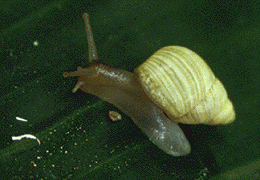
Guam Tree Snail
Partula radiolata
Dave Hopper, U.S. Fish and Wildlife Service, Public domain, via Wikimedia Commons

Polynesian Tree Snail
Partula nodosa
Side by side
| Guam Tree Snail | Polynesian Tree Snail | |
|---|---|---|
| Scientific name | Partula radiolata (L. Pfeiffer, 1846) | Partula nodosa L. Pfeiffer, 1853 |
| English name | Guam Tree Snail | Polynesian Tree Snail |
| Group | Molluscs | Molluscs |
| Class | Gastropoda Gastropod | Gastropoda Gastropod |
| Family | Partulidae Partulids | Partulidae Partulids |
| Genus | Partula Polynesian Tree Snails | Partula Polynesian Tree Snails |
| Named in | 1846 | 1853 |
| Red List category | Endangered | Extinct in the Wild |
| Environment | terrestrial | terrestrial |
| Countries on record | 2 countries | 1 country |
| GBIF occurrence records | 231 records | 92 records |
Rows where the two agree are shown in grey.
Where each is found
Only Guam Tree Snail (2)
Only Polynesian Tree Snail (1)
From Catalogue of Life checklists and GBIF occurrence records. A country missing from a list means no record is held, which is not proof of absence.
Checked facts
| Guam Tree Snail | Polynesian Tree Snail | |
|---|---|---|
| Appearance |
|
|
| Size | No checked fact yet |
|
| Habitat |
|
|
| Diet | No checked fact yet |
|
| Behaviour |
|
|
| Reproduction | No checked fact yet |
|
| Distribution |
|
|
| Conservation |
|
|
| Uses | No checked fact yet |
|
| Other |
|
|
In brief
Guam Tree Snail
The Guam Tree Snail is an air-breathing terrestrial pulmonate gastropod mollusc. The species is endemic to Guam. The Guam Tree Snail is described as endangered. Full profile
Polynesian Tree Snail
The species is endemic to Tahiti in French Polynesia and formerly occurred exclusively on the western side of Tahiti. Its shell has a shape intermediate between conical and ovate, with coloration ranging from cream to reddish brown and parallel stripes. Full profile
Compare something else
Page built on 27 November 2026 from the data on the two species pages, where every source is listed.
Cite this page
ScientificNames.org. (2026). Guam Tree Snail vs Polynesian Tree Snail. Retrieved November 27, 2026, from https://scientificnames.org/compare/guam-tree-snail-vs-polynesian-tree-snail
“Guam Tree Snail vs Polynesian Tree Snail.” ScientificNames.org, 2026, scientificnames.org/compare/guam-tree-snail-vs-polynesian-tree-snail. Accessed 27 Nov. 2026.
ScientificNames.org. “Guam Tree Snail vs Polynesian Tree Snail.” Accessed November 27, 2026. https://scientificnames.org/compare/guam-tree-snail-vs-polynesian-tree-snail.
@misc{scientificnames_guam_tree_snail_vs_polynesian_tree_snail,
  author = {{ScientificNames.org}},
  title = {Guam Tree Snail vs Polynesian Tree Snail},
  year = {2026},
  url = {https://scientificnames.org/compare/guam-tree-snail-vs-polynesian-tree-snail},
  note = {Accessed 2026-11-27}
}