Comparison

Bare-necked Fruitcrow vs Guianan Cock-of-the-rock

Bare-necked Fruitcrow (Gymnoderus foetidus) and Guianan Cock-of-the-rock (Rupicola rupicola) both belong to the family Cotingidae (contingas) and part ways below it. Both are recorded in 8 countries.

Bare-necked Fruitcrow

Bare-necked Fruitcrow

Gymnoderus foetidus

Hector Bottai, CC BY-SA 3.0, via Wikimedia Commons

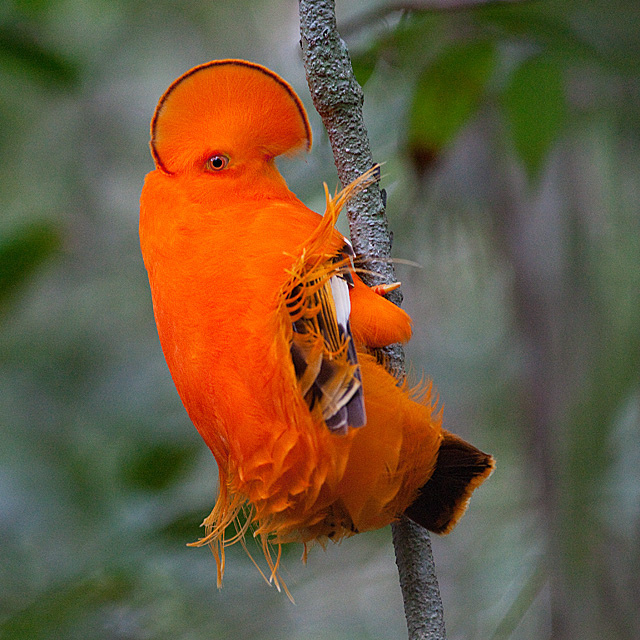
Guianan Cock-of-the-rock

Guianan Cock-of-the-rock

Rupicola rupicola

Almir Cândido de Almeida, CC BY 2.0, via Wikimedia Commons

Side by side

Bare-necked FruitcrowGuianan Cock-of-the-rock
Scientific nameGymnoderus foetidus (Linnaeus, 1758)Rupicola rupicola (Linnaeus, 1766)
English nameBare-necked FruitcrowGuianan Cock-of-the-rock
GroupBirdsBirds
ClassAves BirdAves Bird
OrderPasseriformes PasserinePasseriformes Passerine
FamilyCotingidae ContingasCotingidae Contingas
GenusGymnoderusRupicola Cock-of-the-rock
Named in17581766
Red List categoryLeast ConcernLeast Concern
Countries on record9 countries8 countries
GBIF occurrence records18,862 records4,118 records

Rows where the two agree are shown in grey.

Where each is found

Both recorded in 8 countries

Only Bare-necked Fruitcrow (1)

From Catalogue of Life checklists and GBIF occurrence records. A country missing from a list means no record is held, which is not proof of absence.

Checked facts

Bare-necked FruitcrowGuianan Cock-of-the-rock
Appearance
  • Both sexes have bare blue or bluish-white skin covering the lower face and neck, with the skin forming folds that are more pronounced in males. English Wikipedia
  • Adult males are predominantly black, with most of their wings silvery gray. English Wikipedia
  • Adult females are predominantly slaty gray with a faint, lighter scaly pattern. English Wikipedia
  • Juveniles are predominantly white. English Wikipedia
  • The flanks have large patches of powder down. English Wikipedia
  • The remaining parts of the head are covered in short, velvety feathers. English Wikipedia
  • Both sexes have stout bodies, broad-based bills and prominent half-moon crests. English Wikipedia
  • Both sexes have orange legs and exposed skin. English Wikipedia
  • Male tail feathers are predominantly black with orange tips. English Wikipedia
  • One-year-old juvenile males resemble adult females but have orange speckles across their bodies. English Wikipedia
  • Male plumage becomes predominantly orange with brown and grey spots after approximately two years. English Wikipedia
  • Males acquire their definitive adult plumage at approximately three years of age. animaldiversity.org
SizeNo checked fact yet
Habitat
Diet
  • The species feeds primarily on fruit and also consumes small and large insects. English Wikipedia
  • The species captures flying ants in mid-air by making sallies from treetops. English Wikipedia
  • Adult Guianan cock-of-the-rocks feed primarily on fruit. English Wikipedia
  • Up to 65 fruit species have been recorded in the diet. English Wikipedia
  • Recorded fruits are primarily obtained from canopy trees and lianas. English Wikipedia
  • Black and red fruits account for approximately 75% of fruit consumed at one study site. English Wikipedia
  • Occasional animal prey includes small snakes, lizards, insects and frogs. English Wikipedia
Behaviour
  • The species forages alone, in pairs, and in flocks. English Wikipedia
  • Unlike the typical feeding pattern among cotingas, it obtains much of its food while running or hopping along branches. English Wikipedia
  • The species is frequently observed in small flocks along rivers and crossing them. English Wikipedia
  • It is unknown whether the species' river-associated movements are local movements or seasonal migrations. English Wikipedia
Reproduction
  • One described nest was a shallow cup constructed from lichens and thin plant fibers and coated with fungus. English Wikipedia
  • One described nest was situated on a horizontal branch approximately 6–10 m above the ground. English Wikipedia
  • Another reported nest was located approximately 40 m above the ground in a tree crown. English Wikipedia
  • The clutch is believed to consist of one egg. English Wikipedia
  • Immature individuals develop adult plumage over a period of two to three years. English Wikipedia
Distribution
  • The species occurs throughout mainland South America except in Argentina, Chile, Uruguay, and Paraguay. English Wikipedia
  • The species is primarily distributed in the Amazon Basin, with additional range in the Orinoco River basin. English Wikipedia
  • One northern extension of its range stretches from eastern Colombia and southwestern Venezuela across northern Brazil and the Guianas to the Atlantic coast. English Wikipedia
  • The main range extends from south-central Colombia, eastern Ecuador, and eastern Peru eastward through northern Bolivia and north-central Brazil. English Wikipedia
No checked fact yet
Conservation
  • The species is classified as Least Concern on the IUCN Red List. English Wikipedia
  • The species has a stable population and is fairly common across its extensive range. English Wikipedia
  • Harpy eagles and black-and-white hawk-eagles are among its recorded natural predators. English Wikipedia
Name origin
  • The genus name Gymnoderus combines the Ancient Greek words for bare or naked and neck or throat. English Wikipedia
  • The specific epithet foetidus is Latin for stinking. English Wikipedia
No checked fact yet
Other
  • The bare-necked fruitcrow is the only species currently placed in the genus Gymnoderus. English Wikipedia
  • The species is monotypic, with no recognized subspecies. English Wikipedia
  • Carl Linnaeus formally described the species in 1758 under the scientific name Gracula foetida. English Wikipedia
  • The type locality was originally specified as America and restricted to Surinam in 1902. English Wikipedia
No checked fact yet

In brief

Bare-necked Fruitcrow

Gymnoderus foetidus inhabits humid forests, primarily in the Amazon Basin, with additional range in the Orinoco River basin. It is distinguished by bare blue or bluish-white skin covering the lower face and neck, with folds that are more pronounced in males. Full profile

Guianan Cock-of-the-rock

Rupicola rupicola inhabits humid forests near rocky outcrops and is associated with montane forest habitats. Full profile

Compare something else

Page built on 28 November 2026 from the data on the two species pages, where every source is listed.

Cite this page

ScientificNames.org. (2026). Bare-necked Fruitcrow vs Guianan Cock-of-the-rock. Retrieved November 28, 2026, from https://scientificnames.org/compare/bare-necked-fruitcrow-vs-guianan-cock-of-the-rock