Comparison
Hakea adnata vs Willow Hakea
Hakea adnata (Hakea adnata) and Willow Hakea (Hakea salicifolia) both belong to the genus Hakea (pincushion tree) and part ways below it. Both are recorded in 1 country.


Side by side
| Hakea adnata | Willow Hakea | |
|---|---|---|
| Scientific name | Hakea adnata R.Br. | Hakea salicifolia (Vent.) B.L.Burtt |
| English name | Not recorded | Willow Hakea |
| Group | Flowering plants | Flowering plants |
| Class | Magnoliopsida | Magnoliopsida |
| Order | Proteales | Proteales |
| Family | Proteaceae Protea Family | Proteaceae Protea Family |
| Genus | Hakea Pincushion Tree | Hakea Pincushion Tree |
| Red List category | Endangered | Least Concern |
| Countries on record | 1 country | 7 countries |
| GBIF occurrence records | 113 records | 4,691 records |
Rows where the two agree are shown in grey.
Where each is found
Both recorded in 1 country
Only Willow Hakea (6)
From Catalogue of Life checklists and GBIF occurrence records. A country missing from a list means no record is held, which is not proof of absence.
Checked facts
| Hakea adnata | Willow Hakea | |
|---|---|---|
| Appearance |
|
|
| Size |
|
|
| Habitat |
|
|
| Reproduction |
| No checked fact yet |
| Distribution |
|
|
| Conservation | No checked fact yet |
|
| Uses | No checked fact yet |
|
| Other | No checked fact yet |
|
In brief
Hakea adnata
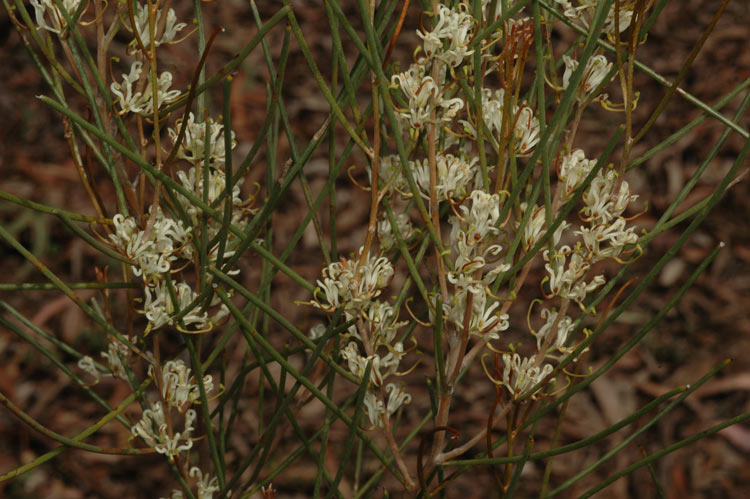
Hakea adnata is native to the south coast of Western Australia, with most of its population occurring between Norseman, Esperance and Cape Arid National Park. It has dark green, needle-like leaves with small hooked tips and produces clusters of sweetly scented white flowers. Full profile
Willow Hakea
The species is endemic to eastern Australia, occurring mainly between Kempsey and the Shoalhaven River, as well as at Dorrigo, Whian Whian and the Blue Mountains. Full profile
Compare something else
Page built on 29 November 2026 from the data on the two species pages, where every source is listed.
Cite this page
ScientificNames.org. (2026). Hakea adnata vs Willow Hakea. Retrieved November 29, 2026, from https://scientificnames.org/compare/hakea-adnata-vs-willow-hakea
“Hakea adnata vs Willow Hakea.” ScientificNames.org, 2026, scientificnames.org/compare/hakea-adnata-vs-willow-hakea. Accessed 29 Nov. 2026.
ScientificNames.org. “Hakea adnata vs Willow Hakea.” Accessed November 29, 2026. https://scientificnames.org/compare/hakea-adnata-vs-willow-hakea.
@misc{scientificnames_hakea_adnata_vs_willow_hakea,
  author = {{ScientificNames.org}},
  title = {Hakea adnata vs Willow Hakea},
  year = {2026},
  url = {https://scientificnames.org/compare/hakea-adnata-vs-willow-hakea},
  note = {Accessed 2026-11-29}
}