Comparison
Hakea psilorrhyncha vs Sea Urchin Hakea
Hakea psilorrhyncha (Hakea psilorrhyncha) and Sea Urchin Hakea (Hakea petiolaris) both belong to the genus Hakea (pincushion tree) and part ways below it. Both are recorded in 1 country.
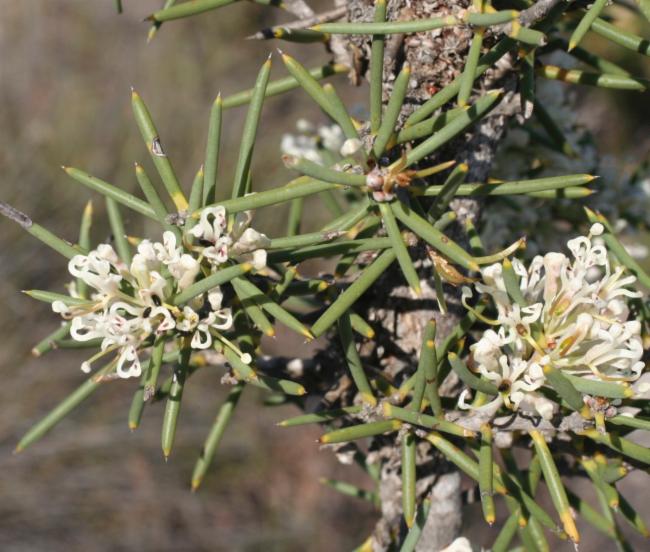


Side by side
| Hakea psilorrhyncha | Sea Urchin Hakea | |
|---|---|---|
| Scientific name | Hakea psilorrhyncha R.M.Barker | Hakea petiolaris Meisn. |
| English name | Not recorded | Sea Urchin Hakea |
| Group | Flowering plants | Flowering plants |
| Class | Magnoliopsida | Magnoliopsida |
| Order | Proteales | Proteales |
| Family | Proteaceae Protea Family | Proteaceae Protea Family |
| Genus | Hakea Pincushion Tree | Hakea Pincushion Tree |
| Red List category | Endangered | Data Deficient |
| Countries on record | 1 country | 1 country |
| GBIF occurrence records | 132 records | 385 records |
Rows where the two agree are shown in grey.
Where each is found
Both recorded in 1 country
From Catalogue of Life checklists and GBIF occurrence records. A country missing from a list means no record is held, which is not proof of absence.
Checked facts
| Hakea psilorrhyncha | Sea Urchin Hakea | |
|---|---|---|
| Appearance |
|
|
| Size |
|
|
| Habitat |
|
|
| Behaviour |
|
|
| Reproduction |
|
|
| Distribution |
|
|
| Conservation |
|
|
| Uses | No checked fact yet |
|
| Other |
|
|
In brief
Hakea psilorrhyncha
Hakea psilorrhyncha R.M.Barker is an erect, very prickly flowering shrub in the family Proteaceae. It is endemic to a small area of Western Australia's west coast, within the Wheatbelt and Mid West regions. It is distinguished by its rusty branchlets, sweetly scented brown-yellow flowers and large, rough, corky fruits with short curved beaks. Full profile
Sea Urchin Hakea
The species is endemic to southwestern Australia, where it occurs in coastal plain, jarrah forest and wheatbelt regions. It is distinguished by approximately spherical clusters of 120–200 flowers and woody seed capsules. Full profile
Compare something else
Page built on 29 November 2026 from the data on the two species pages, where every source is listed.
Cite this page
ScientificNames.org. (2026). Hakea psilorrhyncha vs Sea Urchin Hakea. Retrieved November 29, 2026, from https://scientificnames.org/compare/hakea-psilorrhyncha-vs-sea-urchin-hakea
“Hakea psilorrhyncha vs Sea Urchin Hakea.” ScientificNames.org, 2026, scientificnames.org/compare/hakea-psilorrhyncha-vs-sea-urchin-hakea. Accessed 29 Nov. 2026.
ScientificNames.org. “Hakea psilorrhyncha vs Sea Urchin Hakea.” Accessed November 29, 2026. https://scientificnames.org/compare/hakea-psilorrhyncha-vs-sea-urchin-hakea.
@misc{scientificnames_hakea_psilorrhyncha_vs_sea_urchin_hakea,
  author = {{ScientificNames.org}},
  title = {Hakea psilorrhyncha vs Sea Urchin Hakea},
  year = {2026},
  url = {https://scientificnames.org/compare/hakea-psilorrhyncha-vs-sea-urchin-hakea},
  note = {Accessed 2026-11-29}
}