Comparison
Hakea psilorrhyncha vs Pincushion Hakea
Hakea psilorrhyncha (Hakea psilorrhyncha) and Pincushion Hakea (Hakea laurina) both belong to the genus Hakea (pincushion tree) and part ways below it. Both are recorded in 1 country.
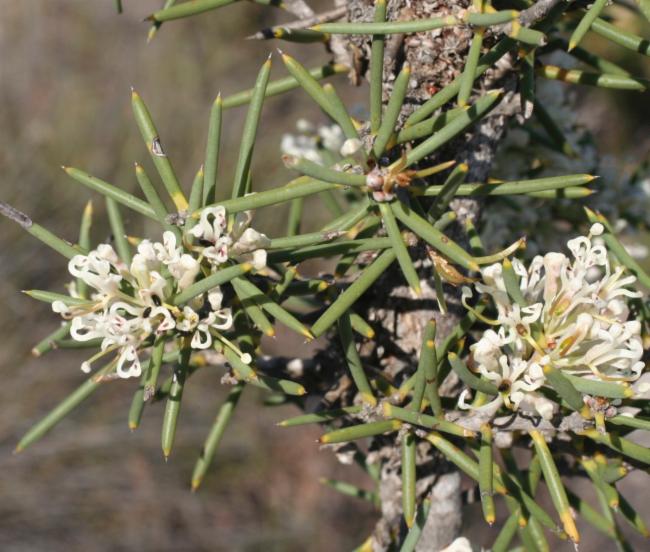


Pincushion Hakea
Hakea laurina
JJ Harrison (https://www.jjharrison.com.au/), CC BY-SA 3.0, via Wikimedia Commons

Side by side
| Hakea psilorrhyncha | Pincushion Hakea | |
|---|---|---|
| Scientific name | Hakea psilorrhyncha R.M.Barker | Hakea laurina R.Br. |
| English name | Not recorded | Pincushion Hakea |
| Group | Flowering plants | Flowering plants |
| Class | Magnoliopsida | Magnoliopsida |
| Order | Proteales | Proteales |
| Family | Proteaceae Protea Family | Proteaceae Protea Family |
| Genus | Hakea Pincushion Tree | Hakea Pincushion Tree |
| Red List category | Endangered | Vulnerable |
| Countries on record | 1 country | 2 countries |
| GBIF occurrence records | 132 records | 1,290 records |
Rows where the two agree are shown in grey.
Where each is found
Both recorded in 1 country
Only Pincushion Hakea (1)
From Catalogue of Life checklists and GBIF occurrence records. A country missing from a list means no record is held, which is not proof of absence.
Checked facts
| Hakea psilorrhyncha | Pincushion Hakea | |
|---|---|---|
| Appearance |
|
|
| Size |
|
|
| Habitat |
|
|
| Behaviour |
|
|
| Reproduction |
|
|
| Distribution |
|
|
| Conservation |
|
|
| Uses | No checked fact yet |
|
| Other |
|
|
In brief
Hakea psilorrhyncha
Hakea psilorrhyncha R.M.Barker is an erect, very prickly flowering shrub in the family Proteaceae. It is endemic to a small area of Western Australia's west coast, within the Wheatbelt and Mid West regions. It is distinguished by its rusty branchlets, sweetly scented brown-yellow flowers and large, rough, corky fruits with short curved beaks. Full profile
Pincushion Hakea
Hakea laurina is endemic to coastal south-western Western Australia, with introduced populations on Kangaroo Island and in the Mount Lofty Ranges in South Australia. It is distinguished by conspicuous, pincushion-shaped flower clusters in the leaf axils, each containing between 120 and 190 flowers. Full profile
Compare something else
Page built on 30 November 2026 from the data on the two species pages, where every source is listed.
Cite this page
ScientificNames.org. (2026). Hakea psilorrhyncha vs Pincushion Hakea. Retrieved November 30, 2026, from https://scientificnames.org/compare/hakea-psilorrhyncha-vs-pincushion-hakea
“Hakea psilorrhyncha vs Pincushion Hakea.” ScientificNames.org, 2026, scientificnames.org/compare/hakea-psilorrhyncha-vs-pincushion-hakea. Accessed 30 Nov. 2026.
ScientificNames.org. “Hakea psilorrhyncha vs Pincushion Hakea.” Accessed November 30, 2026. https://scientificnames.org/compare/hakea-psilorrhyncha-vs-pincushion-hakea.
@misc{scientificnames_hakea_psilorrhyncha_vs_pincushion_hakea,
  author = {{ScientificNames.org}},
  title = {Hakea psilorrhyncha vs Pincushion Hakea},
  year = {2026},
  url = {https://scientificnames.org/compare/hakea-psilorrhyncha-vs-pincushion-hakea},
  note = {Accessed 2026-11-30}
}