Comparison
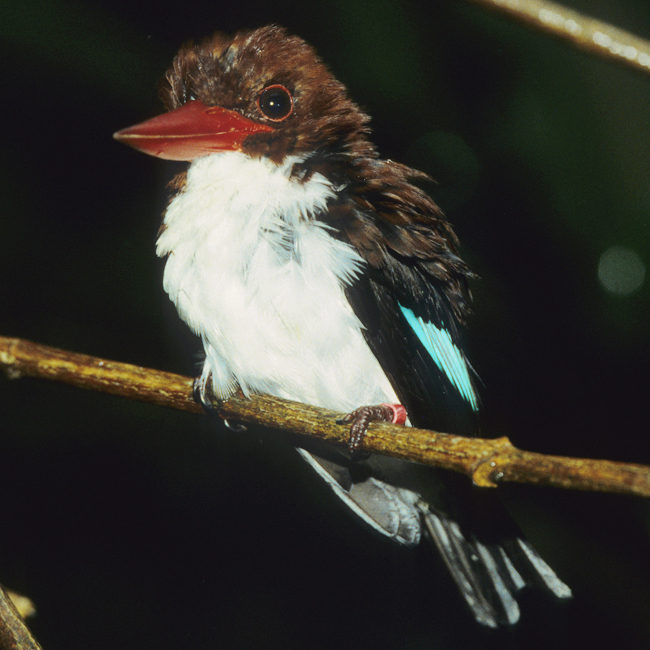
Chocolate-backed Kingfisher vs Woodland Kingfisher
Chocolate-backed Kingfisher (Halcyon badia) and Woodland Kingfisher (Halcyon senegalensis) both belong to the genus Halcyon (blue kingfishers) and part ways below it. Both are recorded in 14 countries.


Woodland Kingfisher
Halcyon senegalensis
Bernard DUPONT from FRANCE, CC BY-SA 2.0, via Wikimedia Commons

Side by side
| Chocolate-backed Kingfisher | Woodland Kingfisher | |
|---|---|---|
| Scientific name | Halcyon badia J. Verreaux & É. Verreaux, 1851 | Halcyon senegalensis (Linnaeus, 1766) |
| English name | Chocolate-backed Kingfisher | Woodland Kingfisher |
| Group | Birds | Birds |
| Class | Aves Bird | Aves Bird |
| Order | Coraciiformes Todies | Coraciiformes Todies |
| Family | Alcedinidae Kingfisher | Alcedinidae Kingfisher |
| Genus | Halcyon Blue Kingfishers | Halcyon Blue Kingfishers |
| Named in | 1851 | 1766 |
| Red List category | Least Concern | Least Concern |
| Countries on record | 14 countries | 39 countries |
| GBIF occurrence records | 4,919 records | 112,477 records |
Rows where the two agree are shown in grey.
Where each is found
Both recorded in 14 countries
- Angola
- Cameroon
- Central African Republic
- Democratic Republic of the Congo
- Equatorial Guinea
- Gabon
- Ghana
- Guinea
- Ivory Coast
- Liberia
- Nigeria
- Republic of the Congo
- Sierra Leone
- Uganda
Only Woodland Kingfisher (25)
- Benin
- Botswana
- Burkina Faso
- Burundi
- Chad
- Eswatini
- Ethiopia
- Gambia
- Guinea-Bissau
- Kenya
- Malawi
- Mali
- Mauritania
- Mozambique
- Namibia
- Niger
- Rwanda
- Senegal
- South Africa
- South Sudan
- Sudan
- Tanzania
- Togo
- Zambia
- Zimbabwe
From Catalogue of Life checklists and GBIF occurrence records. A country missing from a list means no record is held, which is not proof of absence.
Checked facts
| Chocolate-backed Kingfisher | Woodland Kingfisher | |
|---|---|---|
| Appearance |
|
|
| Size | No checked fact yet |
|
| Habitat |
|
|
| Diet |
| No checked fact yet |
| Behaviour |
|
|
| Reproduction |
|
|
| Distribution |
|
|
| Conservation |
|
|
| Similar species | No checked fact yet |
|
In brief
Chocolate-backed Kingfisher
Halcyon badia has chocolate-brown upperparts, white underparts, and bright blue wing patches and tail. Full profile
Woodland Kingfisher
Halcyon senegalensis occurs widely throughout tropical Africa south of the Sahara and northward from Pretoria. Adults have a bright blue back, wing panel and tail, a white head, neck and underparts, black shoulders and a large bill with a red upper mandible and black lower mandible. Full profile
Compare something else
Page built on 29 November 2026 from the data on the two species pages, where every source is listed.
Cite this page
ScientificNames.org. (2026). Chocolate-backed Kingfisher vs Woodland Kingfisher. Retrieved November 29, 2026, from https://scientificnames.org/compare/chocolate-backed-kingfisher-vs-woodland-kingfisher
“Chocolate-backed Kingfisher vs Woodland Kingfisher.” ScientificNames.org, 2026, scientificnames.org/compare/chocolate-backed-kingfisher-vs-woodland-kingfisher. Accessed 29 Nov. 2026.
ScientificNames.org. “Chocolate-backed Kingfisher vs Woodland Kingfisher.” Accessed November 29, 2026. https://scientificnames.org/compare/chocolate-backed-kingfisher-vs-woodland-kingfisher.
@misc{scientificnames_chocolate_backed_kingfisher_vs_woodland_kingfisher,
  author = {{ScientificNames.org}},
  title = {Chocolate-backed Kingfisher vs Woodland Kingfisher},
  year = {2026},
  url = {https://scientificnames.org/compare/chocolate-backed-kingfisher-vs-woodland-kingfisher},
  note = {Accessed 2026-11-29}
}