Comparison
Chocolate-backed Kingfisher vs White-throated Kingfisher
Chocolate-backed Kingfisher (Halcyon badia) and White-throated Kingfisher (Halcyon smyrnensis) both belong to the genus Halcyon (blue kingfishers) and part ways below it.


White-throated Kingfisher
Halcyon smyrnensis
Manjith Kainickara from Dallas, Texas, USA, CC BY-SA 2.0, via Wikimedia Commons

Side by side
| Chocolate-backed Kingfisher | White-throated Kingfisher | |
|---|---|---|
| Scientific name | Halcyon badia J. Verreaux & É. Verreaux, 1851 | Halcyon smyrnensis (Linnaeus, 1758) |
| English name | Chocolate-backed Kingfisher | White-throated Kingfisher |
| Group | Birds | Birds |
| Class | Aves Bird | Aves Bird |
| Order | Coraciiformes Todies | Coraciiformes Todies |
| Family | Alcedinidae Kingfisher | Alcedinidae Kingfisher |
| Genus | Halcyon Blue Kingfishers | Halcyon Blue Kingfishers |
| Named in | 1851 | 1758 |
| Red List category | Least Concern | Least Concern |
| Environment | Not recorded | freshwater, terrestrial |
| Countries on record | 14 countries | 36 countries |
| GBIF occurrence records | 4,919 records | 1,260,034 records |
Rows where the two agree are shown in grey.
Where each is found
Only Chocolate-backed Kingfisher (14)
- Angola
- Cameroon
- Central African Republic
- Democratic Republic of the Congo
- Equatorial Guinea
- Gabon
- Ghana
- Guinea
- Ivory Coast
- Liberia
- Nigeria
- Republic of the Congo
- Sierra Leone
- Uganda
Only White-throated Kingfisher (36)
- Afghanistan
- Bangladesh
- Bhutan
- Bulgaria
- Cambodia
- China
- Cyprus
- Egypt
- Greece
- Hong Kong
- India
- Indonesia
- Iran
- Iraq
- Israel
- Jordan
- Kuwait
- Laos
- Lebanon
- Macao
- Malaysia
- Myanmar
- Nepal
- Oman
- Pakistan
- Palestinian Territory
- Philippines
- Saudi Arabia
- Singapore
- Sri Lanka
- Syria
- Taiwan
- Thailand
- Turkey
- United Arab Emirates
- Vietnam
From Catalogue of Life checklists and GBIF occurrence records. A country missing from a list means no record is held, which is not proof of absence.
Checked facts
| Chocolate-backed Kingfisher | White-throated Kingfisher | |
|---|---|---|
| Appearance |
|
|
| Size | No checked fact yet |
|
| Habitat |
|
|
| Diet |
|
|
| Behaviour |
|
|
| Reproduction |
|
|
| Distribution |
|
|
| Conservation |
|
|
| Uses | No checked fact yet |
|
In brief
Chocolate-backed Kingfisher
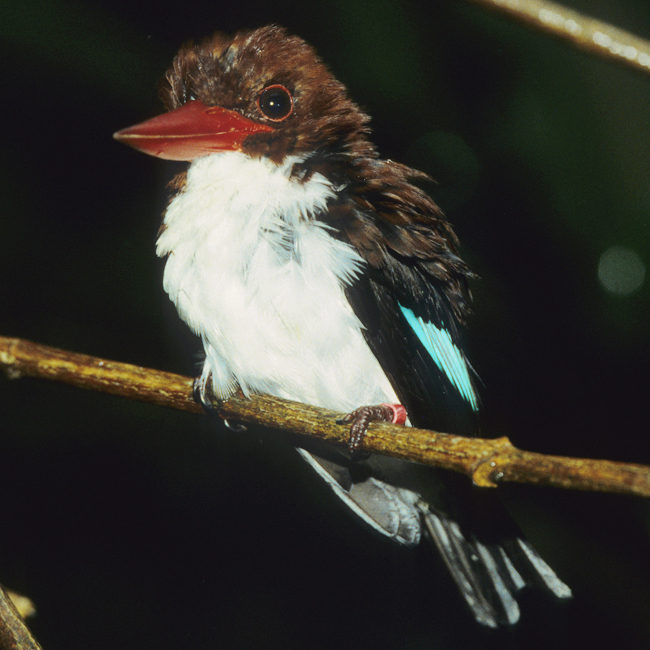
Halcyon badia has chocolate-brown upperparts, white underparts, and bright blue wing patches and tail. Full profile
White-throated Kingfisher
Halcyon smyrnensis occurs from the Sinai Peninsula eastward through the Indian subcontinent to China and Indonesia. Adults have a bright blue back, wings and tail, a chestnut head and underparts, a white throat and breast, and a large bright red bill. Full profile
Compare something else
Page built on 28 November 2026 from the data on the two species pages, where every source is listed.
Cite this page
ScientificNames.org. (2026). Chocolate-backed Kingfisher vs White-throated Kingfisher. Retrieved November 28, 2026, from https://scientificnames.org/compare/chocolate-backed-kingfisher-vs-white-throated-kingfisher
“Chocolate-backed Kingfisher vs White-throated Kingfisher.” ScientificNames.org, 2026, scientificnames.org/compare/chocolate-backed-kingfisher-vs-white-throated-kingfisher. Accessed 28 Nov. 2026.
ScientificNames.org. “Chocolate-backed Kingfisher vs White-throated Kingfisher.” Accessed November 28, 2026. https://scientificnames.org/compare/chocolate-backed-kingfisher-vs-white-throated-kingfisher.
@misc{scientificnames_chocolate_backed_kingfisher_vs_white_throated_kingfisher,
  author = {{ScientificNames.org}},
  title = {Chocolate-backed Kingfisher vs White-throated Kingfisher},
  year = {2026},
  url = {https://scientificnames.org/compare/chocolate-backed-kingfisher-vs-white-throated-kingfisher},
  note = {Accessed 2026-11-28}
}