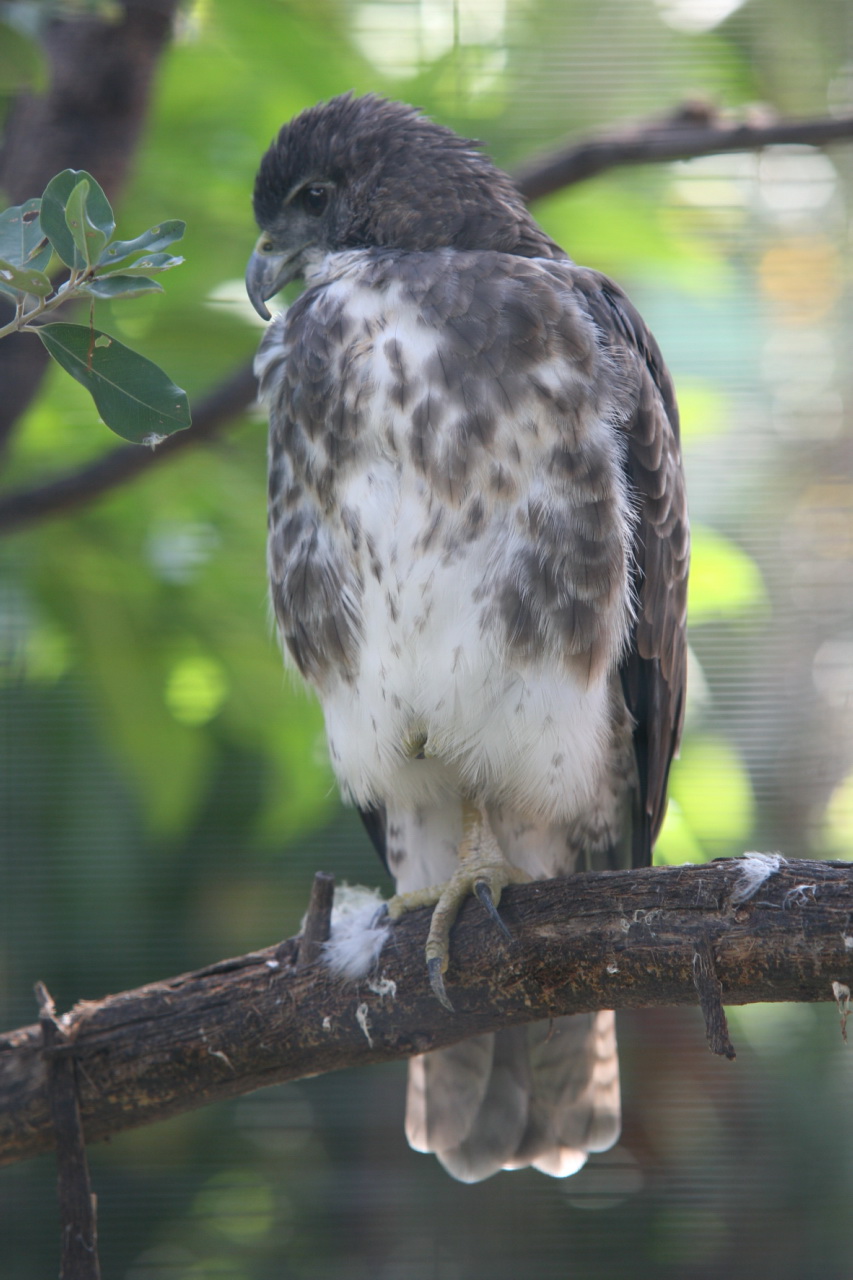
| Appearance | - The species has two distinct plumage morphs, one dark and one light. English Wikipedia
- Adults have yellowish feet and legs, whereas juveniles have greenish feet and legs. English Wikipedia
- Breeding adults may develop a distinctive yellow forecap above the upper mandible. English Wikipedia
| - Adults have long, broad wings and a broad tail that may be gray, rusty, or white. English Wikipedia
- The species has light and dark color morphs. English Wikipedia
- Light-morph individuals have rusty-brown upperparts and pale heads, necks, and underparts. English Wikipedia
- Dark-morph individuals have dark-brown upperparts and underparts, with lighter areas on both surfaces of the wings. English Wikipedia
- The legs are feathered down to the talons. English Wikipedia
- Males and females have similar plumage, although females are larger. wdfw.wa.gov
- The species has yellow toes, cere, and beak margins. wdfw.wa.gov
|
|---|
| Size | - The species measures approximately 40–46 centimetres in length. English Wikipedia
- Females average 605 grams in weight, compared with 441 grams for males. English Wikipedia
| |
|---|
| Habitat | - The species breeds primarily in native ʻōhiʻa forests, where its density and reproductive success are higher than in other habitats. fws.gov
- The species occupies dense native forests as well as agricultural areas. fws.gov
- The species inhabits lowland non-native forests, urban areas, agricultural lands, pasturelands, and high-elevation native forests. dlnr.hawaii.gov
- Some individuals have been recorded in subalpine māmane-naio forests during winter. dlnr.hawaii.gov
| - The species inhabits arid and semiarid grasslands of North America. English Wikipedia
- Its habitat includes open prairies, foothills, and middle-elevation plateaus with few trees. English Wikipedia
- Breeding habitat includes grasslands, sagebrush, and other arid shrublands. English Wikipedia
- Nesting sites include cottonwoods, willows, and swamp oaks along waterways. English Wikipedia
- The species avoids forest interiors, high elevations, narrow canyons, and cliff areas. English Wikipedia
|
|---|
| Diet | - The species currently consumes introduced rats, lizards, game birds, and insects. English Wikipedia
- Its present diet includes rats, mice, mongooses, and various bird species. fws.gov
- Its current diet includes non-native insects, birds, and rodents, together with native insects and birds. dlnr.hawaii.gov
- Before the arrival of land mammals, birds probably constituted the species' principal food source. fws.gov
- The species preys on the Hawaiian crow, which is extinct in the wild. English Wikipedia
| - The species primarily consumes small to medium-sized mammals, with birds, reptiles, and insects also included in its diet. English Wikipedia
- Mammals account for approximately 80–90% of its prey items or dietary biomass. English Wikipedia
- Rabbits, hares, ground squirrels, and pocket gophers are major prey where their ranges overlap with the hawk. English Wikipedia
- The Washington population primarily consumes jackrabbits, pocket gophers, mice, and ground squirrels. wdfw.wa.gov
- Botta's pocket gophers, Gunnison's prairie dogs, and desert cottontails contribute similar proportions of dietary biomass in the studied New Mexico grasslands. scholarworks.boisestate.edu
- Botta's pocket gopher was the most frequently recorded prey species in the New Mexico study. scholarworks.boisestate.edu
- Hawks in the anthropogenically altered Estancia Valley consumed more Gunnison's prairie dogs than those in the Plains of San Agustin. scholarworks.boisestate.edu
- Hawks in the Plains of San Agustin consumed more desert cottontails than those in the Estancia Valley. scholarworks.boisestate.edu
|
|---|
| Behaviour | - The species maintains and defends its territory throughout the year. English Wikipedia
- The species generally hunts from stationary positions but can also dive onto prey from the air. English Wikipedia
- The species is an opportunistic predator with versatile feeding habits. English Wikipedia
- The species produces a shrill, high-pitched vocalization. English Wikipedia
- Individuals are particularly noisy during the breeding season. English Wikipedia
- The species forms monogamous, long-term pair bonds. dlnr.hawaii.gov
- Males perform acrobatic courtship displays from winter through spring. fws.gov
- Both parents feed fledglings, which may remain dependent on adults for up to nine months. dlnr.hawaii.gov
| - The species hunts by searching from the air, perching, or waiting outside prey burrows. English Wikipedia
- Its hunting methods include hovering and low-level flight over the ground. English Wikipedia
- The species migrates between breeding areas and wintering areas. wdfw.wa.gov
- Following nesting, Washington birds typically migrate to the eastern Rocky Mountain front and subsequently to central California. wdfw.wa.gov
|
|---|
| Reproduction | - The species generally lays one egg per clutch, although clutches of up to three eggs have been recorded. English Wikipedia
- Breeding generally begins when individuals reach three or four years of age. fws.gov
- Egg laying generally occurs between March and June. dlnr.hawaii.gov
- Egg laying begins in March, and hatching typically occurs by July. fws.gov
- Both parents participate in incubating the eggs for approximately 38 days. fws.gov
- Females perform most of the incubation, while males undertake most of the hunting during this period. English Wikipedia
- Both sexes contribute to nest construction. dlnr.hawaii.gov
- Nest construction can begin up to two months before the first egg is laid and continue into the nestling period. dlnr.hawaii.gov
- Young birds generally fledge between July and September. dlnr.hawaii.gov
- Chicks generally fledge at seven or eight weeks of age. English Wikipedia
| - In Washington, breeding-area arrival occurs from late April through July. wdfw.wa.gov
- The species sometimes builds nests on the remains of older hawk or crow nests. wdfw.wa.gov
- Artificial nests are provided by conservation managers to encourage nesting. wdfw.wa.gov
- In the New Mexico study, males delivered 72% of prey items to nests. scholarworks.boisestate.edu
- Females spent more time at nests than males during the nestling stage. scholarworks.boisestate.edu
- Female hawks defended nests more aggressively than males by diving and calling more frequently. scholarworks.boisestate.edu
- From 1998 to 2005, hawks in the Estancia Valley produced more fledglings per nesting attempt than those in the Plains of San Agustin. scholarworks.boisestate.edu
|
|---|
| Distribution | - The species is currently restricted to the island of Hawaiʻi. English Wikipedia
- The species occurs throughout the island of Hawaiʻi at all elevations. dlnr.hawaii.gov
- The species' estimated current range covers 2,372 square miles, equivalent to 58.7 percent of Hawaiʻi Island. fws.gov
| - The species is endemic to the interior regions of North America. English Wikipedia
- Washington lies at the northwestern edge of the species' breeding range. wdfw.wa.gov
- More than 200 territories have been documented in Washington, with Franklin and Benton counties together containing approximately 60% of them. wdfw.wa.gov
|
|---|
| Conservation | - The species was federally listed as endangered in the United States in 1967. fws.gov
- The species was removed from the United States federal endangered species list in 2020. English Wikipedia
- NatureServe assigns the species a G2 rank, indicating imperiled status. dlnr.hawaii.gov
- Illegal shooting, poisoning, vehicle collisions, starvation, and predation are identified as threats to the species. English Wikipedia
| - The Washington population is small and its current size is unknown. wdfw.wa.gov
- Agricultural and residential development threaten the species through loss and fragmentation of shrubsteppe and grassland habitat. wdfw.wa.gov
- Illegal shooting, powerline electrocution, and wind-turbine collisions are documented sources of direct mortality. wdfw.wa.gov
- In 2002, only 20% of historical nesting territories in Washington were occupied. wdfw.wa.gov
- Human disturbance can cause nesting failure and nest abandonment. wdfw.wa.gov
- Drought-related declines in prey availability may adversely affect the species. wdfw.wa.gov
- Maintaining intact Gunnison's prairie dog colonies was recommended to support hawk productivity in the Estancia Valley. scholarworks.boisestate.edu
|
|---|
| Uses | No checked fact yet | |
|---|
| Similar species | No checked fact yet | - The species has historically been called the ferrugineous rough-leg because of its similarity to the rough-legged hawk. English Wikipedia
|
|---|
| Other | - The Hawaiian name ʻio is associated with the species' characteristic vocalization. English Wikipedia
| No checked fact yet |
|---|