Comparison

Banded Palm Civet vs African Civet

Banded Palm Civet (Hemigalus derbyanus) and African Civet (Civettictis civetta) both belong to the family Viverridae (oyans) and part ways below it.

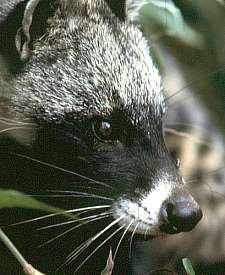
Banded Palm Civet

Banded Palm Civet

Hemigalus derbyanus

Photographer:bobinoz, Cleanup: Yamavu, CC BY 3.0, via Wikimedia Commons

African Civet

African Civet

Civettictis civetta

The original uploader was Baldhur at German Wikipedia. (Original text: http://www.atourhands.com/civet.html), Public domain, via Wikimedia Commons

Side by side

Banded Palm CivetAfrican Civet
Scientific nameHemigalus derbyanus (Gray, 1837)Civettictis civetta (Schreber, 1776)
English nameBanded Palm CivetAfrican Civet
GroupMammalsMammals
ClassMammalia MammalMammalia Mammal
OrderCarnivora CarnivoresCarnivora Carnivores
FamilyViverridae OyansViverridae Oyans
GenusHemigalus Banded CivetsCivettictis African Civets
Named in18371776
Red List categoryNear ThreatenedLeast Concern
EnvironmentNot recordedterrestrial
Countries on record4 countries35 countries
GBIF occurrence records296 records4,288 records

Rows where the two agree are shown in grey.

Where each is found

Only Banded Palm Civet (4)

Only African Civet (35)

From Catalogue of Life checklists and GBIF occurrence records. A country missing from a list means no record is held, which is not proof of absence.

Checked facts

Banded Palm CivetAfrican Civet
Appearance
  • The African civet has coarse, wiry fur ranging from white and creamy yellow to reddish on its back. English Wikipedia
  • Its coat has deep brown to black stripes, spots, and blotches. English Wikipedia
  • Its muzzle is pointed and its ears are small and rounded. English Wikipedia
  • It has a black band across its eyes and two black bands around its short, broad neck. English Wikipedia
  • Its dorsal crest extends from the neck to the base of the tail and can become erect. English Wikipedia
  • Its paws have five digits and compact, black surfaces with hairless soles. English Wikipedia
  • Its claws are long, curved, and semi-retractile. English Wikipedia
Size
Habitat
  • The species inhabits forests, particularly lowland forests. English Wikipedia
  • The species prefers tall forests. animaldiversity.org
  • The species occurs in evergreen forests in Thailand at elevations of 162–695 m. English Wikipedia
  • The species has been recorded in primary forest in Sumatra at elevations of 150 m and 800 m. English Wikipedia
  • The species has been recorded in forest fragments within an oil palm plantation in South Solok Regency, Indonesia. English Wikipedia
  • Regional detections of the species are positively associated with forest cover. pmc.ncbi.nlm.nih.gov
  • Local abundance is negatively associated with forest loss. pmc.ncbi.nlm.nih.gov
  • Local abundance is positively associated with distance from rivers. pmc.ncbi.nlm.nih.gov
  • It can occur along river systems extending into arid areas of Niger, Mali, and Chad. animaldiversity.org
  • It has been recorded in gallery forest along the Mpassa River in Batéké Plateau National Park. English Wikipedia
  • It has been recorded in the Western Congolian forest–savanna mosaic of Odzala-Kokoua National Park. English Wikipedia
Diet
Behaviour
  • The African civet is primarily nocturnal and usually sleeps during the day. English Wikipedia
  • Its peak activity generally begins one to two hours before sunset and continues until approximately midnight. animaldiversity.org
  • It is generally solitary except during breeding. animaldiversity.org
  • It communicates through visual, olfactory, and auditory signals. animaldiversity.org
  • When threatened, it raises its dorsal crest to appear larger and more formidable. English Wikipedia
Reproduction
  • Females are polyestrous and can produce two or three litters annually. animaldiversity.org
  • A typical litter contains one to four young. animaldiversity.org
  • In southern Africa, breeding occurs during the warm, wet summer months from August to January. animaldiversity.org
  • In southern Africa, females give birth between January and February during the rainy season. English Wikipedia
  • Young begin leaving the nest at approximately 17 to 18 days old. animaldiversity.org
  • Young are completely dependent on their mother's milk for approximately six weeks. animaldiversity.org
Distribution
  • The species occurs in Myanmar, Thailand, Peninsular Malaysia, Sumatra, the Mentawai Islands, and Borneo. English Wikipedia
  • The species occurs from sea level to elevations of approximately 1,660 m. English Wikipedia
  • The species has been recorded on Sipora and the Mentawai Islands. English Wikipedia
  • The species has been extirpated from Singapore. English Wikipedia
  • The species has been recorded in peninsular Myanmar. inaturalist.org
Conservation
  • The banded palm civet is classified as Near Threatened on the IUCN Red List. English Wikipedia
  • The species' global population is thought to be decreasing. English Wikipedia
  • The species is protected under Appendix II of CITES. English Wikipedia
  • The species' population was estimated to have declined by approximately 30% over three generations in 2016. English Wikipedia
  • A 2022 study estimated that the species' distribution had contracted to less than 21% of its recognized IUCN Red List range. pmc.ncbi.nlm.nih.gov
  • Approximately 12% of the species' remaining estimated distribution falls within protected areas. pmc.ncbi.nlm.nih.gov
  • Habitat loss and degradation threaten the species. pmc.ncbi.nlm.nih.gov
  • Deforestation and habitat loss are associated with declining numbers of the species. animaldiversity.org
  • Hunting and consumption by local people occur in Sabah. English Wikipedia
Uses
  • Some people capture banded palm civets from their natural habitats to keep them as pets. English Wikipedia
  • The species is hunted and consumed by local people in Sabah. English Wikipedia
  • Wild-caught African civets have been kept to produce civetone for the perfume industry. English Wikipedia
  • Its perineal gland secretion has historically been used as an ingredient in perfumes. English Wikipedia
  • African civets can cause agricultural losses by entering henhouses and killing lambs. animaldiversity.org
Similar species
  • Hose's palm civet is considered closely related to the banded palm civet and has a similar build and appearance. English Wikipedia
No checked fact yet
Other
  • The species' activity pattern overlaps with that of rodents and other civets. English Wikipedia
  • The species' regional detections are negatively associated with human population. pmc.ncbi.nlm.nih.gov
No checked fact yet

In brief

Banded Palm Civet

Hemigalus derbyanus occurs in Myanmar, Thailand, Peninsular Malaysia, Sumatra, the Mentawai Islands, and Borneo, from sea level to elevations of approximately 1,660 m. It is distinguished by seven or eight dark bands across its face and back and black rings on its tail. Full profile

African Civet

Civettictis civetta is native to sub-Saharan Africa and occurs in central and southern Africa. It is the largest viverrid in Africa. Full profile

Compare something else

Page built on 28 November 2026 from the data on the two species pages, where every source is listed.

Cite this page

ScientificNames.org. (2026). Banded Palm Civet vs African Civet. Retrieved November 28, 2026, from https://scientificnames.org/compare/banded-palm-civet-vs-african-civet