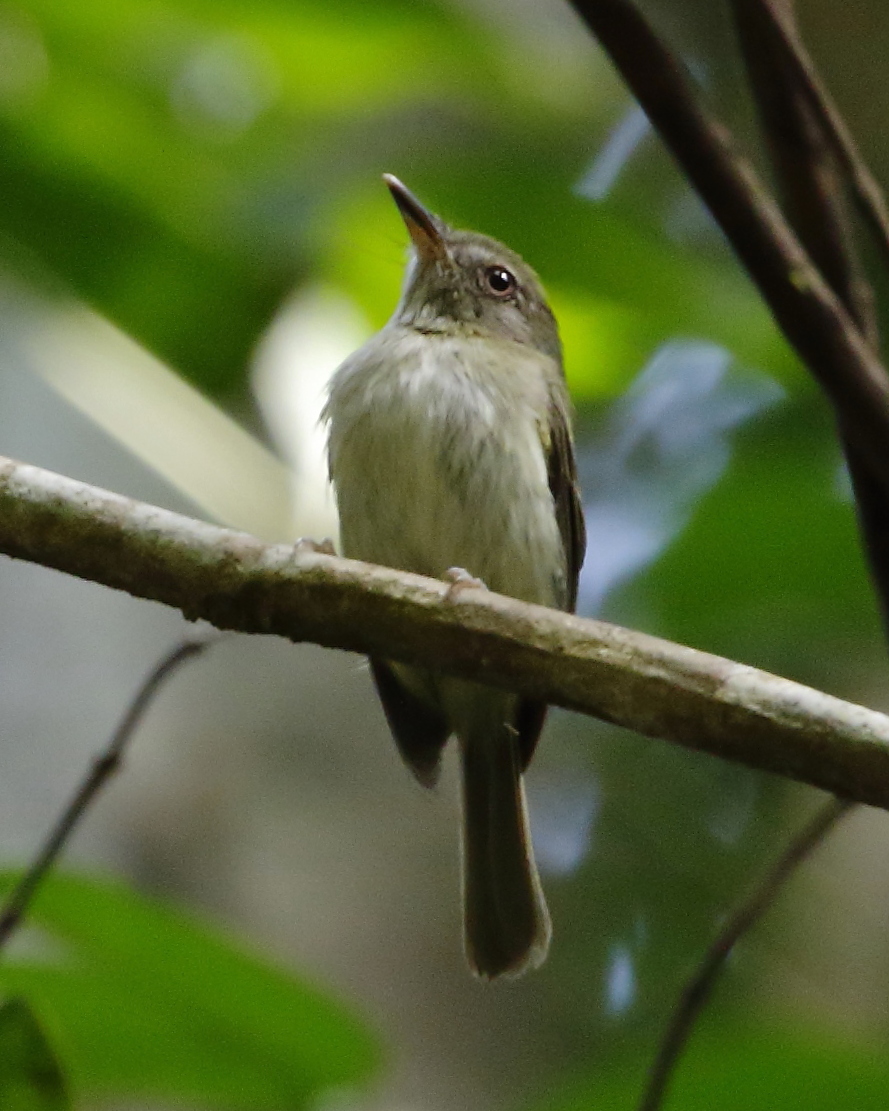
| Appearance | - Adults of the nominate subspecies have an olive-green crown with a short, bushy crest. English Wikipedia
- The nominate subspecies has an olive-green face, back, and rump. English Wikipedia
- Its wings and tail are olive-colored, with greenish-yellow flight-feather edges and yellowish covert tips. English Wikipedia
- Its underparts are mostly pale yellow with faint grayish-olive streaks, except in the center of the belly. English Wikipedia
- Some individuals have predominantly white underparts. English Wikipedia
- The subspecies H. m. pallens has paler underparts and more distinct wing bars than the nominate subspecies. English Wikipedia
- The subspecies H. m. snethlageae has a shorter tail and brighter yellow underparts than the nominate subspecies. English Wikipedia
| - The nominate subspecies has dark olive wings with indistinct yellow edges on the coverts. English Wikipedia
- The nominate subspecies has a dark dusky olive tail. English Wikipedia
- The nominate subspecies has a sooty black upper throat and lower cheeks. English Wikipedia
- The nominate subspecies has a whitish lower throat with grayish edges. English Wikipedia
- The nominate subspecies has a diffuse grayish breast band that fades to white on the lower breast and belly. English Wikipedia
- The lower flanks and undertail coverts of the nominate subspecies have a yellowish tinge. English Wikipedia
- All subspecies have black bills and legs and feet ranging from gray to pinkish gray. English Wikipedia
- Most individuals have an iris that varies from chestnut to pale orange. English Wikipedia
- The subspecies H. g. lehmanni has a brighter, more yellowish-green crown and upperparts than the nominate subspecies. English Wikipedia
- The subspecies H. g. federalis has a whiter breast than the nominate subspecies. English Wikipedia
- The subspecies H. g. pyrrhops has an eye-ring ranging from tawny-buff to deep cinnamon. English Wikipedia
- The subspecies H. g. caesius has a pale ashy gray, grayish white, or buffy white eye-ring and less extensive black throat coloration than the nominate subspecies. English Wikipedia
- The species is described as a small flycatcher with drab olive upperparts, pale grayish underparts, and a distinctive black upper throat. ebird.org
|
|---|
| Size | | No checked fact yet |
|---|
| Habitat | - The nominate subspecies inhabits terra firme and mature secondary tropical evergreen forest. English Wikipedia
- The subspecies H. m. snethlageae inhabits terra firme and mature secondary tropical evergreen forest. English Wikipedia
- The subspecies H. m. pallens primarily inhabits igapó forest. English Wikipedia
- Across its habitats, the species mostly occupies vine tangles and dense vegetation along forest edges and in treefall gaps. English Wikipedia
| - The species inhabits humid montane forests, cloudforests, and regenerating shrubby areas in subtropical and temperate zones. English Wikipedia
- The species often favors relatively open habitats, including forest edges and overgrown tree falls and landslide scars. English Wikipedia
- In Colombia, the species occurs at elevations between 1,500 and 3,500 m. English Wikipedia
- In Ecuador, the species occurs at elevations between 1,700 and 3,000 m. English Wikipedia
- In Peru, the species occurs at elevations between 1,800 and 3,100 m. English Wikipedia
- In Venezuela, the species occurs at elevations between 1,800 and 3,000 m. English Wikipedia
|
|---|
| Diet | | |
|---|
| Behaviour | - The species typically forages alone or in pairs. English Wikipedia
- The species is not known to participate in mixed-species feeding flocks. English Wikipedia
- The species generally feeds in thick undergrowth approximately 3–8 m above the ground. English Wikipedia
- The species captures prey by making short upward sallies from a perch and gleaning it from the underside of vegetation. English Wikipedia
- The species is a year-round resident. English Wikipedia
- Its vocalization has been described as a short, gravelly, downward-slurred trill. English Wikipedia
- The pitch, speed, and length of its vocalization vary among subspecies. English Wikipedia
| - The species is resident throughout the year. English Wikipedia
- The species typically forages alone or in pairs and occasionally joins mixed-species feeding flocks. English Wikipedia
- The species primarily forages in the lower and middle levels of forests. English Wikipedia
- The species usually captures prey by making short upward sallies from a perch to seize it from the underside of leaves. English Wikipedia
- The nominate subspecies produces a short rattling trill or a fast trill. English Wikipedia
|
|---|
| Reproduction | - The species' nest has been anecdotally reported to resemble nests of other Hemitriccus tody-tyrants. English Wikipedia
- The species' breeding biology is otherwise undocumented in the source. English Wikipedia
| - The species' nesting season extends at least from March through July in Colombia and includes December in Peru. English Wikipedia
- Three nests have been documented, including two in Colombia and one in Peru. English Wikipedia
- The documented nests were enclosed pendant pouches inside moss balls, suspended from small branches, with side entrances concealed by vegetation. English Wikipedia
- The documented Colombian and Peruvian nests each contained one egg. English Wikipedia
- The documented Colombian egg was plain tan, whereas the Peruvian egg was bright white with a few red speckles. English Wikipedia
- One documented egg was incubated for 19 days. English Wikipedia
|
|---|
| Distribution | - The species occurs in the Amazon Basin. English Wikipedia
- The species has been recorded in Bolivia, Brazil, and Venezuela, with possible occurrence in Peru. English Wikipedia
- The subspecies H. m. pallens occurs in western Amazonas state between the Peruvian border and the Negro and Madeira rivers. English Wikipedia
- Four records of the species have been reported in southwestern Amazonas state in Venezuela. English Wikipedia
- The species is considered hypothetical in Peru because documented records are lacking. English Wikipedia
| - The species occurs in Bolivia, Colombia, Ecuador, Peru, and Venezuela. English Wikipedia
|
|---|
| Conservation | | - The species was assessed as Least Concern by the IUCN. English Wikipedia
- The species has a large geographic range, but its population size is unknown and believed to be decreasing. English Wikipedia
- No immediate threats to the species have been identified. English Wikipedia
- The species occurs in several protected areas between Colombia and Peru. English Wikipedia
|
|---|
| Other | No checked fact yet | - The species was most recently assessed for the IUCN Red List in 2024. iucnredlist.org
|
|---|