Comparison

Snethlage's Tody-tyrant vs Kaempfer's Tody-tyrant

Snethlage's Tody-tyrant (Hemitriccus minor) and Kaempfer's Tody-tyrant (Hemitriccus kaempferi) both belong to the genus Hemitriccus (tody-tyrants) and part ways below it. Both are recorded in 1 country.
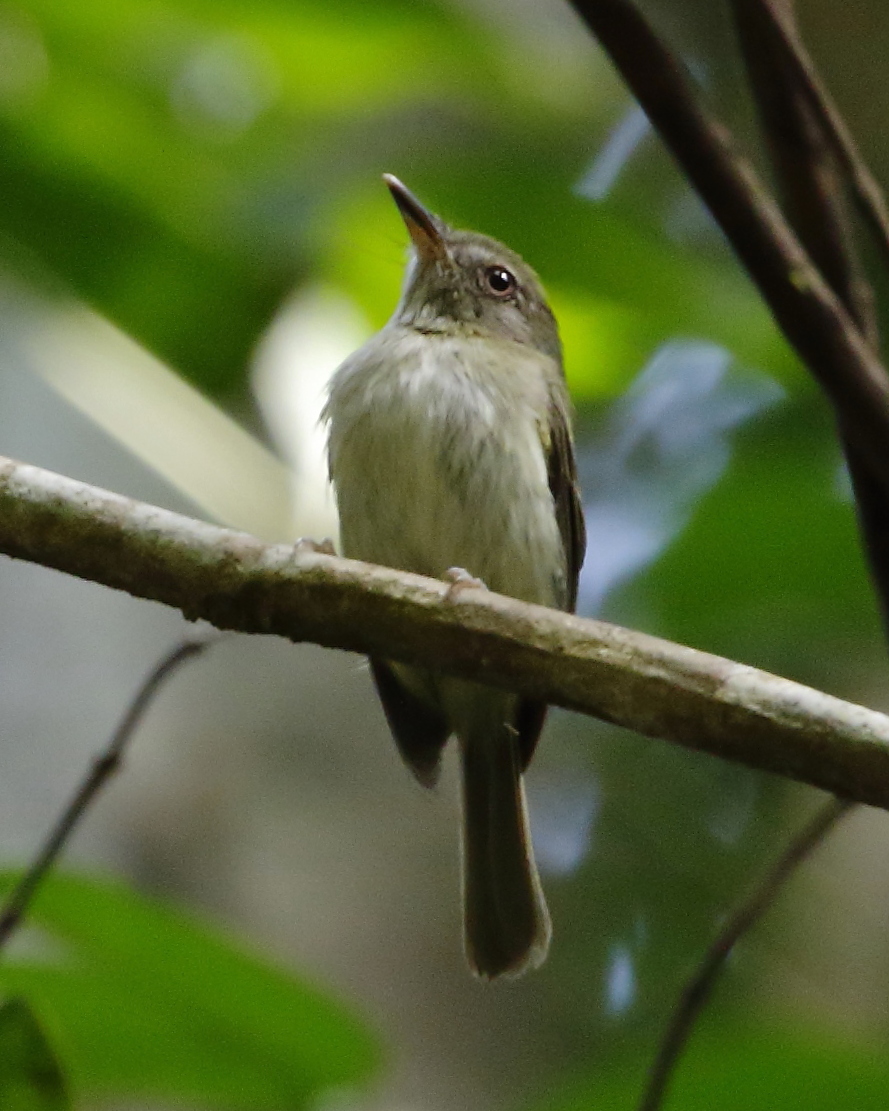
Snethlage's Tody-tyrant

Snethlage's Tody-tyrant

Hemitriccus minor

Hector Bottai, CC BY-SA 4.0, via Wikimedia Commons

Kaempfer's Tody-tyrant

Kaempfer's Tody-tyrant

Hemitriccus kaempferi

Hector Bottai, CC BY-SA 4.0, via Wikimedia Commons

Side by side

Snethlage's Tody-tyrantKaempfer's Tody-tyrant
Scientific nameHemitriccus minor (E. Snethlage, 1907)Hemitriccus kaempferi (J. T. Zimmer, 1953)
English nameSnethlage's Tody-tyrantKaempfer's Tody-tyrant
GroupBirdsBirds
ClassAves BirdAves Bird
OrderPasseriformes PasserinePasseriformes Passerine
FamilyTyrannidae Tyrant FlycatcherTyrannidae Tyrant Flycatcher
GenusHemitriccus Tody-TyrantsHemitriccus Tody-Tyrants
Named in19071953
Red List categoryLeast ConcernVulnerable
Countries on record4 countries1 country
GBIF occurrence records5,350 records777 records

Rows where the two agree are shown in grey.

Where each is found

Both recorded in 1 country

Only Snethlage's Tody-tyrant (3)

From Catalogue of Life checklists and GBIF occurrence records. A country missing from a list means no record is held, which is not proof of absence.

Checked facts

Snethlage's Tody-tyrantKaempfer's Tody-tyrant
Appearance
  • Adults of the nominate subspecies have an olive-green crown with a short, bushy crest. English Wikipedia
  • The nominate subspecies has an olive-green face, back, and rump. English Wikipedia
  • Its wings and tail are olive-colored, with greenish-yellow flight-feather edges and yellowish covert tips. English Wikipedia
  • Its underparts are mostly pale yellow with faint grayish-olive streaks, except in the center of the belly. English Wikipedia
  • Some individuals have predominantly white underparts. English Wikipedia
  • The subspecies H. m. pallens has paler underparts and more distinct wing bars than the nominate subspecies. English Wikipedia
  • The subspecies H. m. snethlageae has a shorter tail and brighter yellow underparts than the nominate subspecies. English Wikipedia
Size
Habitat
  • The nominate subspecies inhabits terra firme and mature secondary tropical evergreen forest. English Wikipedia
  • The subspecies H. m. snethlageae inhabits terra firme and mature secondary tropical evergreen forest. English Wikipedia
  • The subspecies H. m. pallens primarily inhabits igapó forest. English Wikipedia
  • Across its habitats, the species mostly occupies vine tangles and dense vegetation along forest edges and in treefall gaps. English Wikipedia
  • The species inhabits tropical evergreen forest, early-stage secondary forest, and open low-stature woodland. English Wikipedia
  • The species favors dense undergrowth, often containing Cecropia and Heliconia. English Wikipedia
  • The species is often found near rivers. English Wikipedia
  • The species occurs at elevations from near sea level to approximately 250 m. English Wikipedia
Diet
Behaviour
  • The species typically forages alone or in pairs. English Wikipedia
  • The species is not known to participate in mixed-species feeding flocks. English Wikipedia
  • The species generally feeds in thick undergrowth approximately 3–8 m above the ground. English Wikipedia
  • The species captures prey by making short upward sallies from a perch and gleaning it from the underside of vegetation. English Wikipedia
  • The species is a year-round resident. English Wikipedia
  • Its vocalization has been described as a short, gravelly, downward-slurred trill. English Wikipedia
  • The pitch, speed, and length of its vocalization vary among subspecies. English Wikipedia
  • The species is a year-round resident. English Wikipedia
  • The species typically forages alone or in pairs. English Wikipedia
  • The species is not known to participate in mixed-species feeding flocks. English Wikipedia
  • The species mainly forages in dense vegetation approximately 0.5–3 m above the ground. English Wikipedia
  • The species captures prey through short upward sallies from perches, taking prey from the undersides of leaves. English Wikipedia
  • The species also captures prey while briefly hovering after short flights. English Wikipedia
  • The primary vocalization is a high-pitched, nasal, strident, and raspy call. English Wikipedia
Reproduction
  • The species' nest has been anecdotally reported to resemble nests of other Hemitriccus tody-tyrants. English Wikipedia
  • The species' breeding biology is otherwise undocumented in the source. English Wikipedia
  • The only documented nest of the species was discovered in October 1998. English Wikipedia
  • The documented nest was a partially concealed, elongated cup made primarily of moss, with some grass and dead leaves. English Wikipedia
  • Both members of a pair participated in building the documented nest. English Wikipedia
  • The documented nest was wrapped around a horizontal branch approximately 6 m above the ground. English Wikipedia
Distribution
  • The species occurs in the Amazon Basin. English Wikipedia
  • The species has been recorded in Bolivia, Brazil, and Venezuela, with possible occurrence in Peru. English Wikipedia
  • The subspecies H. m. pallens occurs in western Amazonas state between the Peruvian border and the Negro and Madeira rivers. English Wikipedia
  • Four records of the species have been reported in southwestern Amazonas state in Venezuela. English Wikipedia
  • The species is considered hypothetical in Peru because documented records are lacking. English Wikipedia
  • The species is native to the Serra do Mar coastal forests. English Wikipedia
  • By 2025, the species was known from 10 sites in northeastern Santa Catarina and one site in adjacent southeastern Paraná, Brazil. English Wikipedia
Conservation
  • The species was assessed as Threatened in 1988, Endangered in 1994, Critically Endangered in 2004, Endangered in 2009, and Vulnerable from 2017 onward. English Wikipedia
  • The species has an extremely small and severely fragmented geographic range. English Wikipedia
  • The estimated population consists of 6,000–12,000 mature individuals. English Wikipedia
  • The species' population is believed to be declining. English Wikipedia
  • Deforestation continues to affect lowland forest near all known sites. English Wikipedia
  • Banana plantations, rice plantations, timber plantations, and coastal-plain urbanization are identified as apparent major threats. English Wikipedia
  • The species is known from two reserves. English Wikipedia
  • The species is classified as Vulnerable under Brazilian law. English Wikipedia
  • The species is included on the United States' Endangered Species List. English Wikipedia
  • The IUCN Red List record identifies 2017 as the most recent assessment year in the supplied document. iucnredlist.org

In brief

Snethlage's Tody-tyrant

Hemitriccus minor occurs in the Amazon Basin and has been recorded in Bolivia, Brazil, and Venezuela, with possible occurrence in Peru. It measures approximately 10 cm in length and has predominantly olive-green upperparts and mostly pale-yellow underparts. Full profile

Kaempfer's Tody-tyrant

The species is native to the Serra do Mar coastal forests, with known sites in northeastern Santa Catarina and adjacent southeastern Paraná, Brazil. It measures approximately 10 cm in length and has a sharply defined boundary between its dull ochraceous buff breast and pale yellow belly. Full profile

Compare something else

Page built on 27 November 2026 from the data on the two species pages, where every source is listed.

Cite this page

ScientificNames.org. (2026). Snethlage's Tody-tyrant vs Kaempfer's Tody-tyrant. Retrieved November 27, 2026, from https://scientificnames.org/compare/snethlages-tody-tyrant-vs-kaempfers-tody-tyrant