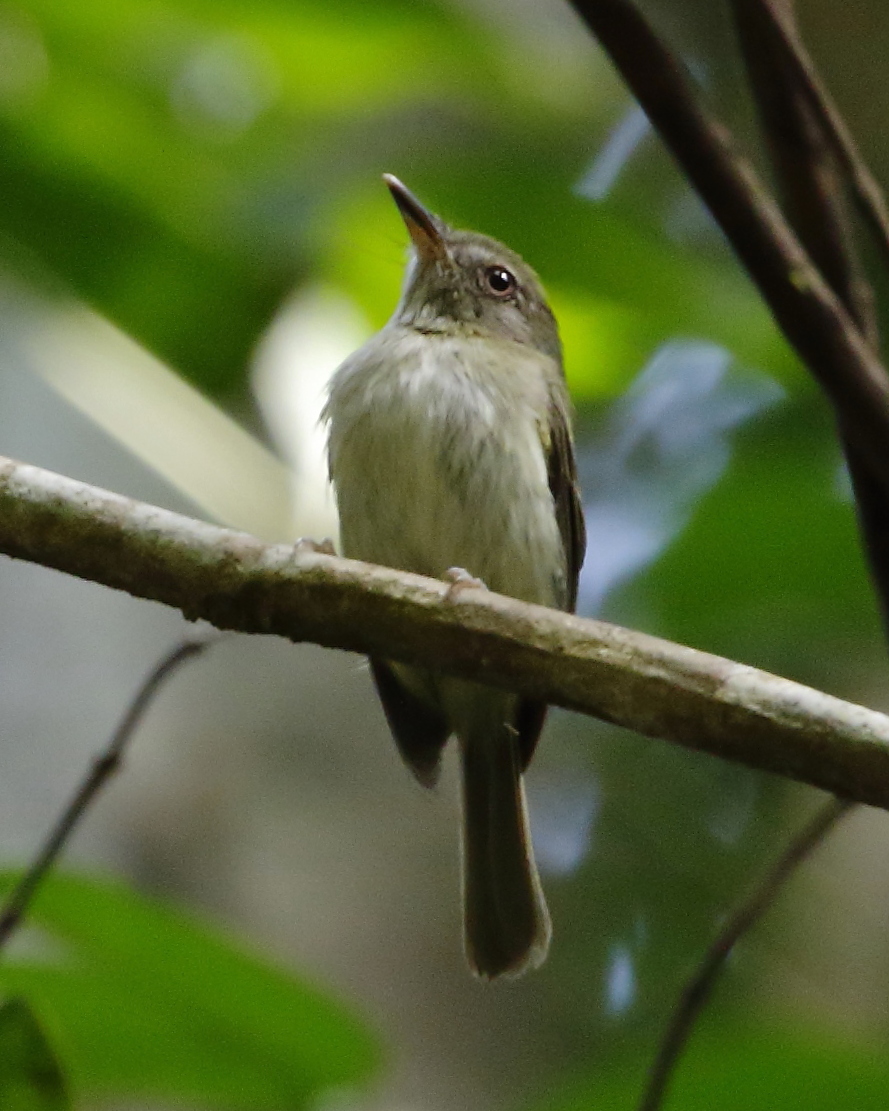
| Appearance | - Adults of the nominate subspecies have an olive-green crown with a short, bushy crest. English Wikipedia
- The nominate subspecies has an olive-green face, back, and rump. English Wikipedia
- Its wings and tail are olive-colored, with greenish-yellow flight-feather edges and yellowish covert tips. English Wikipedia
- Its underparts are mostly pale yellow with faint grayish-olive streaks, except in the center of the belly. English Wikipedia
- Some individuals have predominantly white underparts. English Wikipedia
- The subspecies H. m. pallens has paler underparts and more distinct wing bars than the nominate subspecies. English Wikipedia
- The subspecies H. m. snethlageae has a shorter tail and brighter yellow underparts than the nominate subspecies. English Wikipedia
| - The species has a body length of approximately 10–11 cm. English Wikipedia
- Male and female individuals have the same plumage. English Wikipedia
- Adults of the nominate subspecies have a gray crown. English Wikipedia
- The nominate subspecies has whitish lores and an eye-ring against a grayish-brown face. English Wikipedia
- The nominate subspecies has a drab grayish-brown to brownish-olive back and rump. English Wikipedia
- The wings are dusky with buff-whitish to yellow edging on the flight feathers and pale tips on the coverts. English Wikipedia
- The nominate subspecies has two visible wing bars formed by the pale covert tips. English Wikipedia
- The throat and underparts are white with faint grayish streaking. English Wikipedia
- The nominate subspecies has a pale iris. English Wikipedia
- The nominate subspecies has a reddish-brown to blackish upper bill and a pinkish-brown to pinkish lower bill. English Wikipedia
- The nominate subspecies has pink to pale grayish-pink legs and feet. English Wikipedia
- The impiger subspecies has a deep buff-brown crown and upper back. English Wikipedia
- The septentrionalis subspecies has grayer upperparts and a blacker bill than the nominate subspecies. English Wikipedia
- The chiribiquetensis subspecies has darker crown coloration and more contrasting wing bars than the nominate subspecies. English Wikipedia
- The duidae subspecies has dark-brown upperparts and a buffy to pale orange-yellow belly. English Wikipedia
- The auyantepui subspecies has medium-brown upperparts with a slight olive tinge. English Wikipedia
- The breweri subspecies is darker than the nominate subspecies and has a pale ochraceous-buff belly. English Wikipedia
- The rufipes subspecies has yellower flanks and crissum than the nominate subspecies. English Wikipedia
- The wuchereri subspecies has a less greenish back and more distinctly streaked throat than the nominate subspecies. English Wikipedia
- The species is described as a very small flycatcher with a relatively long bill and a yellow eye. ebird.org
- The species has olive-brown upperparts and whitish wing bars. ebird.org
- The species has indistinct streaking on its white underparts. ebird.org
|
|---|
| Size | | |
|---|
| Habitat | - The nominate subspecies inhabits terra firme and mature secondary tropical evergreen forest. English Wikipedia
- The subspecies H. m. snethlageae inhabits terra firme and mature secondary tropical evergreen forest. English Wikipedia
- The subspecies H. m. pallens primarily inhabits igapó forest. English Wikipedia
- Across its habitats, the species mostly occupies vine tangles and dense vegetation along forest edges and in treefall gaps. English Wikipedia
| - The species inhabits landscapes that are often shrubby and dry. English Wikipedia
- In Brazil, the species occurs in arid scrub, shrubby pastures, deciduous woodland undergrowth, and occasionally gallery forest. English Wikipedia
- In Peru, the species inhabits second-growth scrub and shrubby forest edges. English Wikipedia
- In Venezuela, the species mainly inhabits thickets, arid scrub, and dry deciduous woodland. English Wikipedia
- The species occurs in dense heathlands in the Gran Sabana of Bolívar. English Wikipedia
- In Brazil, the species generally occurs from sea level to 1,000 m elevation. English Wikipedia
- In Colombia, the species occurs at elevations up to 1,100 m. English Wikipedia
- In the Chanchamayo Valley of Peru, the species occurs between 600 and 1,600 m elevation. English Wikipedia
|
|---|
| Diet | | |
|---|
| Behaviour | - The species typically forages alone or in pairs. English Wikipedia
- The species is not known to participate in mixed-species feeding flocks. English Wikipedia
- The species generally feeds in thick undergrowth approximately 3–8 m above the ground. English Wikipedia
- The species captures prey by making short upward sallies from a perch and gleaning it from the underside of vegetation. English Wikipedia
- The species is a year-round resident. English Wikipedia
- Its vocalization has been described as a short, gravelly, downward-slurred trill. English Wikipedia
- The pitch, speed, and length of its vocalization vary among subspecies. English Wikipedia
| - The species generally forages from just above ground level to approximately eye level. English Wikipedia
- The species commonly catches prey by making short upward flights from a perch to capture it beneath leaves. English Wikipedia
- The species also obtains prey by gleaning while perched and catching prey during short flights. English Wikipedia
- The species' vocalizations appear to be similar throughout its geographic range. English Wikipedia
- The species' song has been described as a soft, emphasized sequence of notes. English Wikipedia
- The species' calls include loud, sharp notes rendered as 'tuk, tuk, quéek, quéek'. English Wikipedia
|
|---|
| Reproduction | - The species' nest has been anecdotally reported to resemble nests of other Hemitriccus tody-tyrants. English Wikipedia
- The species' breeding biology is otherwise undocumented in the source. English Wikipedia
| - The species breeds between January and June in Colombia. English Wikipedia
- The species breeds between October and December in Peru, Bolivia, and Argentina. English Wikipedia
- The nest is a domed purse-shaped structure with a side entrance near its bottom. English Wikipedia
- The nest is constructed from dry grass and thin plant fibers and lined with plant down. English Wikipedia
- The nest is usually suspended from a tree or shrub branch approximately 0.5–3 m above the ground. English Wikipedia
- The usual clutch contains two eggs, although clutches of one or three eggs have also been recorded. English Wikipedia
- Young birds fledge approximately 13–14 days after hatching. English Wikipedia
- The incubation period and details of parental care have not been established. English Wikipedia
|
|---|
| Distribution | - The species occurs in the Amazon Basin. English Wikipedia
- The species has been recorded in Bolivia, Brazil, and Venezuela, with possible occurrence in Peru. English Wikipedia
- The subspecies H. m. pallens occurs in western Amazonas state between the Peruvian border and the Negro and Madeira rivers. English Wikipedia
- Four records of the species have been reported in southwestern Amazonas state in Venezuela. English Wikipedia
- The species is considered hypothetical in Peru because documented records are lacking. English Wikipedia
| - The species occurs in every mainland South American country except Chile, Ecuador, French Guiana, and Suriname. English Wikipedia
|
|---|
| Conservation | | |
|---|
| Other | No checked fact yet | - The species was originally described in 1837 under the scientific name Todirostrum margaritacei venter. English Wikipedia
- The species has historically been classified in the genera Euscarthmornis and Idioptilon. English Wikipedia
- Nine subspecies are recognized within the species. English Wikipedia
|
|---|