Comparison

Hangnest Tody-tyrant vs Acre Tody-tyrant

Hangnest Tody-tyrant (Hemitriccus nidipendulus) and Acre Tody-tyrant (Hemitriccus cohnhafti) both belong to the genus Hemitriccus (tody-tyrants) and part ways below it. Both are recorded in 1 country.
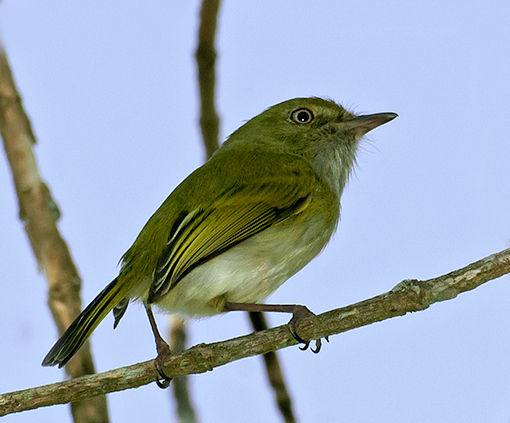
Hangnest Tody-tyrant

Hangnest Tody-tyrant

Hemitriccus nidipendulus

Dario Sanches from São Paulo, Brazil, CC BY-SA 2.0, via Wikimedia Commons

Acre Tody-tyrant

Acre Tody-tyrant

Hemitriccus cohnhafti

Hector Bottai, CC BY-SA 4.0, via Wikimedia Commons

Side by side

Hangnest Tody-tyrantAcre Tody-tyrant
Scientific nameHemitriccus nidipendulus (Wied-M. Neuwied, 1831)Hemitriccus cohnhafti K. J. Zimmer, Whittaker, Sardelli, Guilherme & Aleixo, 2013
English nameHangnest Tody-tyrantAcre Tody-tyrant
GroupBirdsBirds
ClassAves BirdAves Bird
OrderPasseriformes PasserinePasseriformes Passerine
FamilyTyrannidae Tyrant FlycatcherTyrannidae Tyrant Flycatcher
GenusHemitriccus Tody-TyrantsHemitriccus Tody-Tyrants
Named in18312013
Red List categoryLeast ConcernNear Threatened
Countries on record1 country3 countries
GBIF occurrence records8,020 records332 records

Rows where the two agree are shown in grey.

Where each is found

Both recorded in 1 country

Only Acre Tody-tyrant (2)

From Catalogue of Life checklists and GBIF occurrence records. A country missing from a list means no record is held, which is not proof of absence.

Checked facts

Hangnest Tody-tyrantAcre Tody-tyrant
Appearance
  • Male and female individuals have the same plumage. English Wikipedia
  • Adults of the nominate subspecies have a bright olive-green crown. English Wikipedia
  • The nominate subspecies has yellowish olive lores and a bright olive-green remainder of the face. English Wikipedia
  • The back and rump of the nominate subspecies are bright olive-green. English Wikipedia
  • Its wings are olive-colored, with yellow edges on the flight feathers and coverts. English Wikipedia
  • The throat and underparts are mostly white, with faint grayish olive streaks on the breast and flanks. English Wikipedia
  • The subspecies H. n. paulistus has plumage similar to the nominate subspecies. English Wikipedia
  • Both subspecies have creamy white irises. English Wikipedia
  • Both subspecies have brown bills with grayish pink bases to the mandibles. English Wikipedia
  • Both subspecies have light gray legs and feet. English Wikipedia
  • The species has a plain olive-green back. ebird.org
  • Adults have a greenish olive head and nape with darker streaks on the crown. English Wikipedia
  • The species has tawny lores and a tawny wash on its otherwise greenish olive face. English Wikipedia
  • Its back and rump are greenish olive. English Wikipedia
  • Its wings are blackish, with yellow outer edges and whitish inner edges on the flight feathers. English Wikipedia
  • Its black wing coverts have yellowish tawny edges that form two wing bars. English Wikipedia
  • Its tail feathers are blackish with dark green inner vanes. English Wikipedia
  • Its olive-green throat and breast have creamy yellowish streaks. English Wikipedia
  • Its upper belly and flanks are unstreaked olive-green. English Wikipedia
  • Its lower belly and undertail coverts are sulphur-yellow. English Wikipedia
  • Its iris ranges from cream to brownish hazel, and its legs and feet are gray. English Wikipedia
  • Its bill is flatish, has a wide base and large oval nostrils, and is black with a creamy mandible base. English Wikipedia
  • The sexes apparently have the same plumage. English Wikipedia
Size
Habitat
  • The species primarily inhabits secondary forest growing on nutrient-poor sandy soils. English Wikipedia
  • Its typical habitat has a canopy under approximately 12 m high, sometimes reaching only 5 m. English Wikipedia
  • In Brazil, its habitat tends to include dead or dying stands of Guadua bamboo. English Wikipedia
  • The species is known only from elevations below approximately 300 m. English Wikipedia
  • The species is not known to inhabit várzea or terra firme forest. English Wikipedia
Diet
Behaviour
  • The species forages mostly in dense undergrowth approximately 1–4 m above the ground. English Wikipedia
  • It captures prey by making short upward sallies from a perch and gleaning from the undersides of vegetation. English Wikipedia
  • The species is not known to participate in mixed-species feeding flocks. English Wikipedia
  • The species is believed to remain in the same area throughout the year. English Wikipedia
  • Its song consists of a trill of tick notes that is shorter and lower-pitched than the songs of other Hemitriccus tody-tyrants. English Wikipedia
  • Its song trill usually lacks introductory notes. English Wikipedia
  • Its other vocalizations include single-note skep or keek calls and lower-frequency kup calls. English Wikipedia
ReproductionNo checked fact yet
Distribution
  • The species is endemic to Brazil. English Wikipedia
  • The species has a discontinuous distribution in southeastern Brazil. English Wikipedia
  • The nominate subspecies has a small geographic range in the Brazilian states of Sergipe and northeastern Bahia. English Wikipedia
  • The subspecies H. n. paulistus occurs from southern Minas Gerais and Espírito Santo south to northeastern Paraná. English Wikipedia
  • The species is described as having a very large geographic range. datazone.birdlife.org
Conservation
  • The species was assessed as Near Threatened by the IUCN in 1988. English Wikipedia
  • The species has been classified as Least Concern since 2004. English Wikipedia
  • The population size of the species is unknown. English Wikipedia
  • The population of the species is believed to be decreasing. English Wikipedia
  • Historical threats to the species' lowland forests included agricultural conversion and deforestation for mining and plantation production. English Wikipedia
  • Current threats include urbanization, industrialization, agricultural expansion, colonization, and associated road construction. English Wikipedia
  • The species occurs in several protected areas. English Wikipedia
  • The species is described as fairly common. datazone.birdlife.org
  • The IUCN classifies the Acre tody-tyrant as Near Threatened. English Wikipedia
  • The species' population size is unknown. English Wikipedia
  • The species is believed to have a declining population, although the rate of decline is unknown. English Wikipedia
  • Extensive clear-cutting is occurring across large parts of its range, particularly to create cattle pastures. English Wikipedia
  • The species may tolerate some habitat degradation because it can use successional and shrubby habitats. English Wikipedia
OtherNo checked fact yet

In brief

Hangnest Tody-tyrant

Hemitriccus nidipendulus has a bright olive-green back and crown, mostly white underparts, and a very high-pitched, fast, rolling song. Full profile

Acre Tody-tyrant

The Acre Tody-tyrant is a monotypic flycatcher first described in 2013. It occurs in Bolivia, Brazil, and Peru, primarily inhabiting secondary forest on nutrient-poor sandy soils. It has an olive-green throat and breast with creamy yellowish streaks, a sulphur-yellow lower belly, and a distinctive short, low-pitched song trill. Full profile

Compare something else

Page built on 28 November 2026 from the data on the two species pages, where every source is listed.

Cite this page

ScientificNames.org. (2026). Hangnest Tody-tyrant vs Acre Tody-tyrant. Retrieved November 28, 2026, from https://scientificnames.org/compare/hangnest-tody-tyrant-vs-acre-tody-tyrant