Comparison

Mexican Hog-nose Snake vs Southern Hognose Snake

Mexican Hog-nose Snake (Heterodon kennerlyi) and Southern Hognose Snake (Heterodon simus) both belong to the genus Heterodon (hog-nosed snakes) and part ways below it. Both are recorded in 1 country.

Mexican Hog-nose Snake

Heterodon kennerlyi
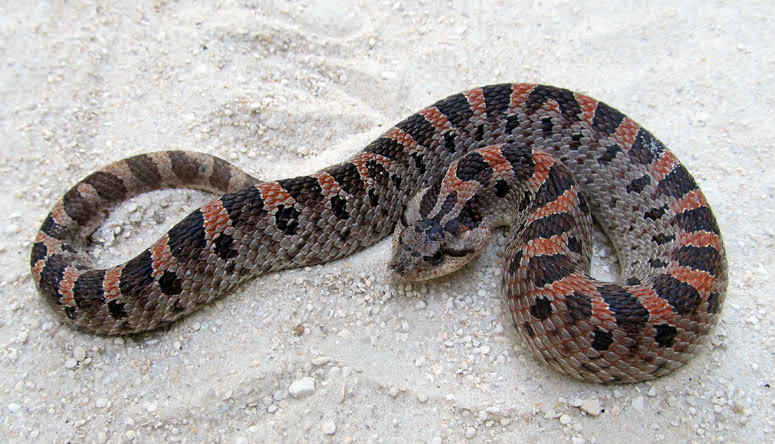
Southern Hognose Snake

Southern Hognose Snake

Heterodon simus

Glenn Bartolotti, Public domain, via Wikimedia Commons

Side by side

Mexican Hog-nose SnakeSouthern Hognose Snake
Scientific nameHeterodon kennerlyi Kennicott, 1860Heterodon simus (Linnaeus, 1766)
English nameMexican Hog-nose SnakeSouthern Hognose Snake
GroupReptilesReptiles
ClassReptilia ReptileReptilia Reptile
OrderSquamata SnakesSquamata Snakes
FamilyColubridae ColubridColubridae Colubrid
GenusHeterodon Hog-nosed SnakesHeterodon Hog-nosed Snakes
Named in18601766
Red List categoryNot recordedVulnerable
Countries on record2 countries1 country
GBIF occurrence records886 records1,644 records

Rows where the two agree are shown in grey.

Where each is found

Both recorded in 1 country

Only Mexican Hog-nose Snake (1)

From Catalogue of Life checklists and GBIF occurrence records. A country missing from a list means no record is held, which is not proof of absence.

Checked facts

Mexican Hog-nose SnakeSouthern Hognose Snake
Appearance
  • Adults have stout bodies, wide necks, and sharply upturned snouts. English Wikipedia
  • The species typically has 25 rows of keeled dorsal scales at midbody. English Wikipedia
  • Its dorsal ground color may be light brown, yellowish, grayish, or reddish, with dark dorsal and lateral blotches. English Wikipedia
  • Juveniles have a darker belly than the underside of their tails. English Wikipedia
  • The underside of the body usually becomes pale white as the snake ages. English Wikipedia
  • A variable red, yellow, or orange stripe may run along the snake's spine. srelherp.uga.edu
  • The species has a more sharply upturned rostral scale than the eastern hognose snake. srelherp.uga.edu
  • Its scales are heavily keeled, producing a rough texture. srelherp.uga.edu
  • The species has a divided anal plate. srelherp.uga.edu
SizeNo checked fact yet
  • Adults measure approximately 35.5–61 cm in total length. English Wikipedia
  • The species typically averages approximately 0.45 m in length and reaches about 0.60 m maximum length. srelherp.uga.edu
HabitatNo checked fact yet
  • The species inhabits xeric grasslands, including longleaf pine sandhills, upland pine forests, and scrubby flatwoods. English Wikipedia
  • Some populations persist in mosaics of overgrown pastures, dry river floodplains, fields, and pine plantations. English Wikipedia
  • The species occurs in upland sandhills, xeric pine-oak habitats with wiregrass, and coastal dunes. srelherp.uga.edu
  • The species shows a strong association with longleaf pine habitats. srelherp.uga.edu
  • The species can occupy agricultural areas with sandy soils, although it is documented there less frequently. srelherp.uga.edu
DietNo checked fact yet
  • The species preys mainly on spadefoot toads and true toads. English Wikipedia
  • Its diet also includes salamanders, frogs, lizards, and small mammals. English Wikipedia
  • Studies indicate that six-lined racerunners and eastern spadefoot toads dominate its diet in parts of its range. srelherp.uga.edu
  • The species may prey on ox beetles. srelherp.uga.edu
BehaviourNo checked fact yet
  • Southern hognose snakes are primarily active during daylight hours. srelherp.uga.edu
  • Their highest surface activity occurs from September through October, usually between late morning and early afternoon. srelherp.uga.edu
  • When threatened, individuals may flatten their necks, hiss, and open their mouths. srelherp.uga.edu
  • Individuals are less likely to play dead than other hognose species. srelherp.uga.edu
  • Many individuals respond to threats by freezing and moving hesitantly. srelherp.uga.edu
  • While hunting, the species uses its rostral scale to excavate buried prey. srelherp.uga.edu
  • One observed individual excavated 11.5 cm into packed sand to capture a spadefoot toad. srelherp.uga.edu
Reproduction
Distribution
  • In the United States, the species occurs in southern Arizona, southern New Mexico, and southwestern Texas. English Wikipedia
  • In Mexico, the species occurs in Aguascalientes, Chihuahua, Coahuila, Durango, Jalisco, Nuevo León, San Luis Potosí, Sonora, Tamaulipas, and Zacatecas. English Wikipedia
  • The species occurs on the southeastern United States coastal plain, from North Carolina south to Lake Okeechobee in Florida and west to Mississippi. English Wikipedia
  • Historically, disjunct populations occurred in central Alabama and southeastern Louisiana. srelherp.uga.edu
ConservationNo checked fact yet
  • The species' population trend is declining. English Wikipedia
  • The Alabama Department of Conservation and Natural Resources has listed the species as possibly extirpated in Alabama. English Wikipedia
  • Widespread population declines have been reported across the species' historical range. srelherp.uga.edu
  • Habitat loss and fragmentation of longleaf pine and sandhill ecosystems are identified as primary threats. srelherp.uga.edu
  • Conversion of natural habitat to dense pine plantations is identified as a primary threat. srelherp.uga.edu
  • The U.S. Fish and Wildlife Service proposed listing the species as federally threatened. srelherp.uga.edu
  • The species is protected by law in all states where it occurs. srelherp.uga.edu
Other
  • The species belongs to the subfamily Dipsadinae within the family Colubridae. English Wikipedia
No checked fact yet

In brief

Mexican Hog-nose Snake

The Mexican Hog-nose Snake (Heterodon kennerlyi Kennicott, 1860) is a reptile in the family Colubridae, order Squamata, and class Reptilia. It occurs in southern Arizona, southern New Mexico, southwestern Texas, and the listed states of Mexico. It has 2–6 small azygous scales behind the rostral. Full profile

Southern Hognose Snake

Heterodon simus occurs on the southeastern United States coastal plain, from North Carolina south to Lake Okeechobee in Florida and west to Mississippi. It is characterized by a stout body, wide neck, sharply upturned snout, and heavily keeled scales. Full profile

Compare something else

Page built on 27 November 2026 from the data on the two species pages, where every source is listed.

Cite this page

ScientificNames.org. (2026). Mexican Hog-nose Snake vs Southern Hognose Snake. Retrieved November 27, 2026, from https://scientificnames.org/compare/mexican-hog-nose-snake-vs-southern-hognose-snake