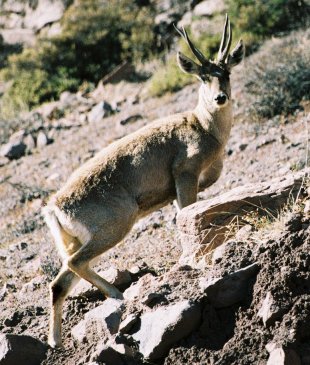
| Appearance | - The taruca has a stocky, heavy body with short legs. English Wikipedia
- Its fur is predominantly sandy brown, with white patches on the underside of the head, neck, tail, genital region, and inner forelegs. English Wikipedia
- Adult males generally have a black facial mask behind the nose and a black Y-shaped or V-shaped marking across the forehead and snout. English Wikipedia
- Males typically grow antlers with two tines branching from the base, with the posterior tine being longer. English Wikipedia
- Male tarucas possess upper-jaw canine teeth, which females usually lack. English Wikipedia
- Both sexes have speckled yellowish-gray-brown fur, a pale throat, a dark band above the eyes, and a light band around the muzzle. animaldiversity.org
| - Adult males generally have broad, flattened antlers with multiple points along their outer edges. English Wikipedia
- The species has long, slender legs, a massive body, a short thick neck, humped shoulders and a large head. animaldiversity.org
- Moose have a distinctive long, bulbous and drooping muzzle. animaldiversity.org
- Their coat is generally dark, ranging from black to brown or grayish brown, with lighter lower legs. animaldiversity.org
- Individual hairs measure approximately 15–25 cm and are hollow. animaldiversity.org
- Young moose have reddish-brown coats and lack the spots found on other young deer. animaldiversity.org
|
|---|
| Size | | - Adult moose typically stand between 1.4 and 2.1 metres tall at the shoulder. English Wikipedia
- Adult males typically weigh 380–700 kg, while females typically weigh 200–490 kg. English Wikipedia
- Adult moose have a head-and-body length of approximately 2.4–3.1 metres. English Wikipedia
- The tail measures approximately 6–8 cm in length. English Wikipedia
|
|---|
| Habitat | - The species inhabits rocky slopes, queñual forests, and puna grasslands near glacial lakes at high elevations. English Wikipedia
- In Argentina, tarucas occupy grasslands with occasional shrubs and rocky outcrops, typically near water. English Wikipedia
- The species inhabits high-elevation rocky outcrops, generally between 4,100 and 5,000 meters. animaldiversity.org
- The species is rarely recorded below 3,960 meters in elevation. animaldiversity.org
- Its habitat includes bush-steppe environments with steep rocky slopes and valleys containing water. pmc.ncbi.nlm.nih.gov
| - Moose inhabit circumpolar boreal forests and temperate broadleaf and mixed forests. English Wikipedia
- Moose occupy taiga, temperate forests and tundra-subalpine habitats. animaldiversity.org
- Moose prefer early successional forest habitats where disturbance increases forage availability. animaldiversity.org
- Moose also seek habitats near ponds, lakes, rivers and swamps. animaldiversity.org
- Moose are attracted to marshes and riverbanks during warmer months because these habitats provide vegetation and water. English Wikipedia
- Prolonged temperatures above 27°C likely restrict the southern distribution of moose. animaldiversity.org
|
|---|
| Diet | - The taruca feeds mainly on bushes, shrubs, and herbs during much of the year, supplementing its diet with grasses during the rainy season. English Wikipedia
- Commonly consumed plants include dwarf gentian, ragworts, lupins, senna, valerian, and clubmosses. English Wikipedia
- The species may consume agricultural crops including alfalfa, barley, and potato plants. English Wikipedia
- Sedges and grasses growing between rocks on high peaks constitute most of the diet according to one account. animaldiversity.org
- Alfalfa was the largest dietary component in a study conducted in the Tarapacá foothills, accounting for 27.6% in the rainy summer and 53.9% at the end of the dry winter. pmc.ncbi.nlm.nih.gov
- Herbaceous dicotyledons accounted for 46.2% of the diet during the rainy summer and 19.4% at the end of the dry winter in the Tarapacá study. pmc.ncbi.nlm.nih.gov
- Grasses and graminoids together contributed relatively little to the diet in the Tarapacá study, with their respective contributions not exceeding 3% and 0.4%. pmc.ncbi.nlm.nih.gov
- Horticultural crops represented approximately 1.3% of the diet in the Tarapacá study and were detected only during the wet season. pmc.ncbi.nlm.nih.gov
- The relative dietary diversity measured in the Tarapacá study was higher during the wet season than during the dry season. pmc.ncbi.nlm.nih.gov
| - Moose are browsing herbivores that consume many types of plants and fruits. English Wikipedia
- Their diet includes terrestrial vegetation, particularly forbs and fresh tree shoots such as willow and birch. English Wikipedia
- Aquatic plants, including lilies and pondweed, can account for approximately half of their diet. English Wikipedia
- During winter, branches, twigs and dead wood make up a large proportion of their diet. English Wikipedia
- Moose commonly select deciduous trees such as white birch, trembling aspen and striped maple for their new growth. English Wikipedia
- An adult moose requires approximately 96 megajoules of energy per day to maintain its body weight. English Wikipedia
- A 360 kg moose can consume up to 32 kg of food daily. English Wikipedia
- Moose can dive more than 5.5 metres to reach aquatic plants growing on lake bottoms. English Wikipedia
|
|---|
| Behaviour | - Tarucas form social groups but do not remain in stable herds, moving between groups of up to 30 individuals. English Wikipedia
- Groups are typically led by females. English Wikipedia
- Males compete during the breeding season by raising their forelegs alternately and pointing their antlers toward rivals. English Wikipedia
- The species has also been reported living in bisexual groups containing four to nine individuals. animaldiversity.org
- During the mating season, males compete for females by fighting with their antlers. animaldiversity.org
- Tarucas move to higher elevations during the rainy season from December through May to find food. animaldiversity.org
- When escaping predators, tarucas may place obstacles between themselves and the predator. animaldiversity.org
| - Moose are generally solitary animals and do not form herds. English Wikipedia
- Moose can become defensively aggressive and move rapidly when angered or startled. English Wikipedia
- Moose are excellent swimmers and enter water to feed on aquatic vegetation. English Wikipedia
- Moose are not territorial. animaldiversity.org
- Moose are among the least social members of the deer family and remain relatively solitary outside the mating season. animaldiversity.org
|
|---|
| Reproduction | - The rut generally occurs between May and July. English Wikipedia
- Gestation lasts approximately 240 days. English Wikipedia
- Females generally give birth to a single fawn between January and March. English Wikipedia
- Twin births have been recorded in captivity but are rare. English Wikipedia
- Females leave their groups to give birth and conceal their fawns behind rocky outcrops during the first month. English Wikipedia
- Rutting activity peaks in June and July during the driest season. animaldiversity.org
- Females remain separated from their groups for approximately 30 days during the fawning period. animaldiversity.org
- The protein content of the diet may be insufficient during late pregnancy and the beginning of lactation. pmc.ncbi.nlm.nih.gov
| |
|---|
| Distribution | - The species occurs in the Andes of Peru, Bolivia, northeastern Chile, and northern Argentina. English Wikipedia
- Peru contains the largest population of tarucas in South America. English Wikipedia
| - Moose have a circumpolar distribution across the boreal forests of the Northern Hemisphere. animaldiversity.org
|
|---|
| Conservation | - The species has been classified as Vulnerable at the international level. pmc.ncbi.nlm.nih.gov
- The taruca has been listed in Appendix I of CITES. pmc.ncbi.nlm.nih.gov
- Approximately 90% of the taruca's habitat in Chile is unprotected. pmc.ncbi.nlm.nih.gov
- Poaching has been associated with population declines in the species. animaldiversity.org
- Agricultural habitat loss, competition with domestic livestock, and logging-related habitat loss have been identified as possible contributors to population decline. animaldiversity.org
| - Hunting and habitat loss have reduced the geographical range of moose. English Wikipedia
- Moose have been reintroduced into some areas of their former range. English Wikipedia
|
|---|
| Uses | No checked fact yet | - Moose historically provided an important source of food for some Indigenous peoples of North America before the early modern period. English Wikipedia
|
|---|
| Similar species | - The taruca is closely related to the southern guemal, Hippocamelus bisulcus, the only other species in its genus. English Wikipedia
- Hippocamelus bisulcus occurs farther south in the Andes of Chile and western Argentina, with its range separated from that of the taruca by a large gap. animaldiversity.org
| No checked fact yet |
|---|