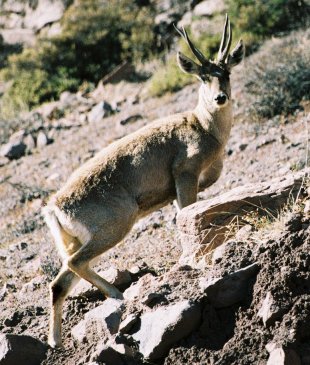
| Appearance | - The taruca has a stocky, heavy body with short legs. English Wikipedia
- Its fur is predominantly sandy brown, with white patches on the underside of the head, neck, tail, genital region, and inner forelegs. English Wikipedia
- Adult males generally have a black facial mask behind the nose and a black Y-shaped or V-shaped marking across the forehead and snout. English Wikipedia
- Males typically grow antlers with two tines branching from the base, with the posterior tine being longer. English Wikipedia
- Male tarucas possess upper-jaw canine teeth, which females usually lack. English Wikipedia
- Both sexes have speckled yellowish-gray-brown fur, a pale throat, a dark band above the eyes, and a light band around the muzzle. animaldiversity.org
| - Elk have thick bodies, slender legs, and short tails. English Wikipedia
- Elk have buff-colored rump patches. wdfw.wa.gov
- Their coats change from light brown in winter to reddish tan in summer. wdfw.wa.gov
- During winter, elk develop a dark brown, shaggy mane extending from the neck to the chest. wdfw.wa.gov
- Male elk grow large, spreading antlers covered by velvet during their growth. wdfw.wa.gov
- Male elk shed their antlers beginning in late February, while younger males may retain theirs until early May. wdfw.wa.gov
- Elk calves are born with spots that disappear by the end of summer. wdfw.wa.gov
|
|---|
| Size | | - Adult elk stand approximately 4.5 to 5 feet tall at the shoulder. wdfw.wa.gov
- Adult elk weigh approximately 600 to 800 pounds, while adult females typically weigh 400 to 500 pounds. wdfw.wa.gov
- Elk have a shoulder height of 0.75–1.5 metres and a nose-to-tail length of 1.6–2.7 metres. English Wikipedia
- Male elk weigh approximately 178–497 kilograms, while females weigh 171–292 kilograms. English Wikipedia
|
|---|
| Habitat | - The species inhabits rocky slopes, queñual forests, and puna grasslands near glacial lakes at high elevations. English Wikipedia
- In Argentina, tarucas occupy grasslands with occasional shrubs and rocky outcrops, typically near water. English Wikipedia
- The species inhabits high-elevation rocky outcrops, generally between 4,100 and 5,000 meters. animaldiversity.org
- The species is rarely recorded below 3,960 meters in elevation. animaldiversity.org
- Its habitat includes bush-steppe environments with steep rocky slopes and valleys containing water. pmc.ncbi.nlm.nih.gov
| - Elk inhabit open forests and forest-edge environments. English Wikipedia
- Ideal elk habitat consists of productive grasslands, meadows, or clearcuts interspersed with closed-canopy forests. wdfw.wa.gov
- Rocky Mountain elk occupy mountain ranges and shrubsteppe in eastern Washington. wdfw.wa.gov
- Roosevelt elk inhabit coastal areas of the Olympic Peninsula, southwestern Washington, and western Cascade slopes. wdfw.wa.gov
- Rocky Mountain elk occupy annual ranges of approximately 2,500 to 10,000 acres. wdfw.wa.gov
- Roosevelt elk occupy annual ranges of approximately 1,500 to 4,000 acres. wdfw.wa.gov
- Elk use protective cover during extreme weather, to avoid hunters, and when disturbed. wdfw.wa.gov
|
|---|
| Diet | - The taruca feeds mainly on bushes, shrubs, and herbs during much of the year, supplementing its diet with grasses during the rainy season. English Wikipedia
- Commonly consumed plants include dwarf gentian, ragworts, lupins, senna, valerian, and clubmosses. English Wikipedia
- The species may consume agricultural crops including alfalfa, barley, and potato plants. English Wikipedia
- Sedges and grasses growing between rocks on high peaks constitute most of the diet according to one account. animaldiversity.org
- Alfalfa was the largest dietary component in a study conducted in the Tarapacá foothills, accounting for 27.6% in the rainy summer and 53.9% at the end of the dry winter. pmc.ncbi.nlm.nih.gov
- Herbaceous dicotyledons accounted for 46.2% of the diet during the rainy summer and 19.4% at the end of the dry winter in the Tarapacá study. pmc.ncbi.nlm.nih.gov
- Grasses and graminoids together contributed relatively little to the diet in the Tarapacá study, with their respective contributions not exceeding 3% and 0.4%. pmc.ncbi.nlm.nih.gov
- Horticultural crops represented approximately 1.3% of the diet in the Tarapacá study and were detected only during the wet season. pmc.ncbi.nlm.nih.gov
- The relative dietary diversity measured in the Tarapacá study was higher during the wet season than during the dry season. pmc.ncbi.nlm.nih.gov
| - Elk graze on grasses and sedges and browse leaves, twigs, bark, and other higher-growing vegetation. English Wikipedia
- Elk primarily consume grasses, sedges, and flowering plants during spring and summer. wdfw.wa.gov
- Elk increasingly browse shrubs and trees during autumn, sometimes consuming conifers when snow covers other plants. wdfw.wa.gov
- Elk continue eating grasses during autumn and winter when vegetation is available and not buried under deep snow. wdfw.wa.gov
- Forbs contribute the largest proportion of the diets studied in tame Rocky Mountain elk, followed by grasses and sedges. digitalcommons.usu.edu
- Mushrooms have particular dietary significance for elk in forested habitat segments. digitalcommons.usu.edu
|
|---|
| Behaviour | - Tarucas form social groups but do not remain in stable herds, moving between groups of up to 30 individuals. English Wikipedia
- Groups are typically led by females. English Wikipedia
- Males compete during the breeding season by raising their forelegs alternately and pointing their antlers toward rivals. English Wikipedia
- The species has also been reported living in bisexual groups containing four to nine individuals. animaldiversity.org
- During the mating season, males compete for females by fighting with their antlers. animaldiversity.org
- Tarucas move to higher elevations during the rainy season from December through May to find food. animaldiversity.org
- When escaping predators, tarucas may place obstacles between themselves and the predator. animaldiversity.org
| - Elk are primarily active around dawn and dusk. wdfw.wa.gov
- Elk may become more active at night during high temperatures or when disturbed. wdfw.wa.gov
- Elk migrate to higher elevations in spring as snow retreats and move in the opposite direction during autumn. English Wikipedia
|
|---|
| Reproduction | - The rut generally occurs between May and July. English Wikipedia
- Gestation lasts approximately 240 days. English Wikipedia
- Females generally give birth to a single fawn between January and March. English Wikipedia
- Twin births have been recorded in captivity but are rare. English Wikipedia
- Females leave their groups to give birth and conceal their fawns behind rocky outcrops during the first month. English Wikipedia
- Rutting activity peaks in June and July during the driest season. animaldiversity.org
- Females remain separated from their groups for approximately 30 days during the fawning period. animaldiversity.org
- The protein content of the diet may be insufficient during late pregnancy and the beginning of lactation. pmc.ncbi.nlm.nih.gov
| - Female elk generally produce one offspring per pregnancy and only rarely produce twins. English Wikipedia
- Elk gestation lasts approximately eight to nine months. wdfw.wa.gov
- Elk calves can join the herd at approximately two weeks of age. English Wikipedia
- Female elk may nurse their calves for up to nine months. wdfw.wa.gov
|
|---|
| Distribution | - The species occurs in the Andes of Peru, Bolivia, northeastern Chile, and northern Argentina. English Wikipedia
- Peru contains the largest population of tarucas in South America. English Wikipedia
| No checked fact yet |
|---|
| Conservation | - The species has been classified as Vulnerable at the international level. pmc.ncbi.nlm.nih.gov
- The taruca has been listed in Appendix I of CITES. pmc.ncbi.nlm.nih.gov
- Approximately 90% of the taruca's habitat in Chile is unprotected. pmc.ncbi.nlm.nih.gov
- Poaching has been associated with population declines in the species. animaldiversity.org
- Agricultural habitat loss, competition with domestic livestock, and logging-related habitat loss have been identified as possible contributors to population decline. animaldiversity.org
| - Hunting, vehicle collisions, predation, and habitat loss negatively affect elk populations. wdfw.wa.gov
- Introduced elk populations can threaten sensitive native ecosystems and species. English Wikipedia
|
|---|
| Uses | No checked fact yet | - Elk are hunted as game animals, and their meat is leaner and higher in protein than beef or chicken. English Wikipedia
- Elk antlers and velvet are ingredients in traditional medicines in parts of Asia. English Wikipedia
|
|---|
| Similar species | - The taruca is closely related to the southern guemal, Hippocamelus bisulcus, the only other species in its genus. English Wikipedia
- Hippocamelus bisulcus occurs farther south in the Andes of Chile and western Argentina, with its range separated from that of the taruca by a large gap. animaldiversity.org
| - Elk are morphologically distinguishable from red deer by their wider rump patches and paler antlers. English Wikipedia
|
|---|
| Other | No checked fact yet | - The Washington population of Roosevelt elk in Olympic National Park and surrounding forests numbers approximately 5,000. wdfw.wa.gov
- Elk can run at speeds of up to 35 miles per hour. wdfw.wa.gov
|
|---|