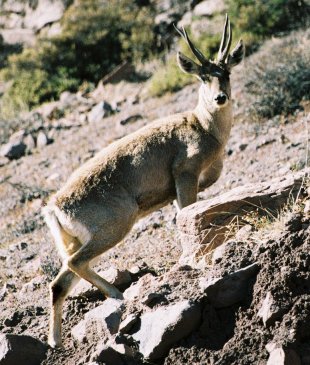
| Appearance | - The taruca has a stocky, heavy body with short legs. English Wikipedia
- Its fur is predominantly sandy brown, with white patches on the underside of the head, neck, tail, genital region, and inner forelegs. English Wikipedia
- Adult males generally have a black facial mask behind the nose and a black Y-shaped or V-shaped marking across the forehead and snout. English Wikipedia
- Males typically grow antlers with two tines branching from the base, with the posterior tine being longer. English Wikipedia
- Male tarucas possess upper-jaw canine teeth, which females usually lack. English Wikipedia
- Both sexes have speckled yellowish-gray-brown fur, a pale throat, a dark band above the eyes, and a light band around the muzzle. animaldiversity.org
| |
|---|
| Size | | |
|---|
| Habitat | - The species inhabits rocky slopes, queñual forests, and puna grasslands near glacial lakes at high elevations. English Wikipedia
- In Argentina, tarucas occupy grasslands with occasional shrubs and rocky outcrops, typically near water. English Wikipedia
- The species inhabits high-elevation rocky outcrops, generally between 4,100 and 5,000 meters. animaldiversity.org
- The species is rarely recorded below 3,960 meters in elevation. animaldiversity.org
- Its habitat includes bush-steppe environments with steep rocky slopes and valleys containing water. pmc.ncbi.nlm.nih.gov
| |
|---|
| Diet | - The taruca feeds mainly on bushes, shrubs, and herbs during much of the year, supplementing its diet with grasses during the rainy season. English Wikipedia
- Commonly consumed plants include dwarf gentian, ragworts, lupins, senna, valerian, and clubmosses. English Wikipedia
- The species may consume agricultural crops including alfalfa, barley, and potato plants. English Wikipedia
- Sedges and grasses growing between rocks on high peaks constitute most of the diet according to one account. animaldiversity.org
- Alfalfa was the largest dietary component in a study conducted in the Tarapacá foothills, accounting for 27.6% in the rainy summer and 53.9% at the end of the dry winter. pmc.ncbi.nlm.nih.gov
- Herbaceous dicotyledons accounted for 46.2% of the diet during the rainy summer and 19.4% at the end of the dry winter in the Tarapacá study. pmc.ncbi.nlm.nih.gov
- Grasses and graminoids together contributed relatively little to the diet in the Tarapacá study, with their respective contributions not exceeding 3% and 0.4%. pmc.ncbi.nlm.nih.gov
- Horticultural crops represented approximately 1.3% of the diet in the Tarapacá study and were detected only during the wet season. pmc.ncbi.nlm.nih.gov
- The relative dietary diversity measured in the Tarapacá study was higher during the wet season than during the dry season. pmc.ncbi.nlm.nih.gov
| - Gunnera plants are an important dietary item for the species. English Wikipedia
- A study in Argentina's Nahuel Huapi National Park identified 32 plant items in the species' diet. English Wikipedia
- Lenga beech is among the species' principal food items. English Wikipedia
|
|---|
| Behaviour | - Tarucas form social groups but do not remain in stable herds, moving between groups of up to 30 individuals. English Wikipedia
- Groups are typically led by females. English Wikipedia
- Males compete during the breeding season by raising their forelegs alternately and pointing their antlers toward rivals. English Wikipedia
- The species has also been reported living in bisexual groups containing four to nine individuals. animaldiversity.org
- During the mating season, males compete for females by fighting with their antlers. animaldiversity.org
- Tarucas move to higher elevations during the rainy season from December through May to find food. animaldiversity.org
- When escaping predators, tarucas may place obstacles between themselves and the predator. animaldiversity.org
| |
|---|
| Reproduction | - The rut generally occurs between May and July. English Wikipedia
- Gestation lasts approximately 240 days. English Wikipedia
- Females generally give birth to a single fawn between January and March. English Wikipedia
- Twin births have been recorded in captivity but are rare. English Wikipedia
- Females leave their groups to give birth and conceal their fawns behind rocky outcrops during the first month. English Wikipedia
- Rutting activity peaks in June and July during the driest season. animaldiversity.org
- Females remain separated from their groups for approximately 30 days during the fawning period. animaldiversity.org
- The protein content of the diet may be insufficient during late pregnancy and the beginning of lactation. pmc.ncbi.nlm.nih.gov
| No checked fact yet |
|---|
| Distribution | - The species occurs in the Andes of Peru, Bolivia, northeastern Chile, and northern Argentina. English Wikipedia
- Peru contains the largest population of tarucas in South America. English Wikipedia
| |
|---|
| Conservation | - The species has been classified as Vulnerable at the international level. pmc.ncbi.nlm.nih.gov
- The taruca has been listed in Appendix I of CITES. pmc.ncbi.nlm.nih.gov
- Approximately 90% of the taruca's habitat in Chile is unprotected. pmc.ncbi.nlm.nih.gov
- Poaching has been associated with population declines in the species. animaldiversity.org
- Agricultural habitat loss, competition with domestic livestock, and logging-related habitat loss have been identified as possible contributors to population decline. animaldiversity.org
| - The species is classified as Endangered on the IUCN Red List. English Wikipedia
- The original global population is estimated to have declined by 99 percent. English Wikipedia
- The species' original distribution range is estimated to have declined by more than 50 percent. English Wikipedia
- Habitat fragmentation and poaching are the principal threats to the species. English Wikipedia
- Fewer than 1,500 individuals were estimated to remain in the wild in 2010. English Wikipedia
- The remaining wild population was distributed among small, largely isolated populations in 2010. English Wikipedia
- A bilateral conservation memorandum between Argentina and Chile entered into force on 4 December 2010. English Wikipedia
- The conservation memorandum addresses illegal hunting, habitat degradation and disease introduction. English Wikipedia
- The species was listed in Appendix I of the Convention on Migratory Species. English Wikipedia
- The species was designated a National Natural Monument in Chile in 2006. English Wikipedia
- Economic activities and invasive species are identified as pressures on huemul populations. English Wikipedia
- Reduced reproduction rates and increased morbidity may be affecting the Argentine population. English Wikipedia
|
|---|
| Similar species | - The taruca is closely related to the southern guemal, Hippocamelus bisulcus, the only other species in its genus. English Wikipedia
- Hippocamelus bisulcus occurs farther south in the Andes of Chile and western Argentina, with its range separated from that of the taruca by a large gap. animaldiversity.org
| No checked fact yet |
|---|