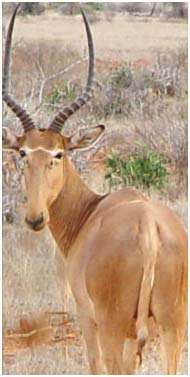
| Appearance | - The hirola has a tan to rufous-tawny coat with slightly lighter underparts. English Wikipedia
- The hirola has predominantly white inner ears and a white tail extending to the hocks. English Wikipedia
- The hirola has sharp, lyrate horns that lack a basal pedicle and are ridged along approximately three quarters of their length. English Wikipedia
- The hirola's coat darkens toward slate grey as it ages. English Wikipedia
- The hirola has white spectacles around its eyes and an inverted white chevron between them. English Wikipedia
- The hirola's horns, hooves, udders, nostrils, lips and ear tips are black. English Wikipedia
- Male hirolas are slightly larger than females and have thicker horns and darker coats. English Wikipedia
- The hirola has long legs, a long body, a long face with a slightly convex forehead, and a relatively short neck. animaldiversity.org
| - The muskox has a stocky body, long hair, a slight shoulder hump, and a very short tail. adfg.alaska.gov
- Both sexes have long, curved horns. English Wikipedia
- Male muskoxen have larger and heavier horns than females. adfg.alaska.gov
- The coat consists of long, coarse outer hair and short, fine underhair. adfg.alaska.gov
- The Greenland muskox has predominantly dark brown coloration with cream-colored hair on its saddle, forehead, and legs. adfg.alaska.gov
- The muskox's long guard hairs can extend almost to the ground. English Wikipedia
- The muskox's qiviut forms an insulating winter coat. animaldiversity.org
- The muskox's short tail measures between 5 and 10 centimetres and is concealed beneath its fur. animaldiversity.org
- Muskoxen have cloven hooves, with all four hooves being the same size. adfg.alaska.gov
|
|---|
| Size | | - Adult muskoxen stand between 1.1 and 1.5 metres high at the withers. English Wikipedia
- Female muskoxen measure between 135 and 200 centimetres in body length. English Wikipedia
- Male muskoxen measure between 200 and 250 centimetres in body length. English Wikipedia
- Adult muskoxen weigh an average of 285 kilograms, with recorded typical weights ranging from 180 to 410 kilograms. English Wikipedia
- Mature male muskoxen weigh approximately 600 to 800 pounds. adfg.alaska.gov
- Female muskoxen weigh approximately 400 to 500 pounds. adfg.alaska.gov
|
|---|
| Habitat | - The hirola inhabits open grasslands with light bush and wooded savannahs containing low shrubs and scattered trees. English Wikipedia
- The hirola commonly inhabits habitats with sandy soils. English Wikipedia
- The hirola is adapted to environments receiving an average annual rainfall of 300–600 millimetres. English Wikipedia
- The hirola inhabits short-grass, seasonally arid grasslands within dry acacia scrub and forest-savannah mosaics. animaldiversity.org
| - Muskoxen inhabit Arctic tundra north of the tree line. animaldiversity.org
- Muskoxen are associated with dry Arctic grasslands. English Wikipedia
- Muskoxen require winter habitat with shallow snow or areas where wind has cleared the snow. adfg.alaska.gov
- Muskoxen experience Arctic summers with growing seasons lasting approximately three to four months. animaldiversity.org
|
|---|
| Diet | - The hirola primarily feeds by grazing, although browsing may become important during the dry season. English Wikipedia
- The hirola favors grasses with a high leaf-to-stem ratio. English Wikipedia
- Chloris and Digitaria grasses are considered important components of the hirola's diet. English Wikipedia
- Eastern Kenyan hirolas consume 17 forage plant species. pmc.ncbi.nlm.nih.gov
- Chloris virgata is the most preferred grass in the hirola's diet. pmc.ncbi.nlm.nih.gov
- Commelina benghalensis and Commelina diffusa are the hirola's most preferred forbs. pmc.ncbi.nlm.nih.gov
- Cyperus kilimandscharicus is the only moderately preferred sedge identified in the hirola's diet. pmc.ncbi.nlm.nih.gov
- Hirolas have been observed eating Panicum infestum, Digitaria rivae and Latipes senegalensis. animaldiversity.org
- Hirolas have been observed consuming Portulaca oleraceae, Commelina erecta and Tephrosia subtriglora. animaldiversity.org
| - Muskoxen consume grasses, sedges, forbs, and woody plants. adfg.alaska.gov
- Muskoxen primarily forage on energy-rich graminoids in productive, wetter ecosystems during summer. pmc.ncbi.nlm.nih.gov
- Muskoxen shift to feeding on willows during winter. pmc.ncbi.nlm.nih.gov
- Snow-rich winters restrict muskoxen's access to forage and increase their reliance on body reserves. pmc.ncbi.nlm.nih.gov
|
|---|
| Behaviour | - Hirolas can survive independently of surface water for extended periods. English Wikipedia
- Hirolas were observed drinking in only 10 of 674 observations. English Wikipedia
- Hirolas most frequently graze during morning and evening hours. animaldiversity.org
- Hirolas associate with oryx, Grant's gazelles, Burchell's zebras and topis. English Wikipedia
- Hirolas avoid direct association with livestock but reportedly prefer short grass in livestock-grazed areas. English Wikipedia
| - Muskoxen form winter herds that can contain up to 75 animals. adfg.alaska.gov
- During mating season, muskoxen form harems containing 5 to 15 females and sub-adults alongside one dominant male. adfg.alaska.gov
- Muskox calves seek warmth and protection beneath their mothers' long guard hair. animaldiversity.org
|
|---|
| Reproduction | - Hirolas are seasonal breeders that give birth between September and November. English Wikipedia
- Hirolas typically mate in March or April at the beginning of the long rainy season. animaldiversity.org
- Hirola gestation typically lasts seven to eight months. animaldiversity.org
- Female hirolas usually give birth to a single calf, although twins are possible. animaldiversity.org
- Female hirolas become sexually mature between two and three years of age. animaldiversity.org
- Female hirolas give birth alone and may remain separated from their herd for up to two months. English Wikipedia
- Female hirolas nurse and care for their offspring. animaldiversity.org
| - The muskox breeding season begins in late summer and extends into autumn. adfg.alaska.gov
- Muskox mating generally takes place between August and October. adfg.alaska.gov
- Female muskoxen generally give birth to single calves between mid-April and mid-May. animaldiversity.org
- Muskox gestation lasts approximately eight months. animaldiversity.org
- Muskox calves typically weigh between 9 and 11 kilograms at birth. animaldiversity.org
- Female muskoxen generally reach sexual maturity between one and four years of age. animaldiversity.org
- Male muskoxen typically reach sexual maturity between three and four years of age. animaldiversity.org
- Female muskoxen generally give birth in alternate years. animaldiversity.org
- Muskox calves can begin eating adult foods within weeks of birth but may continue nursing for up to a year or longer. animaldiversity.org
|
|---|
| Distribution | - The hirola's natural range is restricted to the Kenyan-Somali border region. English Wikipedia
- Hirolas occur naturally between the Tana River in Kenya and the Juba River in Somalia. animaldiversity.org
- A translocated hirola population exists in Tsavo East National Park in Kenya. English Wikipedia
| - Muskoxen were reintroduced to Alaska using animals captured in Greenland during the 1930s. adfg.alaska.gov
|
|---|
| Conservation | - The hirola is classified as Critically Endangered. pmc.ncbi.nlm.nih.gov
- The global hirola population is estimated at approximately 300–500 individuals. English Wikipedia
- The hirola population experienced an estimated 85–90% decline between 1983 and 1985. English Wikipedia
- Habitat loss associated with woody plant encroachment is among the proposed causes of hirola population decline. English Wikipedia
- The Ishaqbini Hirola Conservancy was established in 2005 by four local communities in collaboration with Terra Nuova. English Wikipedia
- A predator-proof fenced sanctuary covering 23 square kilometres was constructed at Ishaqbini by 2014. English Wikipedia
- A founding population of 48 hirolas was breeding successfully within the Ishaqbini sanctuary by 2014. English Wikipedia
| - The native Alaskan muskox population was extirpated by the 1920s. adfg.alaska.gov
- The Alaskan muskox population declined in recent years in the Arctic National Wildlife Refuge and adjoining areas. adfg.alaska.gov
|
|---|
| Uses | | - Muskoxen are occasionally semi-domesticated for harvesting qiviut wool. English Wikipedia
- Muskox wool, known as qiviut, is valued for its softness, length, and insulating properties. English Wikipedia
|
|---|
| Similar species | | - The muskox is more closely related to sheep and goats than to true oxen. English Wikipedia
- The closest living relatives of muskoxen appear to be gorals belonging to the genus Naemorhedus. English Wikipedia
|
|---|
| Other | - The genus Beatragus originated approximately 3.1 million years ago. English Wikipedia
| No checked fact yet |
|---|