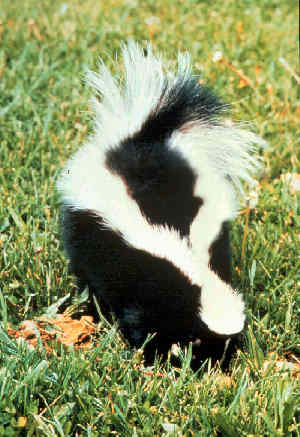
| Appearance | - The hooded skunk has long, soft fur and a distinctive ruff of longer hair around its upper neck. depts.ttu.edu
- White-backed individuals have a broad white band extending from between the eyes across much of the back and upper tail. depts.ttu.edu
- The hooded skunk has a long, bushy tail containing both black and white hairs. animaldiversity.org
- The species has five pairs of nipples, compared with six pairs in striped skunks. animaldiversity.org
- The hooded skunk has 34 teeth. depts.ttu.edu
| - The striped skunk has predominantly black fur with a narrow white stripe along its snout and forehead and a prominent white marking extending from its neck down its back. animaldiversity.org
- The white dorsal marking typically divides into a thick V-shape near the rump. animaldiversity.org
- The striped skunk has a bushy black tail that frequently has white hairs along its edges. animaldiversity.org
- The striped skunk has a small triangular head, short ears, and black eyes. animaldiversity.org
- The striped skunk has five-toed plantigrade feet and long foreclaws adapted for digging. animaldiversity.org
- The striped skunk has 34 teeth. animaldiversity.org
- Individual striped skunks vary considerably in their fur patterns and coloration. English Wikipedia
- Occasional color mutations in striped skunks include brown and cream-colored fur. English Wikipedia
|
|---|
| Size | | |
|---|
| Habitat | - The species occurs in habitats ranging from arid lowlands to boreal forests and high-altitude plateaus. animaldiversity.org
- Hooded skunks occur in ponderosa pine forests, deciduous forests, forest edges, riparian zones, rocky canyons, grasslands, pastures, and desert lowlands. animaldiversity.org
- In Oaxaca, Mexico, hooded skunks prefer grasslands and marshes over scrublands. animaldiversity.org
- Hooded skunks generally prefer denning in rocky, vegetated areas near permanent water. animaldiversity.org
- Hooded skunks in Texas occur along stream courses, where they use rocky ledges and dense streamside vegetation for shelter. depts.ttu.edu
- Hooded skunks are most abundant during the wet season from August to September. animaldiversity.org
| - Striped skunks inhabit woodlands, forests, wooded ravines, and grassy plains. biokids.umich.edu
- Striped skunks also inhabit scrubland, riparian areas, and urban environments. animaldiversity.org
- Striped skunks increasingly occupy suburban neighborhoods and farming areas. biokids.umich.edu
- Striped skunks generally occur at elevations from sea level to 1,800 m, although records extend to 4,200 m. animaldiversity.org
- In cultivated areas, striped skunks may establish dens in fencerows. English Wikipedia
|
|---|
| Diet | - The hooded skunk's diet consists primarily of insects. depts.ttu.edu
- The species also consumes shrews, rodents, and plant materials. depts.ttu.edu
- Prickly pear is a documented food source for hooded skunks. English Wikipedia
- Hooded skunks may consume bird eggs and human garbage. English Wikipedia
- In Costa Rica, hooded skunks use their forelimbs to throw bird eggs between their hindlegs to crack them open. English Wikipedia
| - Striped skunks primarily consume insects, including grasshoppers, beetles, crickets, caterpillars, insect larvae, and bees. English Wikipedia
- Striped skunks also eat worms, crayfish, and other non-insect arthropods. English Wikipedia
- During winter and spring, striped skunks supplement their diet with white-footed mice, voles, eggs, and ground-nesting bird chicks. English Wikipedia
- Striped skunks also consume amphibians, reptiles, carrion, and fish. English Wikipedia
- Striped skunks in California's coastal areas feed on crabs and beached fish. English Wikipedia
- Striped skunks consume apples, blueberries, black cherries, ground cherries, corn, and nightshade when these foods are in season. English Wikipedia
- Striped skunks use their claws to break apart rotting logs in search of grubs and dig in soil for insects. English Wikipedia
|
|---|
| Behaviour | | - Striped skunks are primarily nocturnal and solitary. animaldiversity.org
- Striped skunk activity generally begins around twilight and may continue until daybreak. biokids.umich.edu
- Striped skunks use abandoned underground dens of other mammals for daytime shelter but can dig their own dens. biokids.umich.edu
- Striped skunks may shelter in hollow logs, trees, rock piles, brush piles, and beneath buildings. animaldiversity.org
- Striped skunks do not hibernate but become less active during winter. biokids.umich.edu
- Several striped skunks may share a den during winter. biokids.umich.edu
- When threatened, striped skunks arch their backs, raise their tails, and stomp their forefeet as a warning. biokids.umich.edu
- Striped skunks can spray defensive musk up to 6 m. biokids.umich.edu
- Sudden movements or unexpected noises can trigger a striped skunk to spray its defensive musk. animaldiversity.org
|
|---|
| Reproduction | | - Female striped skunks normally reproduce once annually, while males mate with multiple females. biokids.umich.edu
- Striped skunks generally breed between February and April. biokids.umich.edu
- Female striped skunks may reproduce again during the same season if they lose their litter. biokids.umich.edu
- The gestation period of striped skunks lasts approximately 59 to 77 days. animaldiversity.org
- Striped skunk litters generally contain between two and ten young. biokids.umich.edu
- Newborn striped skunks weigh approximately 32 to 35 g each. biokids.umich.edu
- Newborn striped skunks are sparsely furred and have visible coat patterns at birth. biokids.umich.edu
- Young striped skunks open their eyes at approximately three weeks of age. biokids.umich.edu
- Young striped skunks nurse for approximately six to seven weeks. biokids.umich.edu
- Male juvenile striped skunks become independent by July or August, while females may remain with their mother until the following spring. biokids.umich.edu
- Both male and female striped skunks reach sexual maturity at approximately ten months of age. biokids.umich.edu
|
|---|
| Lifespan | No checked fact yet | - Striped skunks can live up to seven years in the wild after their first year. biokids.umich.edu
- Striped skunks can live up to ten years in captivity. biokids.umich.edu
- Striped skunks have high mortality during their first year, primarily because of severe weather and disease. biokids.umich.edu
|
|---|
| Distribution | - The species occurs in the southern United States, Mexico, Guatemala, Honduras, Nicaragua, and northwestern Costa Rica. animaldiversity.org
- In the United States, hooded skunks occur in southeastern Arizona, southwestern New Mexico, and southwestern Texas. animaldiversity.org
| - Striped skunks occur across most of North America, from the Atlantic to the Pacific Ocean. animaldiversity.org
- The species occurs throughout much of the continental United States and southern Canada. biokids.umich.edu
- The southern distribution of striped skunks extends into northern Mexico. animaldiversity.org
|
|---|
| Conservation | - The IUCN classifies the hooded skunk as Least Concern and reports an increasing population trend. depts.ttu.edu
- The hooded skunk is considered rare in western Texas. depts.ttu.edu
- Some mammalogists believe the hooded skunk could be extinct in Texas. depts.ttu.edu
| |
|---|
| Uses | - Hooded skunk fat and scent glands are used in some local folk medicines. English Wikipedia
- The flesh of hooded skunks is considered a delicacy in some parts of their range. English Wikipedia
| - Striped skunks have historically been trapped and bred in captivity for their fur. English Wikipedia
- Striped skunks were historically kept in barns to control rats and mice. English Wikipedia
- Striped skunks were regularly eaten by trappers and Indigenous peoples. English Wikipedia
- Striped skunk gall bladders were purchased by Chinese immigrants for medicinal purposes. English Wikipedia
- Striped skunk fat was historically regarded as an effective lubricant. English Wikipedia
- Striped skunk musk was historically used as a folk remedy for asthma. English Wikipedia
|
|---|
| Similar species | - The hooded skunk can be distinguished from the striped skunk by its longer tail, softer fur, and larger auditory bullae. English Wikipedia
| No checked fact yet |
|---|
| Name origin | No checked fact yet | - The alternative common name prairie polecat arose because English settlers considered the striped skunk similar to the European polecat. English Wikipedia
|
|---|