| Appearance | - Its elongated nape feathers form a crest. English Wikipedia
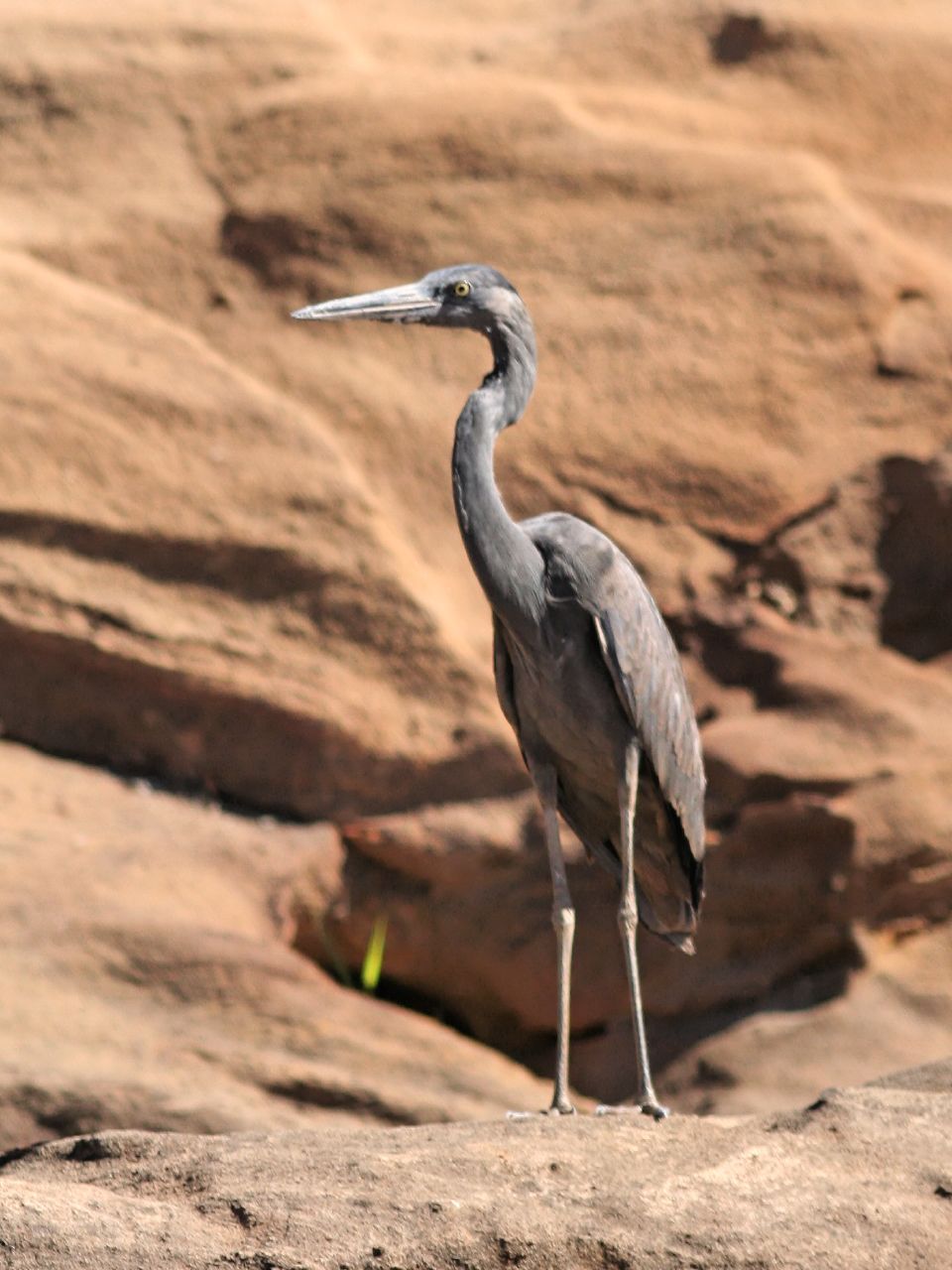
- The species has a large pale bill, pale eyes and pale legs. English Wikipedia
- The species is described as a large, entirely dark heron with a pale bill. ebird.org
| - Adults have predominantly slate-grey and chestnut plumage. English Wikipedia
- The head, crest, face, back, and sides of the neck are chestnut-colored. English Wikipedia
- The chin, throat, fore neck, and upper breast are white with black streaks. English Wikipedia
- The lower breast and belly are buff with black streaks. English Wikipedia
- The back and upper wings are slate-grey, with a chestnut shoulder patch. English Wikipedia
- The upper mandible is black, the orbital areas are yellowish-green, and the eyes are yellow. English Wikipedia
- Juveniles have paler plumage than adults. English Wikipedia
- Juveniles have more rufous, mottled breasts and bellies with less distinct stripes. animaldiversity.org
|
|---|
| Size | | |
|---|
| Habitat | - The species inhabits freshwater, brackish-water and saltwater wetlands. English Wikipedia
- The species prefers tidal areas but also occupies lakes, rivers, mangroves and estuaries. English Wikipedia
- The species is most commonly found at low elevations, although records extend to 1,500 m. English Wikipedia
| - The species inhabits lakes, swamps, mangrove wetlands, and river deltas. English Wikipedia
- The species generally occupies shallow water but can also occur near deep water with dense aquatic vegetation. English Wikipedia
- The species occurs from sea level to elevations of approximately 2,100 m. English Wikipedia
- The species prefers relatively undisturbed wetlands. English Wikipedia
- The species occupies large rivers, lakes, estuaries, swamps, marshes, and shallow freshwater and saltwater habitats. animaldiversity.org
|
|---|
| Diet | - The species primarily feeds on medium-sized and large fish and crustaceans. English Wikipedia
| - Fish constitute almost the entire diet of the species. English Wikipedia
- The species generally catches fish weighing 50–980 g, with an average prey weight of 500–600 g. English Wikipedia
- Its preferred fish prey include breams, mullet, tilapia, and carp. English Wikipedia
- The species also consumes frogs, prawns, small mammals, lizards, snakes, insects, and carrion. English Wikipedia
- The species typically targets fish approximately 30 cm long. animaldiversity.org
|
|---|
| Behaviour | - The species forages on floating vegetation in clear, shallow water and during incoming and outgoing tides. English Wikipedia
- The species feeds passively by remaining stationary for extended periods, often hunched or with its neck extended over the water. English Wikipedia
- After capturing prey, the species flies to solid ground to eat it. English Wikipedia
- The species does not migrate but can disperse over long distances. English Wikipedia
- The species is generally observed alone. ebird.org
| - The species generally forages alone and strongly defends its feeding territories against other herons. English Wikipedia
- The species commonly hunts by standing in shallow water and watching for prey. English Wikipedia
- The species captures fish by rapidly spearing them with its open bill and swallowing them whole. English Wikipedia
- The species sometimes stands on floating vegetation to minimize water disturbance while hunting. English Wikipedia
- The species generally avoids migration but may move to more favorable feeding habitats. animaldiversity.org
- The species communicates using several vocalizations, including a deep bark and a disturbance call. English Wikipedia
- The species is described as a nocturnal feeder. animaldiversity.org
- The species generally flies with slow, deliberate wingbeats. animaldiversity.org
|
|---|
| Reproduction | | - The breeding season commonly coincides with the beginning of the rainy season, approximately November to March. English Wikipedia
- Breeding can occur throughout the year in some locations. English Wikipedia
- The species generally nests on islands or islands of vegetation. English Wikipedia
- Nests may be constructed in sedges, reeds, bushes, trees, or on rocks and large tree stumps. English Wikipedia
- Nests typically measure approximately 1–1.5 m in diameter. English Wikipedia
- The species lays clutches containing two to five eggs, usually three or four. English Wikipedia
- The eggs are pale blue and average 72 by 54 mm in dimensions. English Wikipedia
- Incubation lasts approximately 24–30 days. English Wikipedia
- Both parents participate in guarding the nest and raising the chicks. animaldiversity.org
- Young birds leave the nest at approximately five weeks of age. English Wikipedia
- Parents continue caring for fledglings for approximately 40–80 days after they leave the nest. English Wikipedia
|
|---|
| Distribution | | |
|---|
| Conservation | - The species is classified as endangered on the IUCN Red List. English Wikipedia
- The population of the species in Madagascar was estimated at 1,000–3,000 individuals in 2006. English Wikipedia
- The species faces population decline associated with poaching, habitat destruction and invasive alien species such as water hyacinth. English Wikipedia
- Poaching of both eggs and adult birds is identified as a likely cause of population decline. English Wikipedia
- The rate of population decline has not yet been established. English Wikipedia
| - The estimated number of mature individuals is between 6,700 and 67,000. iucnredlist.org
- The estimated extent of occurrence is 30.8 million square kilometres. iucnredlist.org
- The species occurs in at least one protected area. iucnredlist.org
- Conservation sites have been identified across the species' entire range. iucnredlist.org
|
|---|
| Similar species | - The species has been proposed as a darker morph of the grey heron because of similarities in physical characteristics, but that proposal has been refuted. English Wikipedia
| - The species is closely related to the great-billed heron and white-bellied heron. English Wikipedia
- The species is also reported to be closely related to the Sumatran heron and white-bellied heron. animaldiversity.org
|
|---|
| Other | No checked fact yet | - The species is considered the largest living heron. English Wikipedia
- The species can produce a deep call audible from distances of up to two kilometres. English Wikipedia
|
|---|