Comparison

Dwarf Reed Frog vs Arum Frog

Dwarf Reed Frog (Hyperolius minutissimus) and Arum Frog (Hyperolius horstockii) both belong to the genus Hyperolius (african reed frogs) and part ways below it.
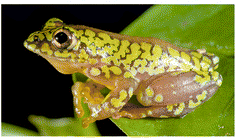
Dwarf Reed Frog

Dwarf Reed Frog

Hyperolius minutissimus

Loader, S. P., Lawson, L. P., Portik, D. M., and Menegon, M., CC BY 4.0, via Wikimedia Commons

Arum Frog

Arum Frog

Hyperolius horstockii

Serban Proches, CC BY-SA 2.5, via Wikimedia Commons

Side by side

Dwarf Reed FrogArum Frog
Scientific nameHyperolius minutissimus Schiøtz, 1975Hyperolius horstockii (Schlegel, 1837)
English nameDwarf Reed FrogArum Frog
GroupAmphibiansAmphibians
ClassAmphibia AmphibiansAmphibia Amphibians
OrderAnura FrogsAnura Frogs
FamilyHyperoliidae African Reed FrogsHyperoliidae African Reed Frogs
GenusHyperolius African Reed FrogsHyperolius African Reed Frogs
Named in19751837
Red List categoryVulnerableLeast Concern
Countries on record1 country2 countries
GBIF occurrence records72 records517 records

Rows where the two agree are shown in grey.

Where each is found

Only Dwarf Reed Frog (1)

Only Arum Frog (2)

From Catalogue of Life checklists and GBIF occurrence records. A country missing from a list means no record is held, which is not proof of absence.

Checked facts

Dwarf Reed FrogArum Frog
Appearance
  • The dorsal surface is brown with light-colored canthal and dorsolateral lines. English Wikipedia
  • Some females have broad light-colored canthal markings, irregular dorsolateral stripes, and dorsal spots. English Wikipedia
  • The species has horizontally oriented pupils. English Wikipedia
  • Males possess a gular flap with black dotted asperities on its anterior and middle regions. English Wikipedia
Size
  • Male individuals typically measure 12–17 mm in snout–vent length. English Wikipedia
  • Female individuals typically measure 18–24 mm in snout–vent length. English Wikipedia
Habitat
  • The species inhabits open, windswept montane grasslands within forested areas. English Wikipedia
  • Its documented habitat elevations range from 1,600 to 2,010 metres above sea level. English Wikipedia
  • The species has also been found in pastureland. English Wikipedia
  • Individuals have been heard calling beside a road near a large pine plantation. English Wikipedia
Behaviour
  • Individuals are frequently found resting beneath the bottoms of arum lilies while attempting to catch pollinating insects. English Wikipedia
  • Individuals can match the colours of their surroundings while inside arum lily flowers. English Wikipedia
  • Colour matching makes individuals difficult for predators and insect prey to detect. English Wikipedia
  • During the day, individuals conceal their orange feet and legs beneath their bodies. English Wikipedia
  • The species does not use flower pollen as camouflage. English Wikipedia
  • Males generally call at night from elevated positions above the water. English Wikipedia
  • Calling males commonly use emergent sedges, reeds, shrubs and grasses as elevated calling sites. English Wikipedia
  • Males sometimes call from water lily pads. English Wikipedia
  • Calling usually begins shortly after sunset. English Wikipedia
  • Males may call sporadically during late afternoons on cloudy, rainy days. English Wikipedia
Reproduction
  • Breeding occurs in large or small pans, dams, vleis and quiet, slow-flowing streams with sufficient emergent vegetation. English Wikipedia
  • The breeding season extends from September through January. English Wikipedia
  • Females lay clutches containing between 10 and 30 eggs after mating. English Wikipedia
  • Egg clutches are attached to submerged plant roots and stems. English Wikipedia
Distribution
  • Hyperolius minutissimus is endemic to Tanzania. English Wikipedia
  • The species is known from the Udzungwa Mountains and areas near Njombe in the Southern Highlands. English Wikipedia
  • The species occurs in the Udzungwa Scarp Forest. English Wikipedia
  • The species had not been recorded in the Southern Highlands since its initial description in 1975. English Wikipedia
  • The species occurs along the southern coastal plain of South Africa, from Cape Town in the Western Cape to Port Elizabeth in the Eastern Cape. English Wikipedia
Conservation
  • Habitat loss threatens Hyperolius minutissimus. English Wikipedia
  • Drainage of breeding habitats for agricultural activities is identified as a threat to the species. English Wikipedia
  • Agricultural expansion is identified as a threat to the species. English Wikipedia
  • Expanding human settlements are identified as a threat to the species. English Wikipedia
  • The species is assessed as being of least concern. English Wikipedia
  • Some populations face threats from habitat loss associated with invasive alien vegetation and fire. English Wikipedia
  • Collection and sale of arum lilies are not identified as threats to the species. English Wikipedia

In brief

Dwarf Reed Frog

Hyperolius minutissimus is endemic to Tanzania, where it occurs in the Udzungwa Mountains, the Udzungwa Scarp Forest, and areas near Njombe in the Southern Highlands. Full profile

Arum Frog

Hyperolius horstockii occurs along the southern coastal plain of South Africa, from Cape Town in the Western Cape to Port Elizabeth in the Eastern Cape. It is distinguished by its bright orange feet and its ability to change colour to blend into its surroundings. Full profile

Compare something else

Page built on 28 November 2026 from the data on the two species pages, where every source is listed.

Cite this page

ScientificNames.org. (2026). Dwarf Reed Frog vs Arum Frog. Retrieved November 28, 2026, from https://scientificnames.org/compare/dwarf-reed-frog-vs-arum-frog