Comparison

Hypocnemis subflava subflava vs Barred Antshrike

Hypocnemis subflava subflava (Hypocnemis subflava subflava) and Barred Antshrike (Thamnophilus doliatus) both belong to the family Thamnophilidae (antbird) and part ways below it.
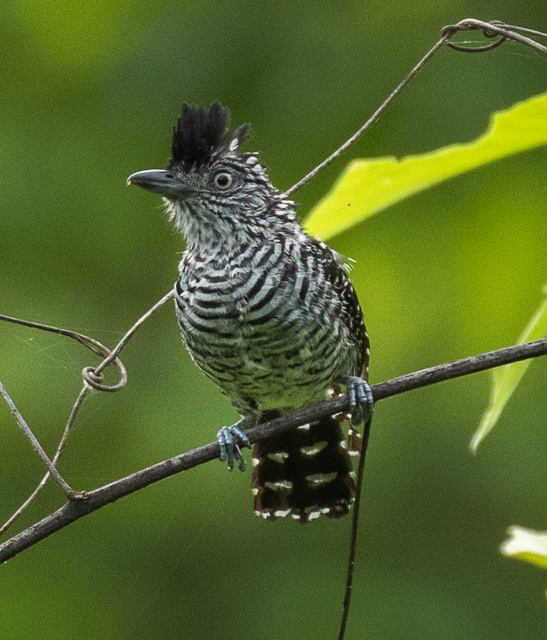
Barred Antshrike

Barred Antshrike

Thamnophilus doliatus

Francesco Veronesi from Italy, CC BY-SA 2.0, via Wikimedia Commons

Side by side

Hypocnemis subflava subflavaBarred Antshrike
Scientific nameHypocnemis subflava subflava Cabanis, 1873Thamnophilus doliatus (Linnaeus, 1764)
English nameNot recordedBarred Antshrike
Ranksubspeciesspecies
GroupBirdsBirds
ClassAves BirdAves Bird
OrderPasseriformes PasserinePasseriformes Passerine
FamilyThamnophilidae AntbirdThamnophilidae Antbird
GenusHypocnemis AntbirdsThamnophilus Antshrikes
Named in18731764
Red List categoryNot recordedLeast Concern
EnvironmentNot recordedterrestrial
Countries on recordNot recorded21 countries
GBIF occurrence recordsNot recorded268,780 records

Rows where the two agree are shown in grey.

Where each is found

Only Barred Antshrike (21)

From Catalogue of Life checklists and GBIF occurrence records. A country missing from a list means no record is held, which is not proof of absence.

Checked facts

Hypocnemis subflava subflavaBarred Antshrike
AppearanceNo checked fact yet
  • Both sexes possess a bushy crest and exhibit pronounced sexual dimorphism. English Wikipedia
  • Adult males of the nominate subspecies have predominantly black-and-white barred plumage. English Wikipedia
  • Adult females of the nominate subspecies have cinnamon-rufous crests and upperparts. English Wikipedia
  • Adults of both sexes have pale yellow irises, black upper mandibles, bluish-gray lower mandibles, and lead-gray legs and feet. English Wikipedia
  • Juvenile males have black and light yellowish-brown barring. English Wikipedia
SizeNo checked fact yet
HabitatNo checked fact yet
  • The Coiba Island subspecies inhabits tropical deciduous forest. English Wikipedia
  • The Tobago subspecies inhabits mature humid forest. English Wikipedia
  • The eastern Brazilian subspecies T. d. capistratus primarily inhabits caatinga and restinga. English Wikipedia
  • In eastern Colombia, the species frequently occurs on river islands. English Wikipedia
  • In Ecuador, northern Peru, and much of Brazilian Amazonia, the species occurs almost exclusively on river islands. English Wikipedia
  • In southern Bolivia, Paraguay, and Argentina, its habitats include savanna, scrub, secondary forest, and riverine belts. English Wikipedia
  • In Mexico, Central America, and Colombia, the species occurs from sea level to approximately 1,500 m elevation. English Wikipedia
  • In Venezuela, the species reaches elevations of 2,000 m, although most records are below 1,250 m. English Wikipedia
  • In Ecuador, the species occurs only below 250 m elevation. English Wikipedia
DietNo checked fact yet
  • Its diet consists primarily of mature and larval insects, supplemented by other arthropods, small lizards, fruit, and seeds. English Wikipedia
  • The species also feeds on prey escaping army ant swarms. English Wikipedia
BehaviourNo checked fact yet
  • The species remains resident throughout its geographical range year-round. English Wikipedia
  • Individuals typically forage in closely associated pairs within dense foliage from ground level to approximately 3 m, occasionally reaching 10 m. English Wikipedia
  • The species almost never participates in mixed-species feeding flocks. English Wikipedia
  • It captures prey by rapidly stabbing at leaves, stems, branches, and trunks. English Wikipedia
  • Both sexes sing while stretching their necks, bowing forward, and pumping their tails up and down. English Wikipedia
ReproductionNo checked fact yet
  • The species is monogamous, and breeding pairs vigorously defend territories throughout the year. English Wikipedia
  • Territory sizes measured in one study ranged from approximately 2,500 to 4,200 square metres. English Wikipedia
  • Breeding has been recorded in every month of the year somewhere within the species' range. English Wikipedia
  • In Trinidad and Tobago, the species apparently breeds throughout the year. English Wikipedia
  • The nest is an open, tightly woven cup with thin walls constructed from fungal and vegetable fibers, vines, grasses, and twigs. English Wikipedia
  • The nest is generally suspended by its rim from a branch fork at heights reaching 10 m above the ground. English Wikipedia
  • Both sexes participate in nest construction. English Wikipedia
  • The usual clutch contains two eggs, although clutches of three have been reported in Trinidad. English Wikipedia
  • Both parents incubate eggs during daylight, while only the female incubates at night. English Wikipedia
  • A Costa Rican study recorded an incubation period of 13 days after the second egg was laid. English Wikipedia
  • Studies in multiple countries recorded a period of 10–13 days between hatching and fledging. English Wikipedia
  • Both parents brood and feed the nestlings. English Wikipedia
DistributionNo checked fact yet
  • The species occurs in Mexico, every Central American country, Trinidad and Tobago, and all mainland South American countries except Chile and Uruguay. English Wikipedia
  • One accepted occurrence record exists from southern Texas. English Wikipedia
  • The subspecies T. d. intermedius occurs from San Luis Potosí and Tamaulipas in east-central Mexico south through Central America to Costa Rica and possibly Panama. English Wikipedia
  • The subspecies T. d. nesiotes occurs on the Pearl Islands in the Gulf of Panama. English Wikipedia
  • The subspecies T. d. eremnus occurs on Coiba Island off western Panama. English Wikipedia
ConservationNo checked fact yet
  • The IUCN classifies the species as Least Concern. English Wikipedia
  • The estimated population comprises at least 50 million mature individuals and is considered stable. English Wikipedia
  • Deforestation, habitat destruction, and habitat fragmentation are identified as challenges to the species' survival. English Wikipedia
Name originNo checked fact yet
  • The specific epithet doliatus derives from Neo-Latin and means barred. English Wikipedia

In brief

Barred Antshrike

Thamnophilus doliatus occurs in Mexico, every Central American country, Trinidad and Tobago, and all mainland South American countries except Chile and Uruguay. Adults of both sexes have bushy crests and pronounced sexual dimorphism, with predominantly black-and-white barred plumage in nominate males and cinnamon-rufous crests and upperparts in nominate females. Full profile

Compare something else

Page built on 26 November 2026 from the data on the two species pages, where every source is listed.

Cite this page

ScientificNames.org. (2026). Hypocnemis subflava subflava vs Barred Antshrike. Retrieved November 26, 2026, from https://scientificnames.org/compare/hypocnemis-subflava-subflava-vs-barred-antshrike