Comparison
Red Morning-glory vs Mexican Morning Glory
Red Morning-glory (Ipomoea coccinea) and Mexican Morning Glory (Ipomoea tricolor) both belong to the genus Ipomoea (morning glory) and part ways below it. Both are recorded in 8 countries.


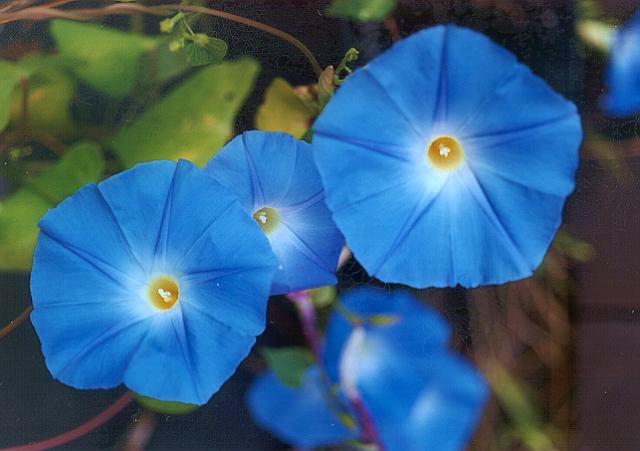
Mexican Morning Glory
Ipomoea tricolor
Russell E (Photograph of Ipomoea violacea, taken by rkundalini.), CC BY-SA 3.0, via Wikimedia Commons

Side by side
| Red Morning-glory | Mexican Morning Glory | |
|---|---|---|
| Scientific name | Ipomoea coccinea L. | Ipomoea tricolor Cav. |
| English name | Red Morning-glory | Mexican Morning Glory |
| Group | Flowering plants | Flowering plants |
| Class | Magnoliopsida | Magnoliopsida |
| Order | Solanales | Solanales |
| Family | Convolvulaceae Bindweed Family | Convolvulaceae Bindweed Family |
| Genus | Ipomoea Morning Glory | Ipomoea Morning Glory |
| Countries on record | 17 countries | 35 countries |
| GBIF occurrence records | 6,157 records | 1,881 records |
Rows where the two agree are shown in grey.
Where each is found
Both recorded in 8 countries
Only Red Morning-glory (9)
Only Mexican Morning Glory (27)
- Antigua and Barbuda
- Argentina
- Bangladesh
- Bolivia
- Bonaire, Saint Eustatius and Saba
- Brazil
- Canada
- Chad
- China
- Colombia
- Costa Rica
- Ecuador
- Ethiopia
- Guadeloupe
- Honduras
- Hungary
- Madagascar
- Malawi
- Mozambique
- Nicaragua
- Peru
- Saint Martin
- U.S. Virgin Islands
- Uzbekistan
- Venezuela
- Zambia
- Zimbabwe
From Catalogue of Life checklists and GBIF occurrence records. A country missing from a list means no record is held, which is not proof of absence.
Checked facts
| Red Morning-glory | Mexican Morning Glory | |
|---|---|---|
| Appearance |
|
|
| Size |
|
|
| Habitat |
|
|
| Behaviour |
|
|
| Reproduction |
|
|
| Lifespan | No checked fact yet |
|
| Distribution | No checked fact yet |
|
| Uses |
|
|
| Similar species |
|
|
| Other |
|
|
In brief
Red Morning-glory
Red morning-glory (Ipomoea coccinea L.) is an annual flowering plant in the family Convolvulaceae, order Solanales and class Magnoliopsida. It occurs in disturbed areas along roads, stream banks, fence rows, old fields and other waste areas. It is a twisting climbing vine with dull red flowers and an orange throat. Full profile
Mexican Morning Glory
Ipomoea tricolor is native to the tropical regions of the Americas and has become naturalised outside its native range. Its seeds contain ergine and lysergic acid hydroxyethylamide, produced by a symbiotic fungus identified as Periglandula ipomoeae. Full profile
Compare something else
Page built on 27 November 2026 from the data on the two species pages, where every source is listed.
Cite this page
ScientificNames.org. (2026). Red Morning-glory vs Mexican Morning Glory. Retrieved November 27, 2026, from https://scientificnames.org/compare/red-morning-glory-vs-mexican-morning-glory
“Red Morning-glory vs Mexican Morning Glory.” ScientificNames.org, 2026, scientificnames.org/compare/red-morning-glory-vs-mexican-morning-glory. Accessed 27 Nov. 2026.
ScientificNames.org. “Red Morning-glory vs Mexican Morning Glory.” Accessed November 27, 2026. https://scientificnames.org/compare/red-morning-glory-vs-mexican-morning-glory.
@misc{scientificnames_red_morning_glory_vs_mexican_morning_glory,
  author = {{ScientificNames.org}},
  title = {Red Morning-glory vs Mexican Morning Glory},
  year = {2026},
  url = {https://scientificnames.org/compare/red-morning-glory-vs-mexican-morning-glory},
  note = {Accessed 2026-11-27}
}